Secondary 5 Geometry Worksheet
Measurement at the level the exam actually asks for: equivalent figures and equivalent solids, the metric relations between chords, secants and tangents in a circle, angles in a circle, decomposing an awkward shape into ones you already know, and recovering a missing dimension from a second-degree equation. The explanations name the relation each step depends on. Free to print, and no email is asked for.
Practice worksheet — free PDF
No email, no account, no watermark. Teachers: photocopy it for your classes freely. Worked solutions and 10 harder problems come with the Secondary 5 Math bundle.
12 of the 13 questions
Each question targets one named concept from the sheet. Read them here, or print the PDF — it has working space under each one. 12 of the 13 questions are printed below. The other 1 is built on a diagram or a table of values that does not translate to the page, so it is in the free PDF — marked below where it would have come.
-
Q1Angles of Depression and Elevation
From an observation deck of a lighthouse, m above sea level, the angle of depression to a moored kayak is . How far is the kayak from the foot of the lighthouse, horizontally? Round to the nearest tenth of a metre.
-
Q2Equivalent Figures
A rhombus-shaped kite panel has diagonals measuring cm and cm. A circular panel is to be cut with exactly the same area. What is the radius of the circular panel, to the nearest hundredth of a centimetre?
-
Q3Equivalent Solids
A solid metal cone with base radius cm and height cm is melted down and recast, without loss, as a solid sphere. Find the radius of the sphere.
-
Q4Finding Missing Measurements in Plane Figures Using a 2nd Degree Equation
The length of a rectangular label is cm more than twice its width, and its area is . Find its dimensions.
-
Q5Geometry
Three words are used constantly in this topic and are easy to confuse: congruent, similar and equivalent. Define each in one sentence, then give a concrete numerical example showing that
- two equivalent figures need not be congruent;
- two similar figures need not be equivalent.
Finally, state the only condition under which two similar figures are equivalent.
-
Q6Methods to Decompose Figures
The floor of a bicycle shelter is a rectangle m long and m wide with a semicircular apron attached to one of its m sides, the diameter of the semicircle being that side. Find the total area of the floor, to the nearest hundredth of a square metre.
-
Q7Metric Relations in a Circle
This question is built around a diagram or a table of values. Open it in the PDF.
-
Q8Metric Relations in a Circle
An archaeologist recovers a fragment of a circular stone wheel. The fragment's straight edge is cm long, and the greatest distance from the midpoint of that straight edge to the curved rim is cm.
- Find the diameter of the complete wheel.
- To display the fragment, a straight rod is fixed at a point lying on the line of the straight edge, cm beyond one of its ends, and its other end just touches the reconstructed rim (the rod is tangent to the circle). How long is the rod, to the nearest hundredth of a centimetre?
-
Q9Missing Measurements in Solids
Explain why the height of a right circular cylinder can be isolated directly from its volume and radius, whereas finding its radius from its volume and height requires solving a second-degree equation. Then find the radius of a cylinder of volume and height cm, and explain why only one of the two solutions of that equation is kept.
-
Q10Solids with the Same Area
A cube with edge cm and a sphere have the same total surface area. Find the sphere's radius, to the nearest hundredth of a centimetre.
-
Q11Tetrahedrons
A tetrahedron has for base a right triangle whose legs measure cm and cm, and its apex lies cm directly above the vertex of the right angle. Find its volume.
-
Q12The Angles of a Circle
Two chords of a circle intersect inside it and form an angle of . One of the two arcs intercepted by that angle and its vertical angle measures . What is the measure of the other intercepted arc?
-
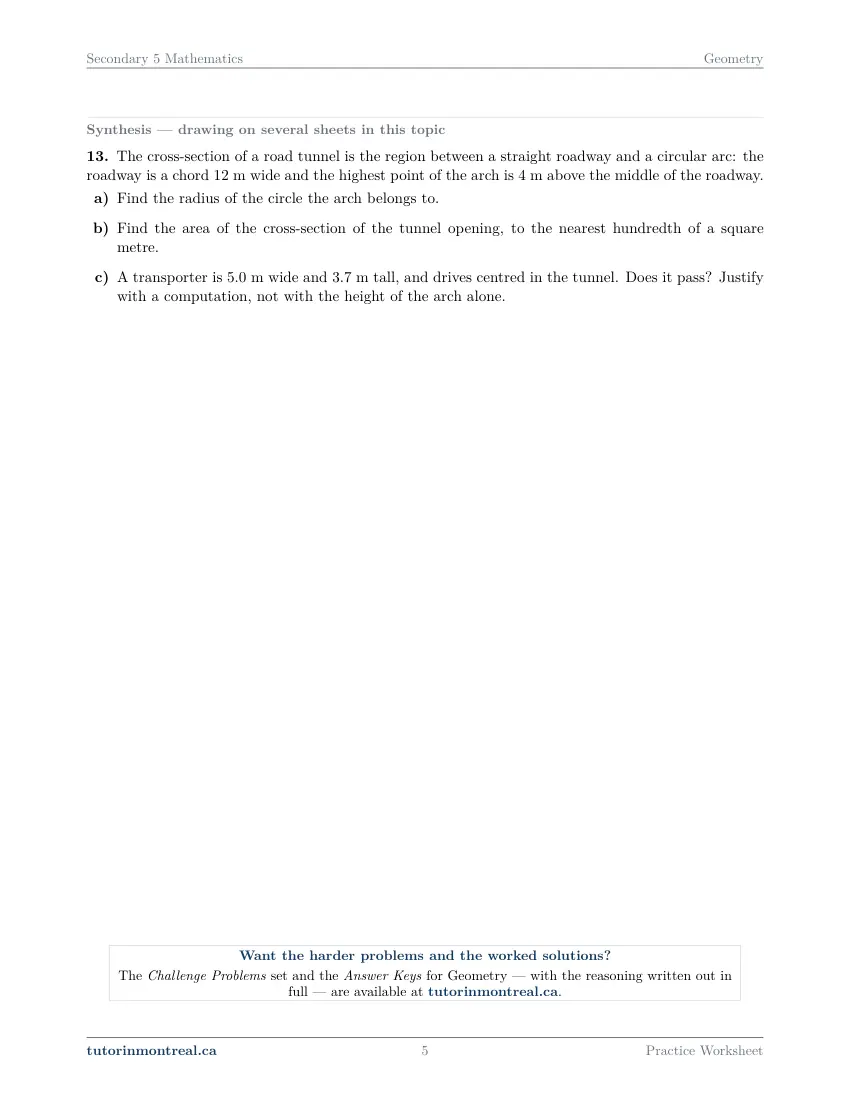
Q13Synthesis — drawing on several sheets in this topic
The cross-section of a road tunnel is the region between a straight roadway and a circular arc: the roadway is a chord m wide and the highest point of the arch is m above the middle of the roadway.
- Find the radius of the circle the arch belongs to.
- Find the area of the cross-section of the tunnel opening, to the nearest hundredth of a square metre.
- A transporter is m wide and m tall, and drives centred in the tunnel. Does it pass? Justify with a computation, not with the height of the arch alone.
The 10 challenge problems for this topic are a separate, paid sheet and are not reproduced here.
Which stream is this for? This sheet is built for SN. It expects the circle's metric relations, equivalence arguments about area and volume, and computations you have to justify rather than merely produce — the depth that program expects.
How to do every concept on this sheet
This is the part worksheet sites usually leave out. Below is the actual reasoning behind each group of questions — not a full solution set, the decisions that get you to one. Read it before you start, or after you get stuck.
Congruent, similar, equivalent — three words, three different claims
Q5 asks for all three definitions and then for numerical examples separating them. It reads like vocabulary and it is the conceptual spine of this entire sheet: Q2, Q3 and Q10 are unsolvable until you know exactly which of the three you are being given.
What each word actually asserts
Each is a strictly weaker claim than the one above it — and the gaps are where the questions live.
- 1Congruent — same shape and same size
Every pair of corresponding sides and angles is equal; one figure is the image of the other under an isometry. Congruent figures are automatically similar and automatically equivalent.
- 2Similar — same shape only
Corresponding angles equal, corresponding sides in a fixed ratio k. Similar figures need not have the same area: lengths scale by k, areas by k², volumes by k³. Two squares of sides 2 and 5 are similar and their areas differ by a factor of 6.25.
- 3Equivalent — same area (or, for solids, same volume)
Nothing at all is claimed about shape. A 6 × 4 rectangle and an 8 × 3 rectangle are equivalent and share not one side length. Equivalent figures usually have different perimeters, and equivalent solids usually have different surface areas.
The closing part of Q5 asks when two similar figures are also equivalent. Since areas of similar figures are in the ratio k², equivalence forces k² = 1, so k = 1 — which is congruence. The three words collapse into one only in that single case, and being able to say so in a sentence is the whole question.
The equivalence recipe (Q2, Q3, Q10)
Three questions, one procedure: write the measure of the first shape, write the measure of the second with its unknown, set them equal, isolate. What changes is which measure — area in Q2, volume in Q3, total surface area in Q10 — and the question always names it. On my own example, a 12 cm × 6 cm rectangle recast as a square of the same area:
s² = 12 × 6 = 72 ⟹ s = √72 = 6√2 ≈ 8.49 cmTwo habits make this reliable. Isolate symbolically before substituting numbers — r = √(A ⁄ π) written once is worth three lines of decimals. And carry π through the algebra rather than replacing it by 3.14 early; on a cone-to-sphere question such as Q3 it cancels completely, and the answer comes out as a clean whole number instead of a rounded mess.
Equal area does not mean equal volume, in either direction. Q3 matches two solids by volume; Q10 matches two solids by surface area. They are different constraints and they produce different answers, so read which one the question imposes before writing anything. The general fact behind both: the more compact a solid, the more volume it holds for a given surface area — which is why a cylinder beats a cube and a sphere beats them both.
Angles of elevation and depression (Q1)
Both are measured from the horizontal, never from the vertical. That is the entire difficulty. In Q1 the angle of depression is given at the top of the lighthouse, between the horizontal and the line of sight going down; the angle at the kayak, between the horizontal ground and the same line of sight, is equal to it by alternate interior angles. So the angle you were handed can be placed at the bottom of the triangle, where the sides you care about meet it.
Then pick the ratio by what you have and what you want. Height and horizontal distance are the two legs of the right triangle, so tangent is the tool; a hypotenuse anywhere in the question means sine or cosine instead. Sketch the triangle, label the 46 m and the unknown, and only then write the ratio — the equation you get from a labelled sketch is almost never the wrong one.
When the unknown is squared (Q4, Q9)
Q4 turns a sentence into a second-degree equation: express both dimensions in terms of one variable, multiply for the area, expand into ax² + bx + c = 0, solve, and then reject the negative root because a length cannot be negative. That rejection sentence is worth a mark on its own and is the most commonly omitted line on the whole sheet.
Q9 asks you to explain the structure rather than just use it. In V = πr²h the height appears to the first power, so isolating it is a single division. The radius appears squared, so isolating it produces r² = V ⁄ (πh) — a second-degree equation, with two opposite solutions, of which only the positive one is a radius. The same asymmetry explains why an area problem with a squared unknown always ends in a rejection step and a linear one never does.
Decomposing a figure (Q6, Q13)
Cut the shape into pieces whose formulas you know, compute each, and add — or, when the region is a shape with a bite taken out of it, subtract. The only real skill is reading what the given lengths mean for the pieces: in Q6 the semicircle is built on a 9 m side, so 9 is the diameter and the radius is 4.5, and using 9 as the radius quadruples that part of the answer.
The decomposition worth knowing by name is the circular segment — the region between a chord and its arc, which appears in Q13 and in the stained-glass family of problems:
segment = sector − triangleFind the central angle from the half-chord (the perpendicular from the centre bisects the chord, giving a right triangle with the radius as hypotenuse), then take the sector as its fraction of the full disc and subtract the triangle formed by the chord and the two radii.
Metric relations in a circle (Q7, Q8)
Three relations cover everything on this sheet, and they are all really the same similar-triangle argument in different positions. (Q7's diagram is on the printable sheet.)
two chords crossing inside: AP · PB = CP · PD tangent and secant from an outside point: PT² = PA · PBThe third is the perpendicular from the centre to a chord, which bisects it. That one is what cracks Q8(a): the straight edge of the fragment is a chord, the greatest distance from its midpoint to the rim lies on the diameter through that midpoint, and the two chords cross at the midpoint. Applying the first relation there gives
(half-chord)² = s · (d − s), where s is the height of the arc above the chordand the diameter falls straight out. It is the standard way to recover the size of a circle from a fragment of it, and Q13 opens with exactly the same move on a tunnel arch.
On the secant relation, measure both distances from the outside point. PA and PB are the distances from P to the near and to the far intersection — not the near distance and the chord length. If the line meets the circle 10 cm away and the chord inside is 48 cm, the far distance is 58 cm, and using 48 there is the classic error.
Angles in a circle (Q12)
An inscribed angle is half the arc it intercepts. Everything else is a variation on that, and the pattern is easy to hold:
vertex inside (two chords): angle = (arc₁ + arc₂) ⁄ 2 vertex outside (two secants): angle = (far arc − near arc) ⁄ 2Sum inside, difference outside, half either way. Q12 gives the angle and one of the two arcs and asks for the other, so the relation is used backwards: double the angle, subtract the known arc. The two arcs in the inside case are the one the angle intercepts and the one its vertical angle intercepts — opposite each other, not adjacent — which is the detail to get right before substituting.
Solids: the pyramid third, and the tetrahedron (Q11)
A pyramid or cone is one third of the prism or cylinder on the same base with the same height:
V = (1 ⁄ 3) · (base area) · (height)The height is the perpendicular distance from the apex to the plane of the base, which is not the same as the length of a slanted edge. Q11 is generous about it — the apex is placed directly above a vertex of the base, so the given 10 cm is the height already. When the apex sits above the centre instead, the height has to be recovered from a right triangle first, and confusing a lateral edge with the height is the usual way volume answers come out too large.
The tunnel synthesis question (Q13)
Three of this sheet's techniques stacked in one problem: the chord relation to recover the radius from the width and the peak height, the segment decomposition for the cross-sectional area, and then a clearance check.
That last part is where the question is really aimed, and it says so: justify with a computation, not with the height of the arch. A vehicle 5 m wide has its top corners 2.5 m either side of the centre line, and the arch is lower there than it is at its peak. So you must compute the height of the arch at the edge of the vehicle, using the circle's equation with the centre as origin, and compare that with the vehicle's height. A load that clears the peak by a comfortable margin can still catch the arch at its corners — which is the whole point of the question, and a good sentence to write down even when the numbers happen to work out.
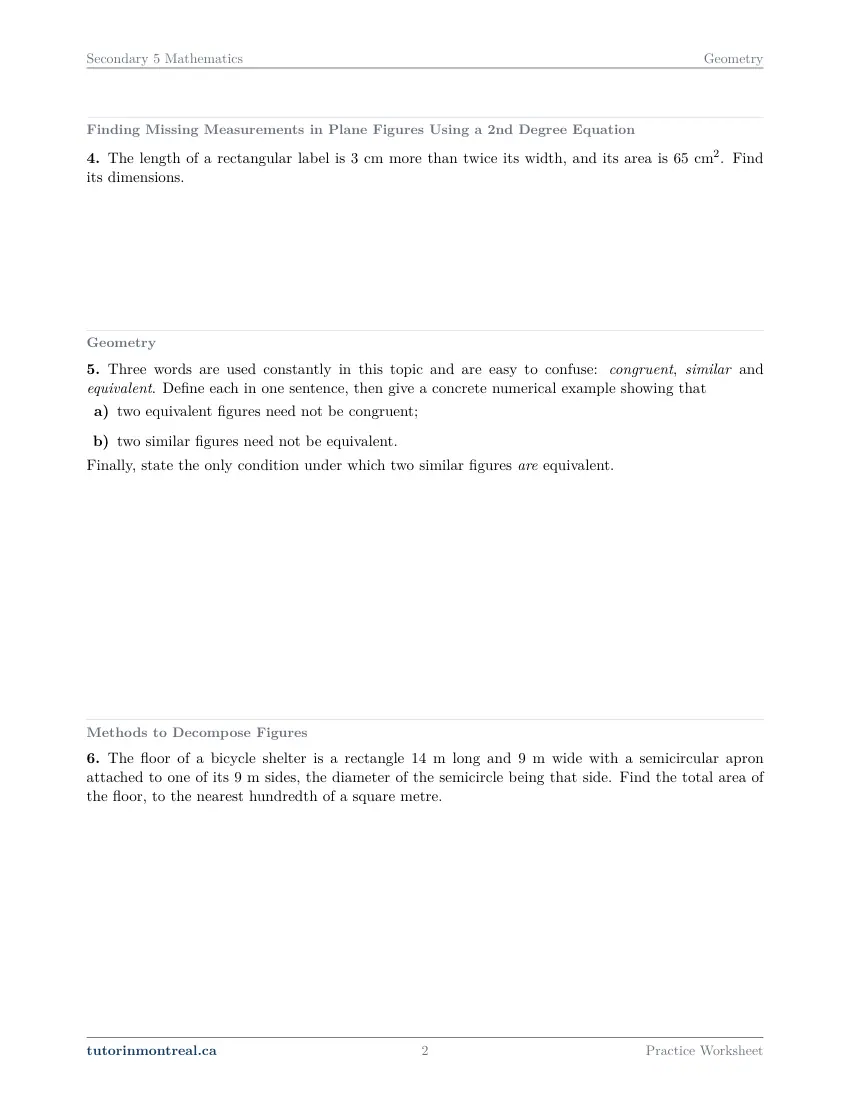
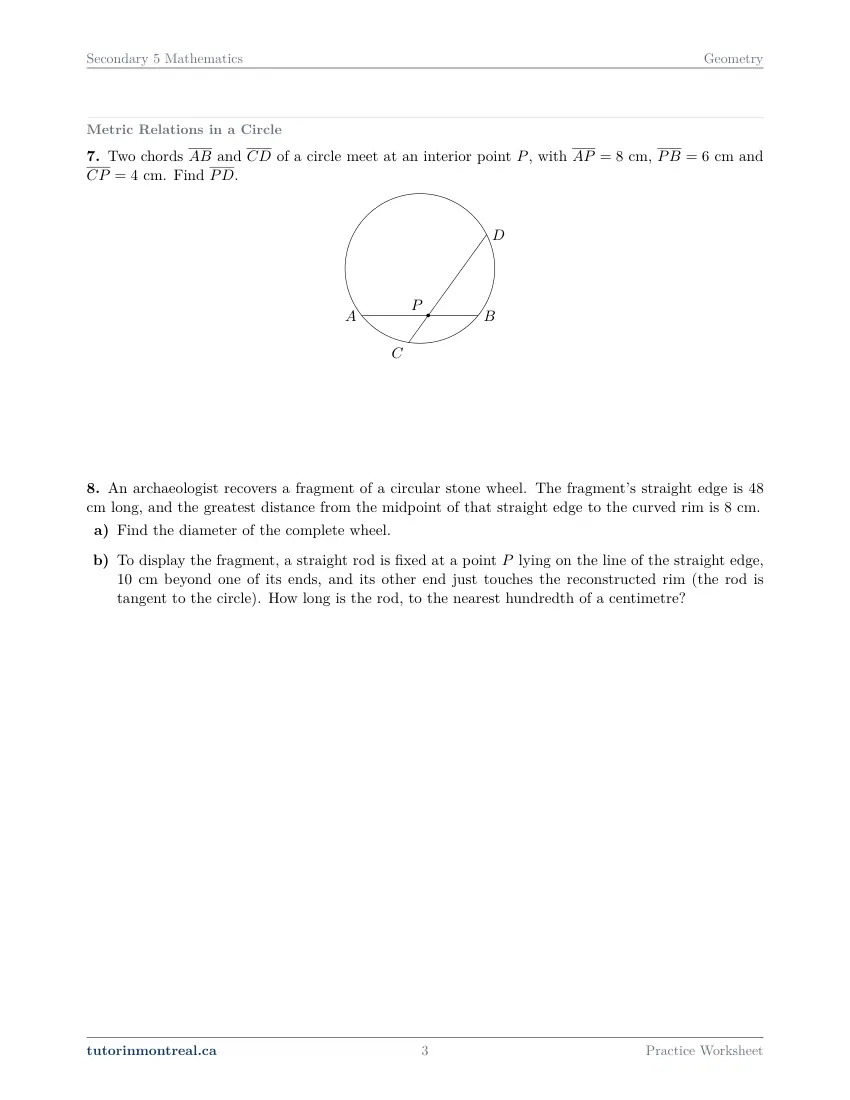
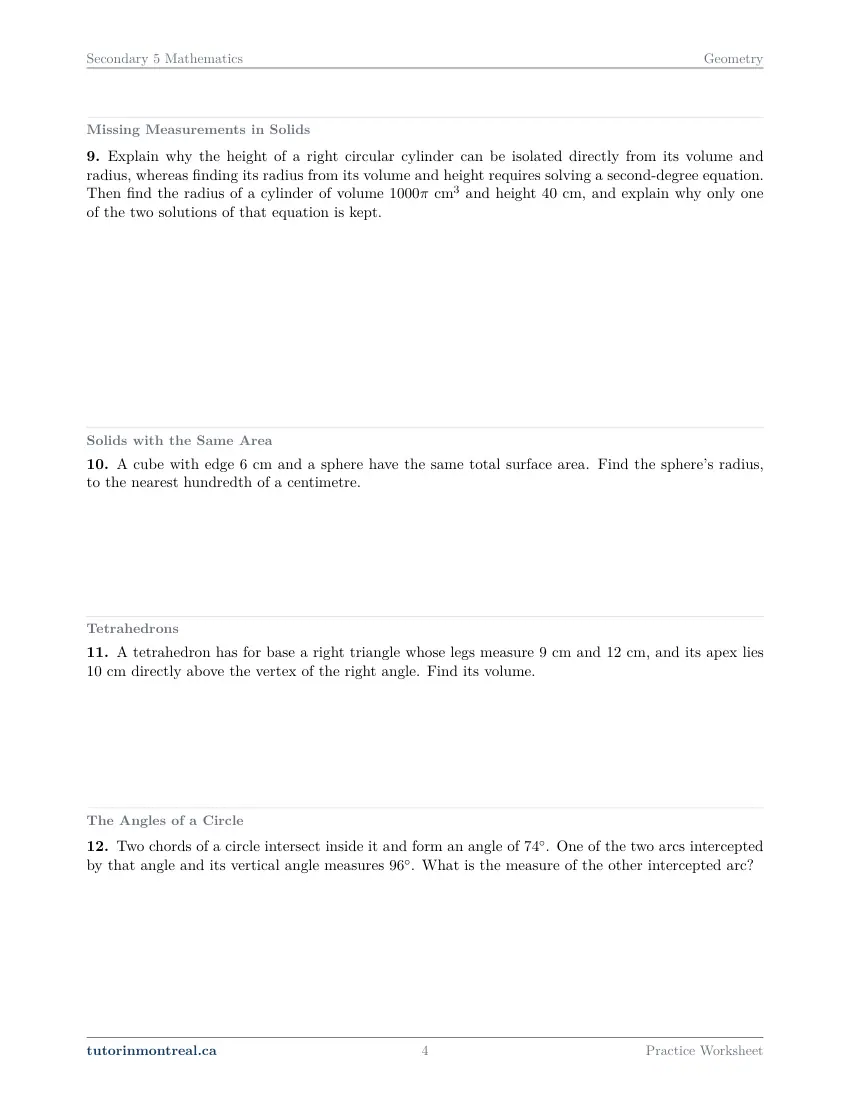
Preview all 5 pages
Click any page to open the full PDF.
Getting the most out of it
Draw and label before you write a single equation
Every question on this sheet describes a figure in words. Redraw it, put every given number on the drawing, and mark the unknown with a letter. Most of the errors on this topic are not algebraic — they are a diameter used as a radius, or an angle placed at the wrong vertex, and both are visible in a sketch and invisible in a formula.
Isolate symbolically, substitute once
Rearrange the formula for the unknown while it is still letters, and only then put the numbers in. It halves the arithmetic, it lets π cancel when it is going to, and it leaves a line a marker can follow if the final number is wrong.
End every measurement answer with a sanity check
Units on the answer, negative roots explicitly rejected, and a glance at whether the size is plausible. A radius larger than the object it sits in, or a volume smaller than one of its parts, is caught in two seconds — and both happen more often than students expect.
Want the solutions, or something more challenging?
The worksheet, the questions above and every explanation on this page stay free permanently. Three more PDFs exist for this topic — the worked answer key, a harder problem set, and the answer key to that. They come with the Secondary 5 Math Solutions Bundle, which is what keeps the rest of the series free.
What else exists for Geometry
Three PDFs · 12 pages · all three are in the bundle below.
- Answer key — 3 pages. All 13 questions worked step by step, including the restrictions and the justifications. Not a list of final answers.
- Challenge problems — 6 pages, 10 problems. A separate sheet at exam-plus difficulty covering the same 11 concepts. Harder than anything on the free sheet.
- Challenge answer key — 3 pages. Every challenge problem worked to the same standard, with the checks shown.
- PDF, letter size, print-ready.
The one thing that's for sale
Every Secondary 5 Math topic — the complete Solutions Bundle
One download, one payment, the whole program. Every answer key and every challenge set for all 21 Secondary 5 Math worksheet sets — including this one.
- Worked solutions, not answer lists — every step written out
- Covers the whole year's program at this level
- Less than the price of one hour of tutoring — for the entire year's solutions
Taking Secondary 1 Math as well? The Secondary 1 Math bundle covers all 15 of its sets — 45 PDFs, 182 pages — on the same terms.
Taking Secondary 2 Math as well? The Secondary 2 Math bundle covers all 14 of its sets — 42 PDFs, 181 pages — on the same terms.
Taking Secondary 3 Math as well? The Secondary 3 Math bundle covers all 11 of its sets — 33 PDFs, 154 pages — on the same terms.
Taking Secondary 4 Math as well? The Secondary 4 Math bundle covers all 17 of its sets — 51 PDFs, 154 pages — on the same terms.
Taking CEGEP Calculus I as well? The CEGEP Calculus I bundle covers all 8 of its sets — 24 PDFs, 82 pages — on the same terms.
Taking CEGEP Calculus II as well? The CEGEP Calculus II bundle covers all 8 of its sets — 24 PDFs, 90 pages — on the same terms.
Taking CEGEP Linear Algebra as well? The CEGEP Linear Algebra bundle covers all 7 of its sets — 21 PDFs, 82 pages — on the same terms.
Taking AP Calculus AB as well? The AP Calculus AB bundle covers all 8 of its sets — 24 PDFs, 126 pages — on the same terms.
Common questions
Is this worksheet really free?
Yes — the questions are on this page to read, and the PDF downloads directly, no email and no account. The one paid item is optional: the complete Secondary 5 Solutions Bundle, which covers every set at this level.
What is the difference between equivalent, congruent and similar figures?
Congruent means same shape and same size. Similar means same shape, with all lengths in a fixed ratio. Equivalent means same area — or, for solids, same volume — with no claim about shape at all. Two similar figures are equivalent only when the ratio is 1, that is, only when they are congruent.
If I double every length, what happens to the area and the volume?
Area is multiplied by 4 and volume by 8. In general, scaling all lengths by k multiplies areas by k² and volumes by k³. This is why a scale model that is half the size holds only one eighth as much, and it is the fact most exam questions on similarity are built around.
How do I find a circle's radius from a chord and the height of its arc?
Use the diameter through the midpoint of the chord: it is perpendicular to the chord and bisects it, so the two chords cross there and the intersecting-chords relation applies. Half the chord squared equals the arc height times the rest of the diameter, which gives the diameter in one line.
Do solids with the same surface area hold the same volume?
No. Equal surface area and equal volume are two different constraints, and matching one generally leaves the other unequal. The more compact the shape, the more volume it encloses for a given area, so among all solids of the same surface area the sphere holds the most.
Why does one solution of the second-degree equation get thrown away?
Because it fails the context, not the algebra. A width, a radius or a length cannot be negative, so a negative root is rejected — and saying so explicitly is part of the expected answer, not an optional remark.
Can teachers use this in class?
Yes. Print and photocopy it for your own classes freely — I just ask that the tutorinmontreal.ca footer stays on the page.
I'm stuck on one question. Can you help?
Yes — through one-on-one tutoring, in Montreal or online. Get in touch to arrange a session, or see the current rates.
← All 21 Secondary 5 Math worksheets · Secondary 1 Math series (15 sheets) → · Secondary 2 Math series (14 sheets) → · Secondary 3 Math series (11 sheets) → · Secondary 4 Math series (17 sheets) → · CEGEP Calculus I series (8 sheets) → · CEGEP Calculus II series (8 sheets) → · CEGEP Linear Algebra series (7 sheets) → · AP Calculus AB series (8 sheets) →
The same topic at the other level: Secondary 4 Math · Geometry.