Secondary 5 Financial Mathematics Worksheet
Money is only comparable at a single date, and that one idea drives the sheet: simple interest, compound interest, periodic against effective rates, present value, and the comparison questions where two offers have to be dragged to the same moment before either can win. Watch the compounding period — it is where most of the marks are lost. Work through it on screen, or print it out; the PDF is free either way.
Practice worksheet — free PDF
No email, no account, no watermark. Teachers: photocopy it for your classes freely. Worked solutions and 5 harder problems come with the Secondary 5 Math bundle.
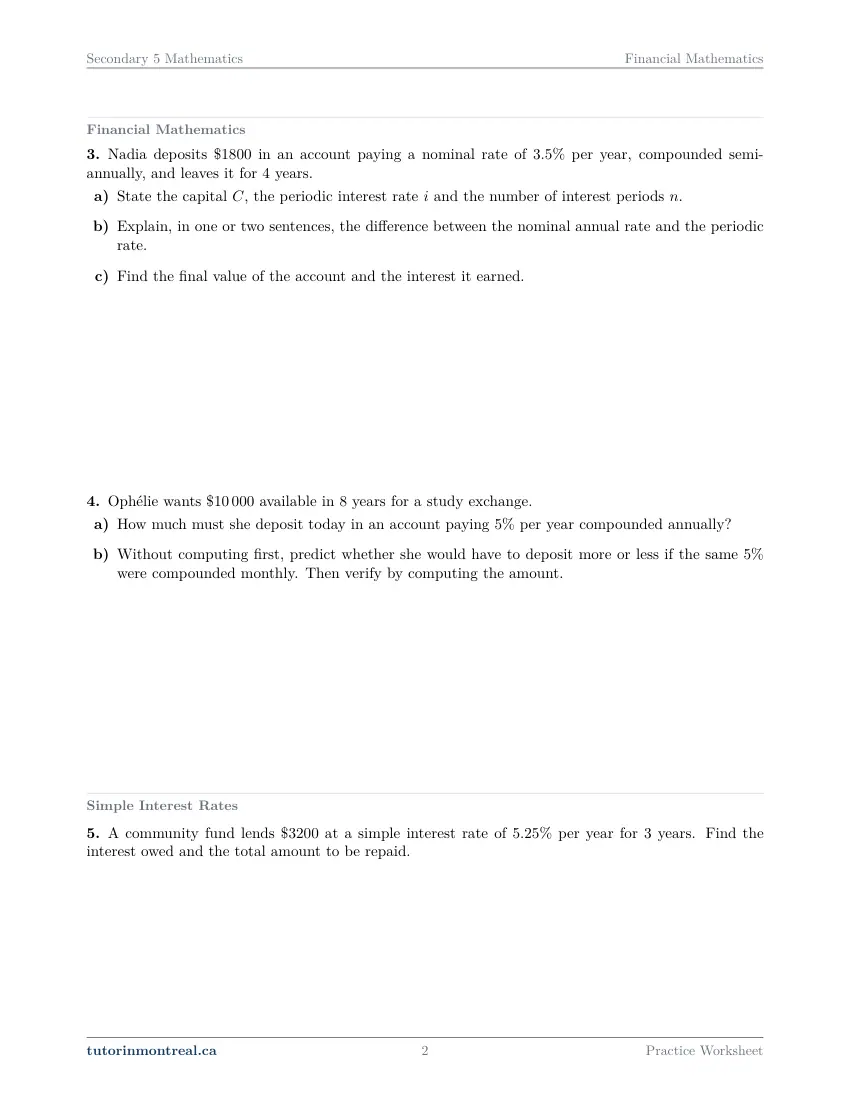
All 9 questions
Each question targets one named concept from the sheet. Read them here, or print the PDF — it has working space under each one.
-
Q1Compound Interest Rates
Kenji deposits $2500 in an account paying per year, compounded annually. He makes no other deposit and no withdrawal for 6 years. Find the value of the account after 6 years and the total interest earned. Round to the nearest cent.
-
Q2Compound Interest Rates
Sabrina has $4000 to place for 5 years. The Banque du Nord offers per year compounded quarterly; the Caisse de l'Est offers per year compounded annually. Determine which institution returns more, and by how much.
-
Q3Financial Mathematics
Nadia deposits $1800 in an account paying a nominal rate of per year, compounded semi-annually, and leaves it for 4 years.
- State the capital , the periodic interest rate and the number of interest periods .
- Explain, in one or two sentences, the difference between the nominal annual rate and the periodic rate.
- Find the final value of the account and the interest it earned.
-
Q4Financial Mathematics
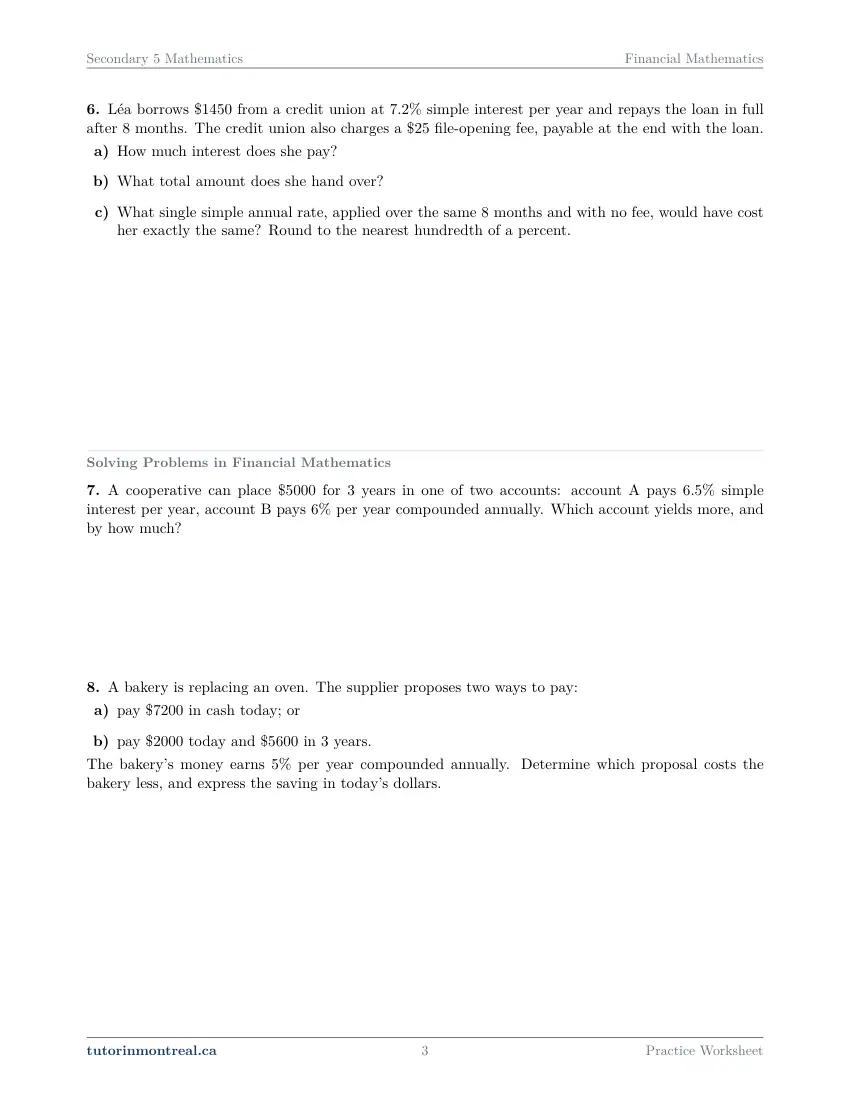
Ophélie wants $10 000 available in 8 years for a study exchange.
- How much must she deposit today in an account paying per year compounded annually?
- Without computing first, predict whether she would have to deposit more or less if the same were compounded monthly. Then verify by computing the amount.
-
Q5Simple Interest Rates
A community fund lends $3200 at a simple interest rate of per year for 3 years. Find the interest owed and the total amount to be repaid.
-
Q6Simple Interest Rates
Léa borrows $1450 from a credit union at simple interest per year and repays the loan in full after 8 months. The credit union also charges a $25 file-opening fee, payable at the end with the loan.
- How much interest does she pay?
- What total amount does she hand over?
- What single simple annual rate, applied over the same 8 months and with no fee, would have cost her exactly the same? Round to the nearest hundredth of a percent.
-
Q7Solving Problems in Financial Mathematics
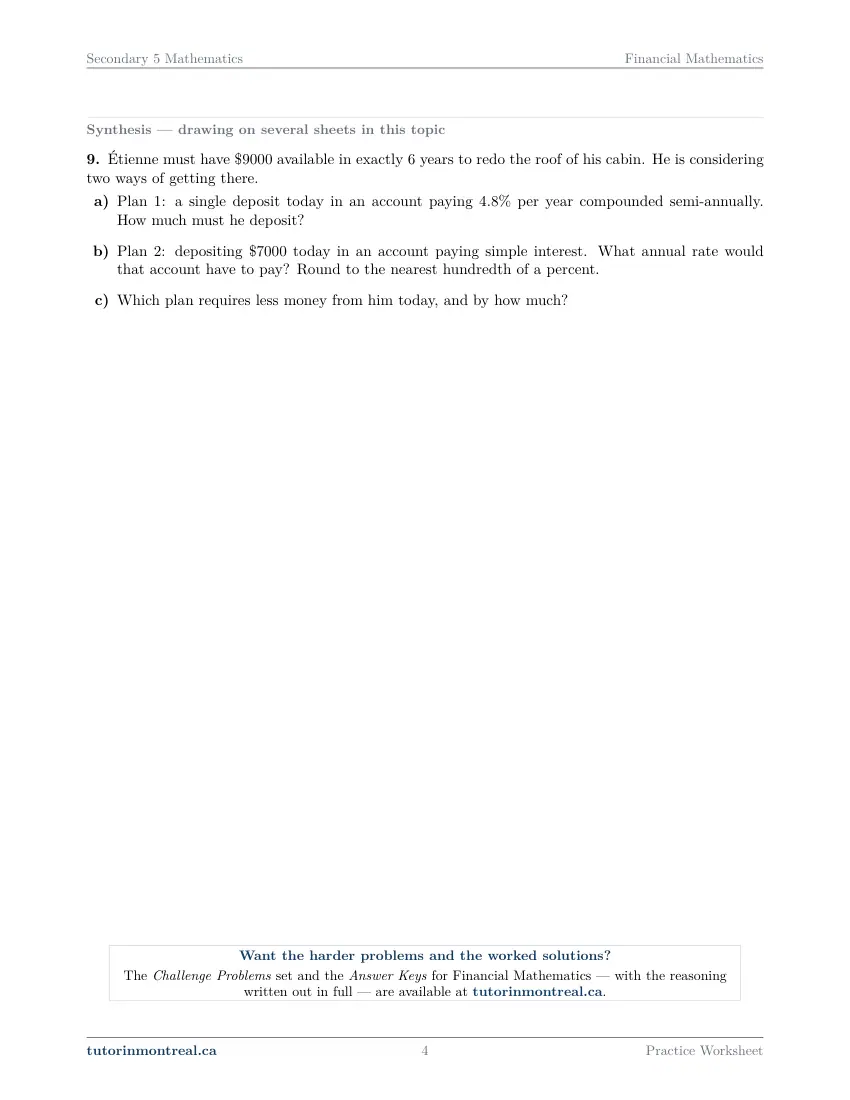
A cooperative can place $5000 for 3 years in one of two accounts: account A pays simple interest per year, account B pays per year compounded annually. Which account yields more, and by how much?
-
Q8Solving Problems in Financial Mathematics
A bakery is replacing an oven. The supplier proposes two ways to pay:
- pay $7200 in cash today; or
- pay $2000 today and $5600 in 3 years.
The bakery's money earns per year compounded annually. Determine which proposal costs the bakery less, and express the saving in today's dollars.
-
Q9Synthesis — drawing on several sheets in this topic
Étienne must have $9000 available in exactly 6 years to redo the roof of his cabin. He is considering two ways of getting there.
- Plan 1: a single deposit today in an account paying per year compounded semi-annually. How much must he deposit?
- Plan 2: depositing $7000 today in an account paying simple interest. What annual rate would that account have to pay? Round to the nearest hundredth of a percent.
- Which plan requires less money from him today, and by how much?
The 5 challenge problems for this topic are a separate, paid sheet and are not reproduced here.
Which stream is this for? This sheet is built for SN. It expects the compound-interest model handled in both directions, comparisons made through effective rates or present values, and a written justification of which option wins — the depth that program expects.
How to do every concept on this sheet
This is the part worksheet sites usually leave out. Below is the actual reasoning behind each group of questions — not a full solution set, the decisions that get you to one. Read it before you start, or after you get stuck.
Two models, and knowing instantly which one you are in
Every question on this sheet uses one of two formulas, and reading which one from the wording is half the exercise. Q5 and Q6 are simple interest; Q1, Q3 and Q4 are compound; Q7 and Q9 put the two models head to head. Q2 and Q8 are comparisons that stay inside the compound model throughout — Q2 sets one compounding frequency against another, Q8 sets two payment dates against each other — so the first decision there is not which formula but which date everything will be measured at.
simple: A = C(1 + i·t) compound: A = C(1 + i)ⁿUnder simple interest only the original capital ever earns. The same amount is added each year, so the value grows along a straight line, and the interest for t years is just C·i·t. Under compound interest the interest earned is itself added to the capital and starts earning too, so growth is exponential and the interest is A − C, never C·i·n.
The wording that gives it away: "simple interest" is always stated explicitly, and "compounded annually / semi-annually / quarterly / monthly" always signals the second model — while telling you how to build i and n.
Setting up any compound-interest computation
Four lines before any arithmetic. Q3(a) asks for the first three of them explicitly, because that is where the marks are.
- 1C — the capital
The amount actually placed or borrowed at the start. Not the target, not the total repaid.
- 2i — the periodic rate
The nominal annual rate divided by the number of interest periods in a year. Semi-annually divides by 2, quarterly by 4, monthly by 12. Write it as a decimal.
- 3n — the number of periods
Periods per year multiplied by the number of years — not the number of years. Four years compounded semi-annually is n = 8, not 4.
- 4Decide the direction
Going forwards in time you multiply:
A = C(1 + i)ⁿ. Going backwards — "how much must be deposited today" — you divide:C = A ⁄ (1 + i)ⁿ. Choosing the direction before you touch the calculator prevents the single most expensive error on this sheet.
The mistake that survives every other check: putting the nominal annual rate into the formula while counting sub-annual periods. A nominal 3.5% compounded semi-annually is i = 0.0175 over 8 periods for four years — not 0.035 over 8, which would double the return, and not 0.035 over 4, which quietly ignores the compounding you were told about.
Q3(b) asks you to explain the distinction in words, and the sentence is worth having ready: the nominal rate is the figure quoted for a year, the periodic rate is the fraction of it actually applied at the end of each interest period, and only the periodic rate may be used as i.
The posted rate is not what you earn (Q2)
Q2 puts a lower rate compounded four times a year against a higher rate compounded once, and the lower one can win. That is not a trick; it is the reason effective rates exist. One year of compounding k times at periodic rate i multiplies the capital by (1 + i)ᵏ, so
effective annual rate = (1 + i)ᵏ − 1Converting both offers to their effective annual rates puts them on one scale, and the comparison becomes a comparison of two numbers. It also proves the answer for every duration at once: if one growth factor is larger than the other and both exceed 1, raising both to the same power t keeps the inequality, so the better bank is better no matter how long the money stays. Answering "which is better" by computing a single term is fine when the question fixes the term, but the effective-rate argument is what makes the conclusion general.
Present value: run the formula backwards (Q4, Q8, Q9)
"How much must be deposited today to have a given amount later" is the same formula read the other way. Dividing by the growth factor is not a new technique — it is isolating C.
C = A ⁄ (1 + i)ⁿQ4(b) asks you to predict, before computing, whether more frequent compounding raises or lowers the deposit needed. The reasoning is short and it is the kind of sentence exams reward: more frequent compounding makes the same capital grow faster, so the growth factor you divide by is larger, so a smaller deposit suffices. The computation then confirms a prediction instead of producing an unexamined number.
Q8 is the idea behind all of this, stated plainly. Two payment plans can only be compared at the same date. Dollars today and dollars in three years are not the same units, so adding a payment made now to a payment due later is meaningless as it stands. Bring the later payment back to today by discounting it, then add. (Pushing both forward to the final date works equally well and gives the same winner — what matters is that both are measured at one date.) The saving is then a difference of two present values, and saying "in today's dollars" is part of the answer.
When the rate is the unknown (Q6, Q9)
Twice on this sheet the money is known at both ends and the rate is what you are asked for, and both times the model is simple interest — which is good news, because A = C(1 + r·t) is linear in r. Nothing clever is needed: divide, subtract the 1, divide by the time.
A = C(1 + r·t) ⟹ r = (A ⁄ C − 1) ⁄ tQ9(b) is that formula used directly, with the deposit known and the target known. Q6(c) reaches the same algebra from a different angle: there the amount you must reproduce is not handed to you but assembled first, and the section on simple interest below is about how.
Two habits keep these honest. Convert the term to years before it enters the formula, and give the answer as a percentage rounded the way the question asks — an answer left as a decimal is an unfinished answer when the wording says "to the nearest hundredth of a percent". Then check it by running the rate forwards: if it does not rebuild the amount you started from, the slip is almost always the time.
Simple interest, and the traps that live in the wording (Q5, Q6)
The formula is easy; the reading is not. Two things to watch:
Time must be in years. A rate quoted per year and a term given in months means converting: eight months is 8/12 of a year. Leaving t = 8 in the formula multiplies the interest by twelve.
A fee is not interest, but it is a cost. Q6 adds a flat file-opening fee and then asks what single rate, with no fee, would have cost the same. The method is to total the real cost of borrowing — interest plus fee — and solve C·r·t = that total for r. The result is startling and it is the point of the question: a small fixed fee spread over a short term raises the true annual cost by several percentage points, because the fee does not shrink when the loan is short.
Which model wins depends on how long you wait (Q7, Q9)
Q7 pits a higher simple rate against a lower compound one over a short term, and the simple account can come out ahead. Compounding is a slow advantage: in the first period the two models earn identically, and the compound account only pulls away as the interest-on-interest accumulates. Over a long enough horizon compounding always wins, because exponential growth eventually beats linear growth for any positive rate — but "eventually" may be well past the term in the question.
So the method for any comparison question is the same three lines: compute each option separately, compare, and state the difference in dollars and the reason. An answer that names the winner without the reason is half an answer; Q9(c) in particular is asking for the sentence, not just the subtraction.
Preview all 4 pages
Click any page to open the full PDF.
Getting the most out of it
Write C, i and n in a column before you touch the calculator
Three short lines, every time, even on a question that looks obvious. Almost every lost mark on this sheet is a periodic rate that was never divided or a count of periods that was never multiplied, and both become visible the moment they are written down separately.
Keep six decimals in the growth factor, round only the money
A factor rounded to three decimals and then applied to thousands of dollars shifts the answer by more than the cent the question asks for. Carry the factor at full precision, and round once, at the end, to the nearest cent.
Predict before you compute
Q4(b) asks for this explicitly, and it is worth doing on every question: will the answer be bigger or smaller, and why? A prediction that the computation contradicts tells you immediately that something is wrong — which is far better than a plausible wrong number you never questioned.
Want the solutions, or something more challenging?
The worksheet, the questions above and every explanation on this page stay free permanently. Three more PDFs exist for this topic — the worked answer key, a harder problem set, and the answer key to that. They come with the Secondary 5 Math Solutions Bundle, which is what keeps the rest of the series free.
What else exists for Financial Mathematics
Three PDFs · 7 pages · all three are in the bundle below.
- Answer key — 2 pages. All 9 questions worked step by step, including the restrictions and the justifications. Not a list of final answers.
- Challenge problems — 3 pages, 5 problems. A separate sheet at exam-plus difficulty covering the same 4 concepts. Harder than anything on the free sheet.
- Challenge answer key — 2 pages. Every challenge problem worked to the same standard, with the checks shown.
- PDF, letter size, print-ready.
The one thing that's for sale
Every Secondary 5 Math topic — the complete Solutions Bundle
One download, one payment, the whole program. Every answer key and every challenge set for all 21 Secondary 5 Math worksheet sets — including this one.
- Worked solutions, not answer lists — every step written out
- Covers the whole year's program at this level
- Less than the price of one hour of tutoring — for the entire year's solutions
Taking Secondary 1 Math as well? The Secondary 1 Math bundle covers all 15 of its sets — 45 PDFs, 182 pages — on the same terms.
Taking Secondary 2 Math as well? The Secondary 2 Math bundle covers all 14 of its sets — 42 PDFs, 181 pages — on the same terms.
Taking Secondary 3 Math as well? The Secondary 3 Math bundle covers all 11 of its sets — 33 PDFs, 154 pages — on the same terms.
Taking Secondary 4 Math as well? The Secondary 4 Math bundle covers all 17 of its sets — 51 PDFs, 154 pages — on the same terms.
Taking CEGEP Calculus I as well? The CEGEP Calculus I bundle covers all 8 of its sets — 24 PDFs, 82 pages — on the same terms.
Taking CEGEP Calculus II as well? The CEGEP Calculus II bundle covers all 8 of its sets — 24 PDFs, 90 pages — on the same terms.
Taking CEGEP Linear Algebra as well? The CEGEP Linear Algebra bundle covers all 7 of its sets — 21 PDFs, 82 pages — on the same terms.
Taking AP Calculus AB as well? The AP Calculus AB bundle covers all 8 of its sets — 24 PDFs, 126 pages — on the same terms.
Common questions
Is this worksheet really free?
Yes — the questions are on this page to read, and the PDF downloads directly, no email and no account. The one paid item is optional: the complete Secondary 5 Solutions Bundle, which covers every set at this level.
What is the difference between the nominal rate and the periodic rate?
The nominal rate is the figure quoted for a full year. The periodic rate is the fraction of it actually applied at the end of each interest period — divide by 2 for semi-annual, 4 for quarterly, 12 for monthly compounding. Only the periodic rate may be used as i in A = C(1 + i)ⁿ, and n counts periods, not years.
Why does compounding more often earn more, if the posted rate is the same?
Because interest credited earlier starts earning interest itself for the rest of the term. The comparison that makes this precise is the effective annual rate, (1 + i)^k − 1, which is what a nominal rate really returns over one year. It is also why a lower posted rate compounded often can beat a higher one compounded annually.
How do I know whether to multiply or divide by (1 + i)ⁿ?
By the direction in time. Moving money forwards — what will this be worth later? — you multiply. Moving backwards — how much is needed today to reach that amount? — you divide. Deciding this in words before computing prevents the most common error on present-value questions.
Can simple interest ever beat compound interest?
Yes, over a short enough term with a high enough rate. Compounding is a slow advantage: the two models earn the same in the first period, and the compound account only pulls ahead as interest starts earning interest. Over a long horizon compounding always wins, but the term in the question may end before it does.
Why do I have to bring both payment plans back to the same date?
Because a dollar today and a dollar in three years are not interchangeable — the first can be invested in the meantime. Adding a payment made now to one due later is like adding two different units. Discount the later payment back to today, or push both forward to the same future date, and only then compare.
Can teachers use this in class?
Yes. Print and photocopy it for your own classes freely — I just ask that the tutorinmontreal.ca footer stays on the page.
I'm stuck on one question. Can you help?
Yes — through one-on-one tutoring, in Montreal or online. Get in touch to arrange a session, or see the current rates.
← All 21 Secondary 5 Math worksheets · Secondary 1 Math series (15 sheets) → · Secondary 2 Math series (14 sheets) → · Secondary 3 Math series (11 sheets) → · Secondary 4 Math series (17 sheets) → · CEGEP Calculus I series (8 sheets) → · CEGEP Calculus II series (8 sheets) → · CEGEP Linear Algebra series (7 sheets) → · AP Calculus AB series (8 sheets) →