Secondary 5 Trigonometric Functions Worksheet
The full Secondary 5 trigonometry unit: radians and arc length, the unit circle and exact values, the properties of sine, cosine and tangent, what each parameter does to a periodic graph, graphing, finding a rule from a description, zeroes and trigonometric equations with their general solutions, the inverse functions arcsin, arccos and arctan, sinusoidal models of tides, daylight and rotating machinery, and the laws of sines and cosines. Every general-solution question turns on the period, so that is where the explanations start. The PDF is free, and there is nothing to fill in before you get it.
Practice worksheet — free PDF
No email, no account, no watermark. Teachers: photocopy it for your classes freely. Worked solutions and 23 harder problems come with the Secondary 5 Math bundle.
All 28 questions
Each question targets one named concept from the sheet. Read them here, or print the PDF — it has working space under each one.
-
Q1Finding the Rule of a Cosine Function
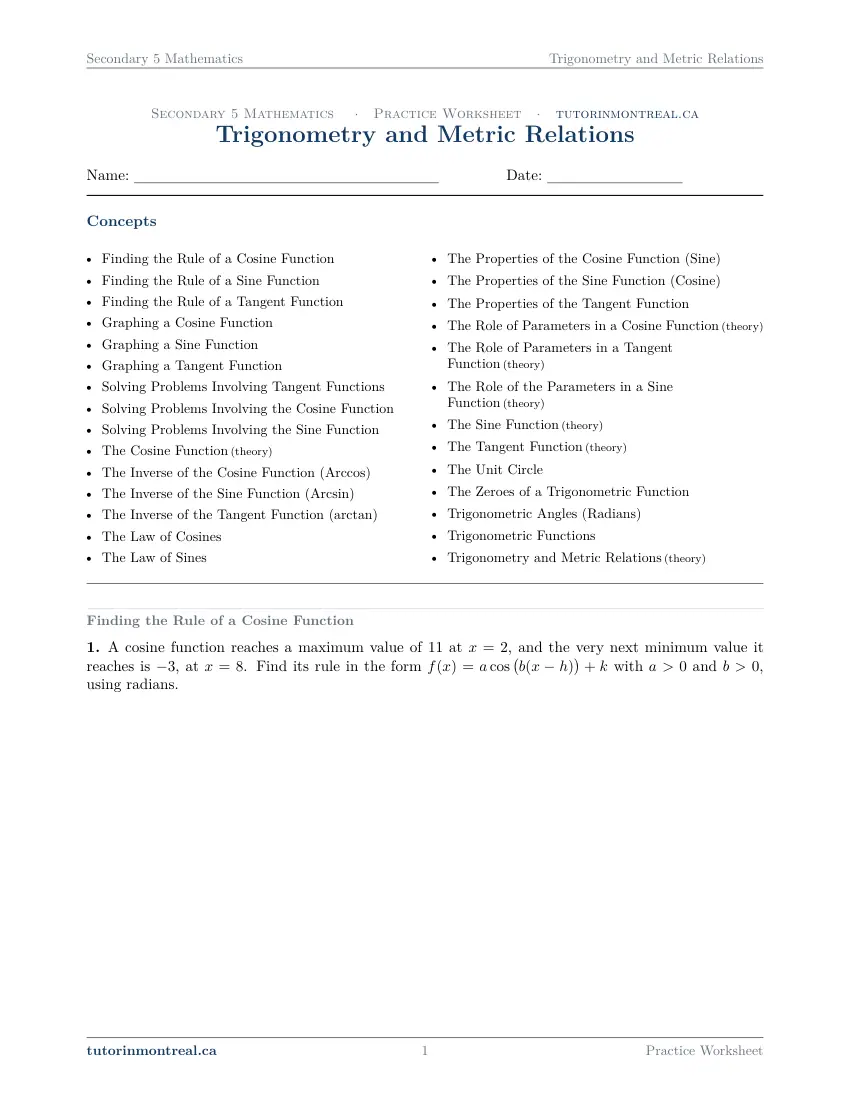
A cosine function reaches a maximum value of at , and the very next minimum value it reaches is , at . Find its rule in the form with and , using radians.
-
Q2Finding the Rule of a Sine Function
A buoy bobs on the swell. Its height above mean sea level is m at s and rising, and it first reaches its greatest height, m, at s. The motion is sinusoidal.
- Find the rule of this function.
- Find the buoy's height at s, to the nearest hundredth of a metre.
-
Q3Finding the Rule of a Tangent Function
A tangent function has consecutive asymptotes at and . Its centre point is and it passes through . Find its rule in the form with , then compute .
-
Q4Graphing a Cosine Function
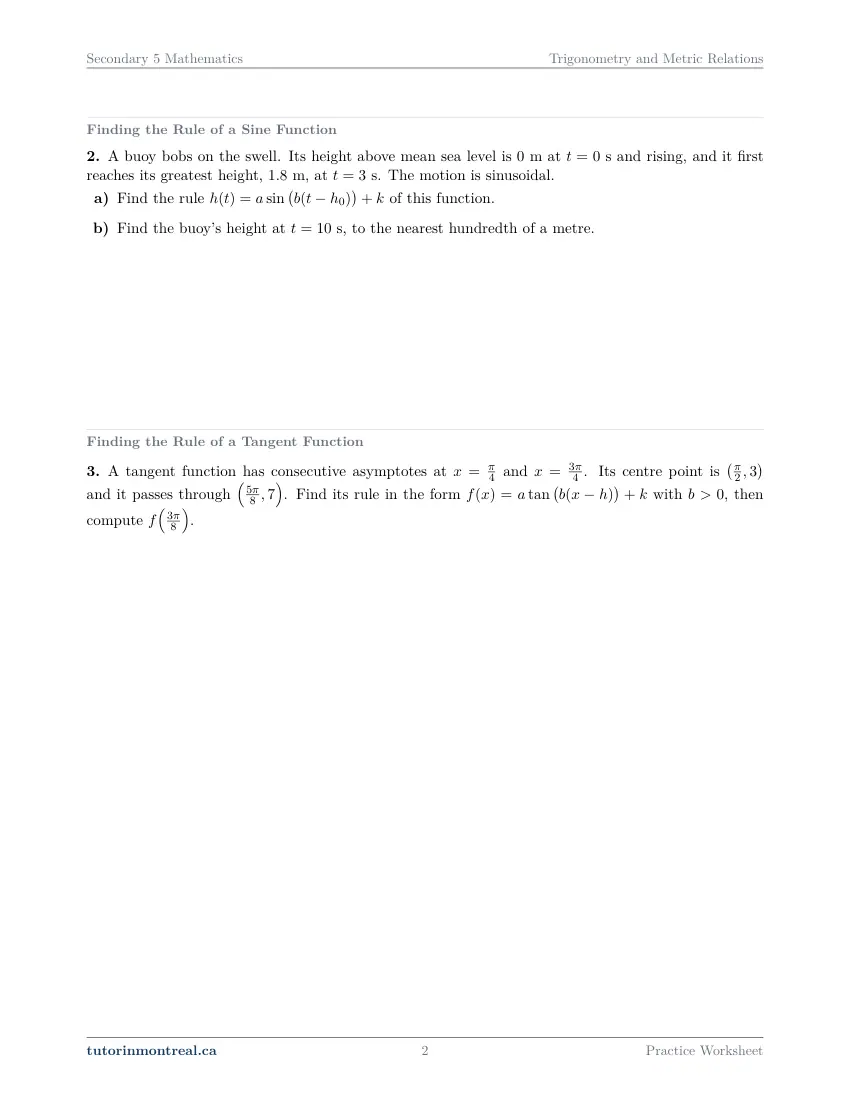
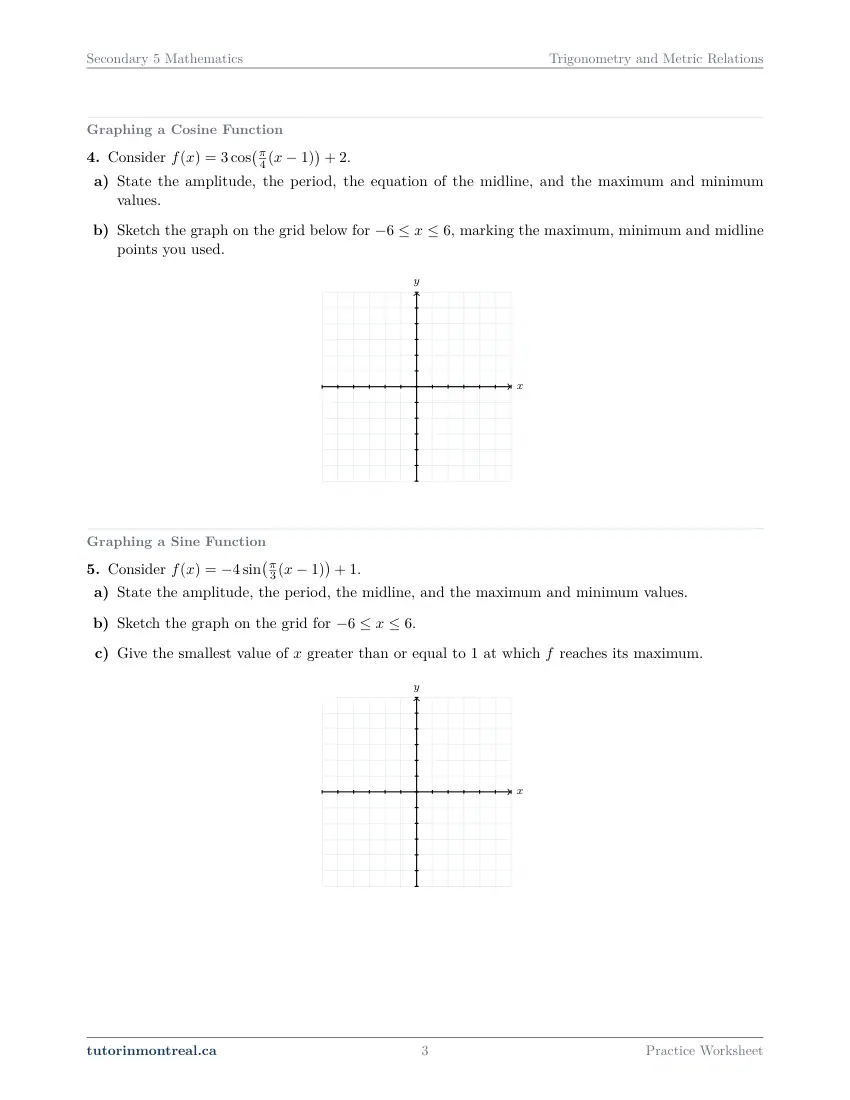
Consider .
- State the amplitude, the period, the equation of the midline, and the maximum and minimum values.
- Sketch the graph on the grid below for , marking the maximum, minimum and midline points you used.
A blank Cartesian grid for this question is on the printable PDF.
-
Q5Graphing a Sine Function
Consider .
- State the amplitude, the period, the midline, and the maximum and minimum values.
- Sketch the graph on the grid for .
- Give the smallest value of greater than or equal to at which reaches its maximum.
A blank Cartesian grid for this question is on the printable PDF.
-
Q6Graphing a Tangent Function
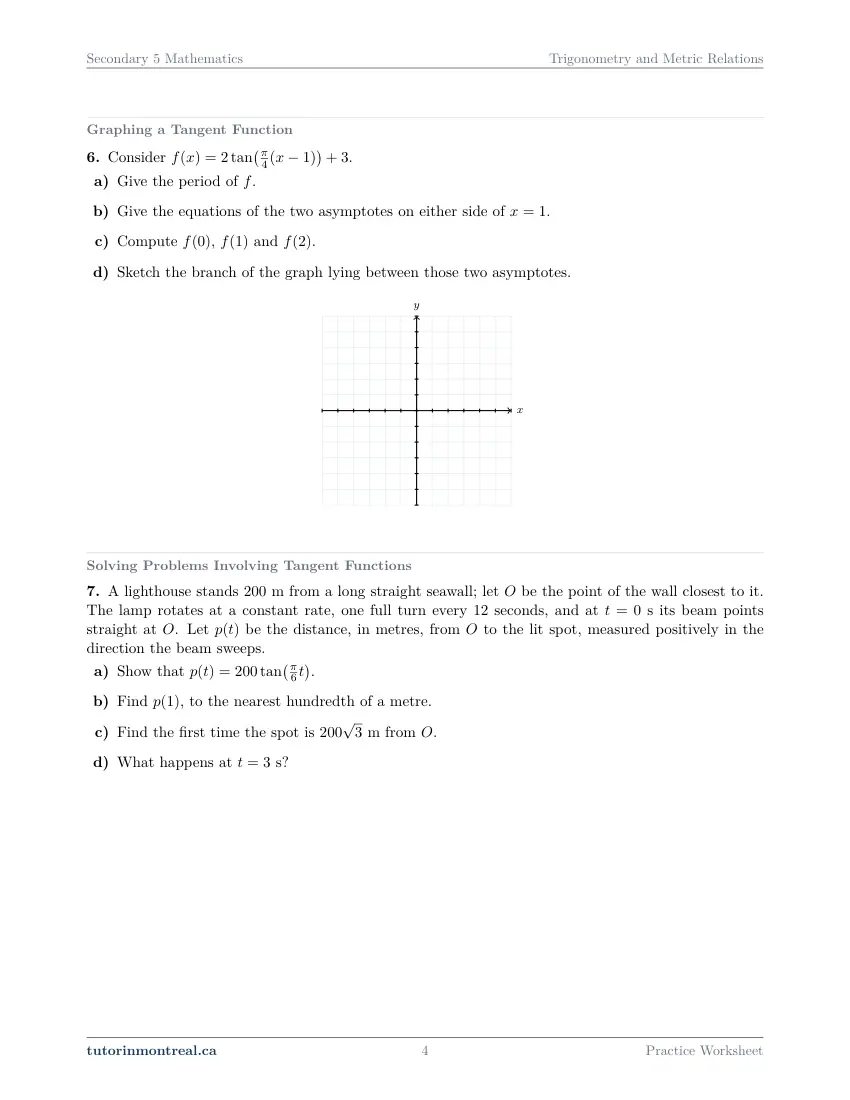
Consider .
- Give the period of .
- Give the equations of the two asymptotes on either side of .
- Compute , and .
- Sketch the branch of the graph lying between those two asymptotes.
-
Q7Solving Problems Involving Tangent Functions
A lighthouse stands m from a long straight seawall; let be the point of the wall closest to it. The lamp rotates at a constant rate, one full turn every seconds, and at s its beam points straight at . Let be the distance, in metres, from to the lit spot, measured positively in the direction the beam sweeps.
- Show that .
- Find , to the nearest hundredth of a metre.
- Find the first time the spot is m from .
- What happens at s?
-
Q8Solving Problems Involving the Cosine Function
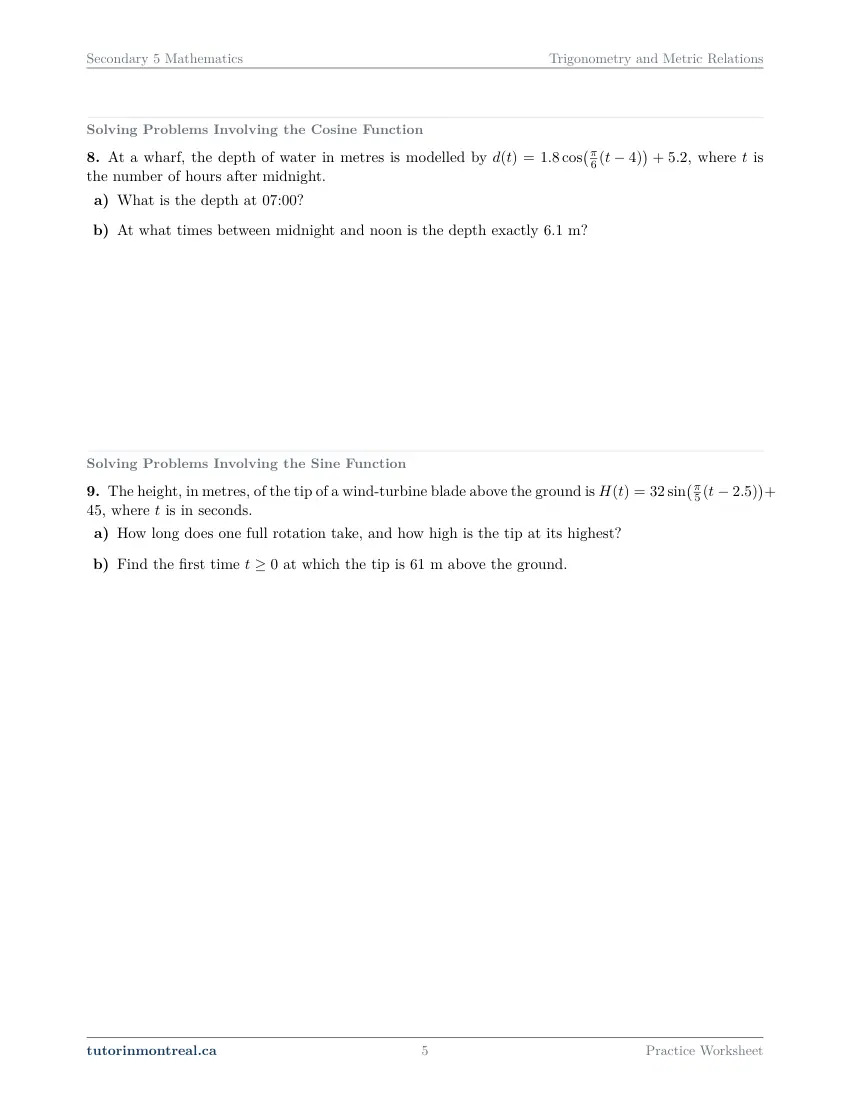
At a wharf, the depth of water in metres is modelled by , where is the number of hours after midnight.
- What is the depth at 07:00?
- At what times between midnight and noon is the depth exactly m?
-
Q9Solving Problems Involving the Sine Function
The height, in metres, of the tip of a wind-turbine blade above the ground is , where is in seconds.
- How long does one full rotation take, and how high is the tip at its highest?
- Find the first time at which the tip is m above the ground.
-
Q10The Cosine Function
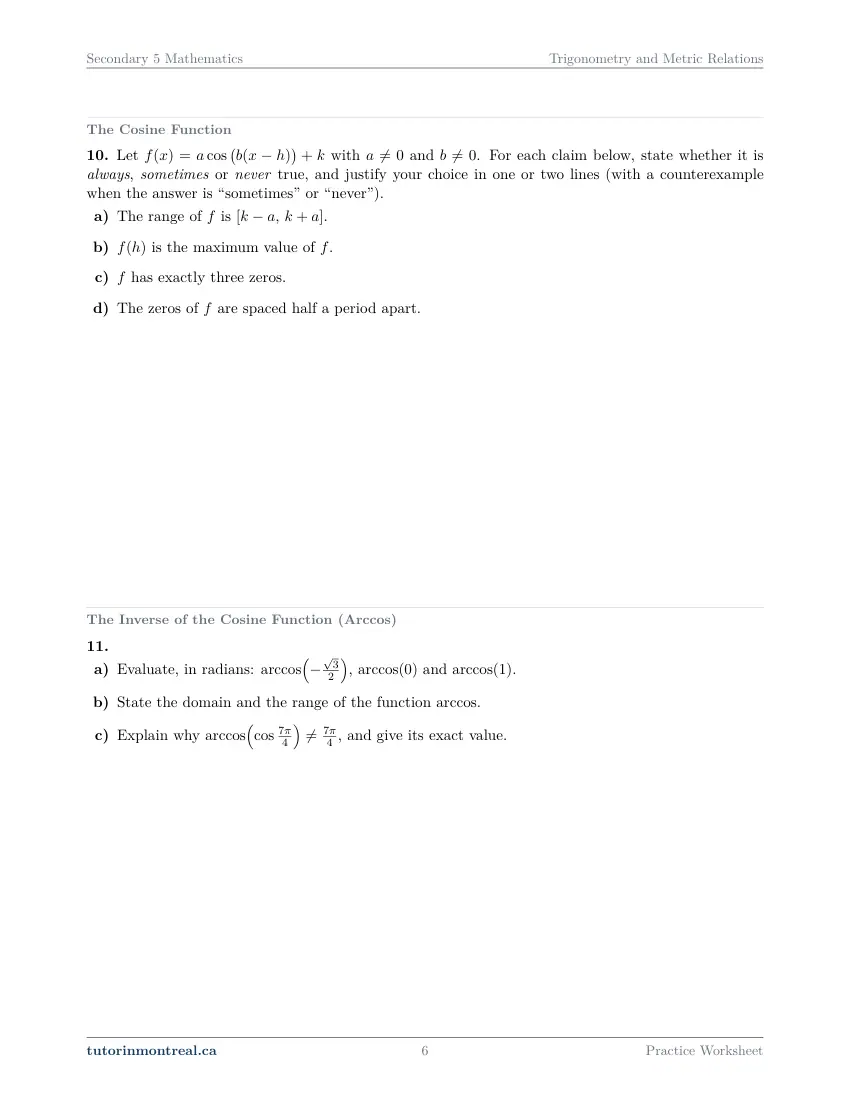
Let with and . For each claim below, state whether it is always, sometimes or never true, and justify your choice in one or two lines (with a counterexample when the answer is “sometimes” or “never”).
- The range of is .
- is the maximum value of .
- has exactly three zeros.
- The zeros of are spaced half a period apart.
-
Q11The Inverse of the Cosine Function (Arccos)
- Evaluate, in radians: , and .
- State the domain and the range of the function .
- Explain why , and give its exact value.
-
Q12The Inverse of the Sine Function (Arcsin)
- Evaluate, in radians: , and .
- State the domain and the range of , using Québec interval notation.
- Using the value of , find every such that .
-
Q13The Inverse of the Tangent Function (arctan)
- Evaluate, in radians: , and .
- State the domain and the range of , using Québec interval notation, and say why the range brackets are open.
- A loading ramp rises m over a horizontal run of m. Find the angle it makes with the horizontal, in radians to the nearest hundredth.
-
Q14The Law of Cosines
A surveyor walks two sides of a triangular lot: m, then m, with an angle of between them.
- Find the length of the third side, to the nearest tenth of a metre.
- Find the smallest angle of the lot, to the nearest tenth of a degree.
-
Q15The Law of Sines
Two fire-lookout towers and stand on a straight ridge, km apart. Both spot the same smoke plume on the far side of the valley. From tower , the sight line to makes an angle of with the ridge ; from tower , the sight line makes an angle of with the ridge . How far is the plume from tower ? Round to the nearest hundredth of a kilometre.
-
Q16The Properties of the Cosine Function (Sine)
Let .
- State the amplitude, the period and the range of .
- Give the coordinates of all maxima and of all minima of .
- Compute .
- How many maxima does have on the interval ?
-
Q17The Properties of the Sine Function (Cosine)
Let .
- Rewrite the rule in the form and state , , , .
- Give the period and the range of .
- Give the coordinates of one maximum and one minimum.
- On which intervals is increasing?
-
Q18The Properties of the Tangent Function
Let .
- Give the period of and the equations of all its asymptotes.
- Give the domain and the range of .
- Find all the zeroes of .
- Evaluate exactly.
-
Q19The Role of Parameters in a Cosine Function
Consider . Each change below alters exactly one parameter. For each, state the geometric effect on the graph and say whether the period and the range change.
- is replaced by .
- is replaced by .
- is replaced by .
- is replaced by .
-
Q20The Role of Parameters in a Tangent Function
Four tangent functions are given:
- Sort the four functions into groups having the same period, and give each period.
- Exactly two of them have the same set of asymptotes. Which two, and what are those asymptotes?
- Explain why the parameters and can never move the asymptotes of a tangent function.
-
Q21The Role of the Parameters in a Sine Function
While revising, Simon writes: “In , making larger makes the graph both taller and faster.” Only half of his sentence is right. State precisely what does and does not control, back your answer up with a specific pair of rules and their ranges and periods, and say what a negative value of does to the graph.
-
Q22The Sine Function
Answer using the unit circle, without a calculator.
- State the domain, the range and the period of the basic function .
- Explain why for every real number .
- Use b) to give the exact value of .
- Give all for which .
-
Q23The Tangent Function
Answer the following about the basic function .
- Using , explain why is undefined exactly at , .
- State the domain, the range and the period of .
- Explain why it makes no sense to speak of the amplitude of .
- Give the exact value of .
-
Q24The Unit Circle
Work from the unit circle; give exact values.
- Give the coordinates of the point associated with a rotation of .
- Evaluate , and .
- Which rotation in lands on the point ?
-
Q25The Zeroes of a Trigonometric Function
Find all the zeroes of , then list those that belong to .
-
Q26Trigonometric Angles (Radians)
- Convert and to radians, in exact form.
- Convert rad to degrees.
- A rotating sprinkler is set to sweep an angle of rad and throws water m. Find the exact length of the arc traced by the outer edge of the spray and the exact area watered, then give each to the nearest hundredth.
-
Q27Trigonometric Functions
In a research greenhouse, the air temperature hours after midnight is modelled by where is in degrees Celsius.
- What is the period of the model, and what does it mean here?
- What is the warmest temperature reached, and at what time of day?
- Compute and interpret the value.
-
Q28Trigonometry and Metric Relations
This topic supplies several distinct tools. For each situation below, name the one tool you would reach for first and give a one-sentence reason. Choose from: the law of sines, the law of cosines, the unit circle, an inverse trigonometric function (arcsin, arccos, arctan), a sinusoidal model .
- In a triangle you know two sides and the angle between them, and you want the third side.
- In a triangle you know two angles and the side opposite one of them, and you want another side.
- You need the exact value of , with no calculator.
- The height of water in a lock rises and falls, repeating every minutes.
- You know the two legs of a right triangle and want its acute angles.
The 23 challenge problems for this topic are a separate, paid sheet and are not reproduced here.
Which stream is this for? This sheet is built for SN. It works in radians throughout, expects the standard form a·sin(b(x − h)) + k for all three functions, and includes the inverse trigonometric functions and the two laws — the depth that program expects.
How to do every concept on this sheet
This is the part worksheet sites usually leave out. Below is the actual reasoning behind each group of questions — not a full solution set, the decisions that get you to one. Read it before you start, or after you get stuck.
The unit circle is a memory device, not a table to memorise (Q22, Q23, Q24)
A rotation of θ from the positive horizontal axis lands on the point (cos θ, sin θ). That single sentence generates everything: the cosine is the abscissa, the sine is the ordinate, and the tangent is their quotient, which is why it is undefined exactly where the abscissa is zero.
Any exact value, in three steps
Two pieces of information: which quadrant, and which reference angle.
- 1Place the angle in its quadrant
This alone fixes the two signs. In the second quadrant the abscissa is negative and the ordinate positive, so the cosine is negative and the sine positive. Decide the signs before computing anything.
- 2Find the reference angle
The acute angle to the horizontal axis: subtract from π in the second quadrant, subtract π in the third, subtract from 2π in the fourth. So 11π/6 has reference π/6, and 3π/4 has reference π/4.
- 3Read the value of the reference angle and attach the signs
Only three values are needed — the ones for π/6, π/4 and π/3 — and the quadrant supplies the rest.
The symmetries asked for in Q22 and Q24 come from the same picture. The points for θ and π − θ are mirror images in the vertical axis, so they have opposite abscissas and the same ordinate — which is exactly sin(π − θ) = sin θ. Adding π sends a point to the diametrically opposite one, so both coordinates change sign. Replacing θ by −θ reflects in the horizontal axis, so the abscissa survives and the ordinate flips. Learning the picture is faster and more reliable than learning the four identities.
Radians, arc length and sector area (Q26)
Multiply by π/180 to go from degrees to radians and by 180/π to come back — and if you can never remember which, note that a radian is much bigger than a degree, so a number of degrees must shrink.
s = r·θ A = ½·r²·θBoth formulas are true only with θ in radians — that is the entire reason radians exist, and it is what makes them the natural unit for the rest of this sheet. The sprinkler question also carries a units trap of its own: the radius and the arc must be measured in the same unit before you multiply, and the answer is asked for exactly and then rounded, so keep the π until the final line.
The calculator mode. Every question on this sheet is in radians. A calculator left in degree mode will return a plausible-looking number for something like sin(π/6) — it will read π/6 as about 0.524 degrees — and nothing in the arithmetic will look wrong. Check the mode before the first question and again after anyone else has touched the calculator. A quick test: sin(π/6) must be exactly 0.5.
Reading a, b, h, k off a rule — after factoring b out (Q4, Q5, Q16, Q17, Q19, Q21)
In the standard form a·sin(b(x − h)) + k, and identically for cosine and tangent:
|a| is the amplitude — half the distance between the maximum and the minimum, which is why a tangent function has no amplitude at all. k is the midline y = k, and the range is [k − |a|, k + |a|]. b controls only the horizontal behaviour: the period is 2π/|b| for sine and cosine and π/|b| for tangent. h is the horizontal shift.
You cannot read h until b is factored out. A rule written as cos(3x + π) is not shifted π units; rewrite the inside as 3(x + π/3) and the shift is π/3 units to the left. Reading the constant inside the bracket as though b were 1 is the most common single error on this whole topic, and Q19 and Q21 are built around what each parameter does and does not control.
Two more that are marked: the range uses |a|, so with a negative a the interval [k − a, k + a] comes out backwards and is not even a valid interval. And b has no effect whatever on height — a larger |b| makes the curve repeat faster, not grow taller.
The sign of a decides where the curve starts. With a > 0 a cosine has a maximum at x = h; with a < 0 it has a minimum there, and every extremum swaps. For a sine with a > 0, x = h is a rising midline crossing; with a < 0 it is a falling one. Q16 and Q17 ask for the coordinates of all maxima and minima, which means a general expression with an integer n in it — spaced one full period apart, with the minima half a period from the maxima.
Sketching a sinusoidal curve from its rule
Five landmarks per period, and the quarter period does all the work. Q4 and Q5 are exactly this.
- 1Draw the midline y = k
Lightly, right across the grid. Everything is measured from it.
- 2Draw the maximum and minimum lines
At k + |a| and k − |a|. The curve lives entirely in that band.
- 3Compute the period, then the quarter period
Period 2π/|b|; a quarter of it is the horizontal step between consecutive landmarks.
- 4Plant the landmark at x = h
Cosine with a > 0: a maximum. Cosine with a < 0: a minimum. Sine with a > 0: a rising midline point. Sine with a < 0: a falling one.
- 5Step out by quarter periods in both directions
Maximum, midline, minimum, midline, maximum — and keep going left as well as right until the whole required interval is covered. Half-finished graphs usually stop at the left edge of the given domain.
Finding the rule from a description (Q1, Q2, Q3)
Three questions, one procedure. Whatever you are told, a and k come from the extremes and b comes from the period:
k = (max + min) ⁄ 2 |a| = (max − min) ⁄ 2The midline is the average of the two extremes; the amplitude is half their difference. What changes between the questions is how the period is disguised, and it is worth knowing the three disguises by heart. A maximum and the next minimum are half a period apart (Q1). A rising midline crossing and the next maximum are a quarter period apart (Q2). Two consecutive asymptotes of a tangent function are a whole period apart — and for tangent the period is π/b, not 2π/b (Q3).
Then h is placed by whichever landmark the question hands you: the abscissa of a maximum for a cosine with a > 0, the abscissa of a rising midline crossing for a sine with a > 0, the centre of a branch for a tangent. Q3 gives a further point on the curve, which is how a is found once b, h and k are known: substitute the point and solve the resulting one-unknown equation.
h is never unique, and questions exploit that. Adding one whole period to h reproduces the identical curve, so the admissible values of h form a list spaced one period apart. That is why a question can ask for the value in a given interval and expect exactly one answer, and it is why two rules that look completely different can describe the same function. Always finish by checking your rule against a value from the question — the check takes one line and catches a quarter-period slip immediately.
Tangent behaves differently, and the differences are the marks (Q6, Q18, Q20, Q23)
Its period is π/|b|, half of what the same b would give a sine. Its asymptotes are where the argument hits π/2 + πn, so solving b(x − h) = π/2 + πn for x gives the whole family at once — and the answer is a family, with an integer n in it, not a single line. Its zeroes are where the argument is πn. The centre of each branch sits at a zero, exactly midway between two consecutive asymptotes, and the branch has point symmetry about that centre, which is what lets Q3 predict a second point from a first.
Two things it does not have: an amplitude and a bounded range. On each branch a tangent function takes every real value, so it has no maximum and no minimum, and half the distance between them is not a quantity that exists. Its range is all the reals — with the domain excluding the asymptotes. And a and k can never move an asymptote (Q20): an asymptote is where the function is undefined, which depends only on the argument b(x − h). Multiplying an undefined value by a or adding k to it cannot make it defined. Finally, the branch is increasing exactly when a and b have the same sign — two reversals cancel.
Solving a trigonometric equation: one solution is never the answer (Q8, Q9, Q12, Q25)
The full procedure
Skipping step 3 or step 5 is what turns four solutions into one.
- 1Isolate the trigonometric function
Get to sin(something) = a number. Do the arithmetic on the outside first — subtract k, divide by a — before touching an inverse function.
- 2Find the principal angle
The inverse function gives exactly one angle. Recognise the special values rather than reaching for a decimal: a right-hand side of ½ or √2/2 or √3/2 has an exact answer, and the question usually wants it exact.
- 3Find the second angle of the cycle
For cosine, the other angle is the negative of the first (or 2π minus it) — the two are symmetric about the horizontal axis. For sine, it is π minus the first. For tangent there is only one per period. This step is the one that disappears from most solutions.
- 4Add the period
Attach "+ 2πn" to each angle for sine and cosine, "+ πn" for tangent. These are equations about the argument, not about x, so do not solve for x yet.
- 5Solve for x, then keep only what fits the interval
The required interval for x becomes a different, stretched interval for the argument — if b is 2, the argument runs over two full periods while x runs over one. Work out that interval explicitly and count the solutions inside it before converting back.
Q25 asks for all the zeroes and then the ones inside an interval, which is this procedure with the right-hand side placed by the constant term. An inequality — Q8's "at what times is the depth exactly this", or a modelling question asking when a quantity stays above a threshold — is the same work with one extra step: find the two boundary angles, then keep the stretch of the cycle between them, and read off an interval of time rather than a list of instants.
The inverse functions and why their ranges are restricted (Q11, Q12, Q13)
A sine takes the same value infinitely often, so it has no inverse until its domain is cut down to a stretch on which it is one-to-one. That is what the ranges of the inverse functions are: arccos returns an angle in [0, π], arcsin in [−π/2, π/2], and arctan in ]−π/2, π/2[ — with reversed brackets, because the tangent is undefined at those two ends and no input can ever be sent there. Their domains are [−1, 1] for arcsin and arccos, since a sine or cosine never leaves that interval, and all the reals for arctan, since a tangent takes every real value on one branch.
arccos(cos θ) is not always θ. Every output of arccos lies in [0, π], so an angle outside that interval simply cannot come back out. Compute the cosine first, then take the arccos of that number, and you land on the angle in [0, π] sharing the same cosine — its mirror image in the horizontal axis. The same reasoning explains why Q12 has to hunt for the second and third solutions by hand: arcsin returned only one angle, and the question asked for every angle in an interval.
Modelling: tides, blades and beams (Q7, Q8, Q9, Q27)
A quantity that oscillates between a fixed maximum and a fixed minimum with a constant period is exactly what a sinusoidal rule describes, and the modelling questions are the graphing skills read in context. The vocabulary translates directly: the midline is the average level, the amplitude is how far it swings either side, the period is how long one full cycle takes, and h is anchored by whichever event the problem times for you — a high tide, a peak temperature, the moment the rider boards.
A rotating beam is the exception that needs a tangent instead: the lit spot's distance along a straight wall is the perpendicular distance times the tangent of the swept angle, which is why the spot accelerates away and why the beam going parallel to the wall is an asymptote, not a very large number. Q7 asks what happens at that instant, and the honest answer is that there is no lit spot at all.
Two habits for these questions. Convert the answer back into the language of the problem — "at 06:00", "1.56 m below mean sea level" — because the interpretation carries its own mark. And check the model against a value you were given before using it for anything else.
Always, sometimes, never (Q10)
Q10 gives four claims about a cosine function and asks for a verdict with a justification. "Sometimes" and "never" both need an explicit counterexample — a specific rule, with the arithmetic shown — while "always" needs a general argument. Two of the claims turn on the sign of a, which is the recurring theme of this whole topic. A third is about zeroes: a periodic function that has one zero automatically has infinitely many, one per period, so "exactly three zeroes" is impossible rather than unusual — the count is either none or infinite. Recognising an impossible claim, rather than an unlikely one, is what the question is testing.
Law of sines or law of cosines? (Q14, Q15, Q28)
Both relate the sides of a triangle to its angles, and the choice is made by what you were given, not by what you want.
Choosing between the two laws
Look at the given information, in this order.
- 1Two sides and the angle between them, or all three sides → law of cosines
It is the only one of the two that ties three sides to one angle. Rearranged, it also gives the cosine of any angle from the three sides — which is how Q14 finds an angle after finding the third side.
- 2An angle paired with the side opposite it → law of sines
It pairs each side with its opposite angle, so you need one complete pair plus one more piece. Two angles and any side qualifies, because the third angle comes free from the angle sum — that is the first move in Q15.
- 3Two sides and an angle not between them → law of sines, with care
This is the ambiguous case. A positive sine belongs to two angles, one acute and one obtuse, and both can give a valid triangle. Always check whether the obtuse candidate still leaves an angle sum under 180°.
Two checks worth building in. The largest angle always faces the longest side and the smallest faces the shortest — so if your smallest angle is opposite the longest side, something is wrong before you go any further. And the three angles must sum to 180°, which costs nothing to verify.
Q28 asks you to name the right tool for five situations without solving anything. It looks like the easiest question on the sheet and it is the one that predicts an exam result best, because on an exam nobody tells you which tool the problem wants.
Preview all 15 pages
Click any page to open the full PDF.
Getting the most out of it
Check the calculator mode before the first question
Everything here is in radians, and a calculator in degree mode fails silently — it returns a number, just the wrong one. Test it with sin(π/6), which must come out as exactly 0.5, and test it again whenever the calculator has left your hands.
Sketch the curve even for the algebra questions
Midline, amplitude band, one period marked in quarters. It takes twenty seconds and it turns the equation questions into counting exercises: you can see how many times the curve crosses the level you are solving for, so you know before you start whether to expect two solutions per period or four in the interval.
Do the tool-naming question last, as a review
Come back to the question that asks which tool fits which situation after you have worked through the rest. By then it stops being vocabulary and becomes a summary of everything on the sheet — which is exactly the form an exam problem takes, since an exam never tells you whether it wants the law of sines or a sinusoidal model.
Want the solutions, or something more challenging?
The worksheet, the questions above and every explanation on this page stay free permanently. Three more PDFs exist for this topic — the worked answer key, a harder problem set, and the answer key to that. They come with the Secondary 5 Math Solutions Bundle, which is what keeps the rest of the series free.
What else exists for Trigonometry and Metric Relations
Three PDFs · 27 pages · all three are in the bundle below.
- Answer key — 6 pages. All 28 questions worked step by step, including the restrictions and the justifications. Not a list of final answers.
- Challenge problems — 14 pages, 23 problems. A separate sheet at exam-plus difficulty covering the same 28 concepts. Harder than anything on the free sheet.
- Challenge answer key — 7 pages. Every challenge problem worked to the same standard, with the checks shown.
- PDF, letter size, print-ready.
The one thing that's for sale
Every Secondary 5 Math topic — the complete Solutions Bundle
One download, one payment, the whole program. Every answer key and every challenge set for all 21 Secondary 5 Math worksheet sets — including this one.
- Worked solutions, not answer lists — every step written out
- Covers the whole year's program at this level
- Less than the price of one hour of tutoring — for the entire year's solutions
Taking Secondary 1 Math as well? The Secondary 1 Math bundle covers all 15 of its sets — 45 PDFs, 182 pages — on the same terms.
Taking Secondary 2 Math as well? The Secondary 2 Math bundle covers all 14 of its sets — 42 PDFs, 181 pages — on the same terms.
Taking Secondary 3 Math as well? The Secondary 3 Math bundle covers all 11 of its sets — 33 PDFs, 154 pages — on the same terms.
Taking Secondary 4 Math as well? The Secondary 4 Math bundle covers all 17 of its sets — 51 PDFs, 154 pages — on the same terms.
Taking CEGEP Calculus I as well? The CEGEP Calculus I bundle covers all 8 of its sets — 24 PDFs, 82 pages — on the same terms.
Taking CEGEP Calculus II as well? The CEGEP Calculus II bundle covers all 8 of its sets — 24 PDFs, 90 pages — on the same terms.
Taking CEGEP Linear Algebra as well? The CEGEP Linear Algebra bundle covers all 7 of its sets — 21 PDFs, 82 pages — on the same terms.
Taking AP Calculus AB as well? The AP Calculus AB bundle covers all 8 of its sets — 24 PDFs, 126 pages — on the same terms.
Common questions
Is this worksheet really free?
Yes — the questions are on this page to read, and the PDF downloads directly, no email and no account. The one paid item is optional: the complete Secondary 5 Solutions Bundle, which covers every set at this level.
Should I work in degrees or in radians?
Radians, throughout. The arc length and sector area formulas are only valid in radians, and the whole standard form of a trigonometric function assumes them. Set the calculator to radian mode before you start and verify with sin(π/6), which must give exactly 0.5 — in degree mode it returns a small number instead, and nothing else in the arithmetic will look wrong.
How do I find the period from the rule?
Divide by the absolute value of b — but the numerator differs by function. For sine and cosine the period is 2π over |b|; for tangent it is π over |b|, because a tangent repeats after half a turn rather than a full one. Mixing the two is one of the most common errors when a sheet moves between the three functions.
Why does my equation have more solutions than my calculator gave me?
Because an inverse trigonometric function returns exactly one angle, and a periodic equation has infinitely many. Add the second angle of the cycle — the negative of the first for cosine, π minus it for sine — then add whole periods, and only then convert to x and keep those inside the required interval. Remember that if b is not 1, the argument covers more than one full period while x covers the given interval.
How do I know whether to read the shift as h?
Only after b has been factored out of the bracket. A rule written with 3x + π inside is a shift of π/3, not π, because the inside is 3(x + π/3) — and the sign means it is to the left. Reading the constant directly, as though b were 1, is the single most frequent mistake on graphing questions.
Do I use the law of sines or the law of cosines?
Two sides with the angle between them, or all three sides, means the law of cosines — it is the only one relating three sides to one angle. An angle together with the side opposite it means the law of sines. The case to watch is two sides and an angle that is not between them: a sine value belongs to both an acute and an obtuse angle, so there may be two valid triangles and you have to test whether the obtuse one still leaves an angle sum under 180°.
Can teachers use this in class?
Yes. Print and photocopy it for your own classes freely — I just ask that the tutorinmontreal.ca footer stays on the page.
I'm stuck on one question. Can you help?
Yes — through one-on-one tutoring, in Montreal or online. Get in touch to arrange a session, or see the current rates.
← All 21 Secondary 5 Math worksheets · Secondary 1 Math series (15 sheets) → · Secondary 2 Math series (14 sheets) → · Secondary 3 Math series (11 sheets) → · Secondary 4 Math series (17 sheets) → · CEGEP Calculus I series (8 sheets) → · CEGEP Calculus II series (8 sheets) → · CEGEP Linear Algebra series (7 sheets) → · AP Calculus AB series (8 sheets) →
The same topic at the other level: Secondary 4 Math · Trigonometry and Metric Relations.