Secondary 5 Step Functions Worksheet
From the notation upward, starting where most of the errors do: evaluating brackets on negative numbers. Then reading step length and step height off the parameters, deciding which end of each step carries the filled dot, building a rule from a described graph, solving floor equations whose answers are intervals rather than single numbers, describing a discrete range, and seeing why the inverse can never be a function. Written methods follow underneath, and the printable file is free.
Practice worksheet — free PDF
No email, no account, no watermark. Teachers: photocopy it for your classes freely. Worked solutions and 5 harder problems come with the Secondary 5 Math bundle.
All 7 questions
Each question targets one named concept from the sheet. Read them here, or print the PDF — it has working space under each one.
-
Q1Finding the Rule of a Step Function (Greatest Integer Function)
The graph of a step function is made of horizontal segments of length whose heights increase by from one segment to the next. The segment covering sits at the height , and every segment includes its left endpoint (closed dot on the left, open dot on the right).
- Find a rule of the form .
- Evaluate and .
-
Q2Graphing a Step Function (Greatest Integer Function)
Consider , restricted to .
- Give the length and the height of each step, and say which endpoint of each step is closed.
- Sketch the graph on the grid below.
- Evaluate and .
A blank Cartesian grid for this question is on the printable PDF.
-
Q3Solving Problems Involving the Step Function (the Greatest Integer Function)
A ferry carries at most vehicles per crossing. The number of crossings needed to move vehicles () is
- How many crossings are needed for vehicles?
- For which numbers of vehicles are exactly crossings needed?
-
Q4The Inverse of the Step Function (Greatest Integer Function)
Let .
- Find every value of whose image is .
- Deduce why the inverse of a step function is never a function.
- Describe the set of values on which the inverse relation of is defined.
-
Q5The Properties of the Step Function (Greatest Integer Function)
Let .
- Evaluate , and .
- Give the length and the height of each step, and say whether is increasing or decreasing.
- Describe the range of .
-
Q6The Role of the Parameters in a Step Function (Greatest Integer Function)
Consider . Without graphing, determine:
- the length of each step and the vertical distance between two consecutive steps;
- whether the steps go up or down as increases;
- whether the solid (included) endpoint of each step is at its left or its right end — justify, then confirm your answer by computing and .
-
Q7The Step Function (Greatest Integer Function)
Evaluate , and . Then solve and write the solution set in interval notation.
The 5 challenge problems for this topic are a separate, paid sheet and are not reproduced here.
Which stream is this for? This sheet is built for SN. It assumes you work with the full form a⌊b(x − h)⌋ + k including fractional and negative values of b, write solution sets in interval notation, and describe ranges as discrete sets, and it goes to the depth that program expects.
How to do every concept on this sheet
This is the part worksheet sites usually leave out. Below is the actual reasoning behind each group of questions — not a full solution set, the decisions that get you to one. Read it before you start, or after you get stuck.
The definition, and the one place it surprises everybody
⌊x⌋ is the greatest integer that is less than or equal to x. Read it as "round down", never as "cut off the decimals" — for positive numbers the two agree, and for negative numbers they do not.
⌊−3.2⌋ is −4, not −3. The candidates are the integers below −3.2, and −3 is above it. Rounding down means moving left on the number line, which for a negative number makes it bigger in magnitude. Q7 asks for this deliberately, and it comes back in Q1(b), where the argument evaluates to −0.25 and the bracket gives −1 rather than 0. If you get a step function question wrong and cannot see where, check every negative argument first.
Two easy cases to have ready: the bracket of an integer is that integer itself (⌊4⌋ = 4), and a negative half-integer such as −7/2 goes down to −4.
One consequence worth stating early: the brackets are not linear. You may not move a coefficient across them, and ⌊2x⌋ is not 2⌊x⌋. Whatever is inside stays inside, and is evaluated completely before the bracket acts.
What each parameter does to the staircase
The general rule is
f(x) = a ⌊ b(x − h) ⌋ + kand the four parameters split the description of the graph into four independent answers. This is the content of Q2(a), Q5(b) and Q6, and it is worth knowing cold.
Reading a step function without graphing it
Four questions, four parameters. Q6 asks for exactly these, in this order.
- 1Step length = 1 ⁄ |b|
The bracket changes value each time its argument passes an integer, and the argument moves b times as fast as x. So a large b makes short steps. With
b = ½the steps are 2 units long; withb = 1they are 1 unit long. - 2Step height = |a|
The bracket jumps by exactly 1 at each boundary, and a multiplies that jump. So consecutive steps sit
|a|apart vertically — the "rise" of the staircase. - 3Up or down: the two signs multiplied
The staircase climbs as x increases when a and b have the same sign, and descends when they have opposite signs. A negative b runs the argument backwards; a negative a flips the output. Two flips cancel.
- 4Which endpoint is filled: the sign of b alone
b > 0→ each step is closed on its left end and open on its right, because⌊u⌋holds its value on[n, n + 1[.b < 0→ the input order is reversed, so each step is closed on its right end. The sign of a has nothing to do with it, and Q6(c) asks you to justify that.
h and k only slide the whole staircase sideways and vertically. They change where the steps start and how high they sit; they cannot change the length, the height, the direction or which dot is filled.
Evaluating: strictly inside out
Q1(b), Q2(c) and Q5(a) are pure evaluation, and the only way to get them wrong is to floor at the wrong moment. Compute the whole argument first, apply the bracket to that one number, then multiply by a and add k. For f(x) = −2⌊x + 3⌋ + 1 at x = 2.7:
⌊2.7 + 3⌋ = ⌊5.7⌋ = 5 ⟹ f(2.7) = −2(5) + 1 = −9Flooring 2.7 first and adding 3 afterwards would give a different, wrong answer. The bracket is applied to everything the notation encloses, and to nothing outside it.
Solving a floor equation: the answer is an interval
This is the technique behind Q3(b), Q4(a) and Q7, and it rests on one equivalence:
⌊u⌋ = n ⟺ n ≤ u < n + 1 (n an integer)Closed on the left, open on the right, always. Isolate the bracket first — move k across, divide by a — then apply the equivalence, then solve the resulting double inequality for x. Every operation is performed on all three parts at once. For ⌊x ⁄ 3⌋ = 2:
2 ≤ x ⁄ 3 < 3 ⟹ 6 ≤ x < 9 ⟹ S = [6, 9[A step function equation almost never has a single solution. Producing one number is the sign that the equivalence was skipped. Each horizontal step is a whole interval of inputs sharing one output, so the solution set is an interval and must be written as one, with a square bracket at the closed end and a reversed bracket at the open end.
The other half of the check: after isolating, the bracket must equal an integer. If dividing leaves you with, say, ⌊u⌋ = 2.5, there is no solution at all, because a greatest integer is by definition a whole number. And if you multiply the double inequality by a negative number, both senses reverse and the two brackets swap ends.
The range is a set of numbers, not an interval (Q5)
Because ⌊…⌋ takes every integer value and nothing in between, a⌊…⌋ + k takes the values a·n + k as n runs through the integers — an evenly spaced, discrete set, with gap |a| between neighbours. That is the whole staircase seen edge-on.
So the correct way to write a range here is set-builder notation or an explicit listing with dots, never an interval. A function like −2⌊x + 3⌋ + 1 produces only odd integers, because doubling anything and adding 1 does. The domain, by contrast, is usually all of ℝ unless the question restricts it, as Q2 does — a step function accepts every real input and simply returns one of countably many outputs.
Building the rule from a described graph (Q1)
Q1 gives you the staircase in words and asks for the algebra. Work the four parameters in the same order you read them.
The step length gives |b| as its reciprocal, and the step height gives |a|. Which endpoint is closed then fixes the sign of b: left-closed means positive. Whether the heights increase or decrease fixes the sign of a relative to b. That leaves h and k, and the trick is to choose h to be the left edge of a step you were told about — then on that step the bracket evaluates to 0, and k is simply that step's height.
Finish by testing the neighbouring step: it should come out exactly one step-height away. That check catches a wrong h immediately, and it takes one line.
Sketching a staircase (Q2)
Find the boundaries by asking where the argument hits an integer, then draw one horizontal segment per step at the height you compute for it. Two conventions carry marks.
Every segment gets a filled dot at one end and a hollow dot at the other, and which end is filled is decided once, by the sign of b, for the whole graph — not step by step.
Never join the steps with vertical strokes. A vertical segment would give one x two different images, which no function can do. The gaps between the steps are the point of the graph, not an omission.
When the question restricts the domain, as Q2 does, stop drawing at the restriction and give the last step the endpoint style the restriction requires.
Step models in context (Q3)
Step functions describe anything charged or counted in whole blocks: crossings, fares, started hours, packets. The signature is a quantity that stays flat and then jumps, and the modelling question is always the same — where exactly does the jump fall?
Q3's rule counts how many full loads are needed. The −1 inside and the +1 outside are there so that an exact multiple of the capacity does not trigger an extra crossing: a load exactly filling the ferry should be the last crossing, not the first of a new one. That is a general pattern worth recognising, and it is why part (b) asks for the numbers of vehicles giving a fixed answer — the reply is a range of values, found with the interval equivalence above and then narrowed to whole numbers, since a count of vehicles is an integer.
Related idea for pricing by "each block begun": that convention needs steps closed on the right, because the last instant of a block still costs the old price and the very next instant starts a new one. By step 4 above, right-closed steps require a negative b — which is how a real-world phrase turns into the sign of a parameter.
Why the inverse is never a function (Q4)
Q4(a) asks which inputs map to a single given output, and the answer is an entire interval — that is the finding, not an inconvenience. Part (b) then wants the consequence spelled out: swapping the coordinates would assign to that one number every value in that interval, so it hands one input infinitely many images and fails the definition of a function. It is not a fixable defect either, because every step is a horizontal segment, so it happens at every output value.
Part (c) is about where the inverse relation is defined at all. A relation's inverse is defined exactly on the range of the original, and that range is the discrete set described above — so the inverse accepts only those isolated values and returns a half-open interval for each one. Restricting the domain, which rescues the inverse of an absolute value or a parabola, cannot help here: no restriction makes a horizontal segment one-to-one.
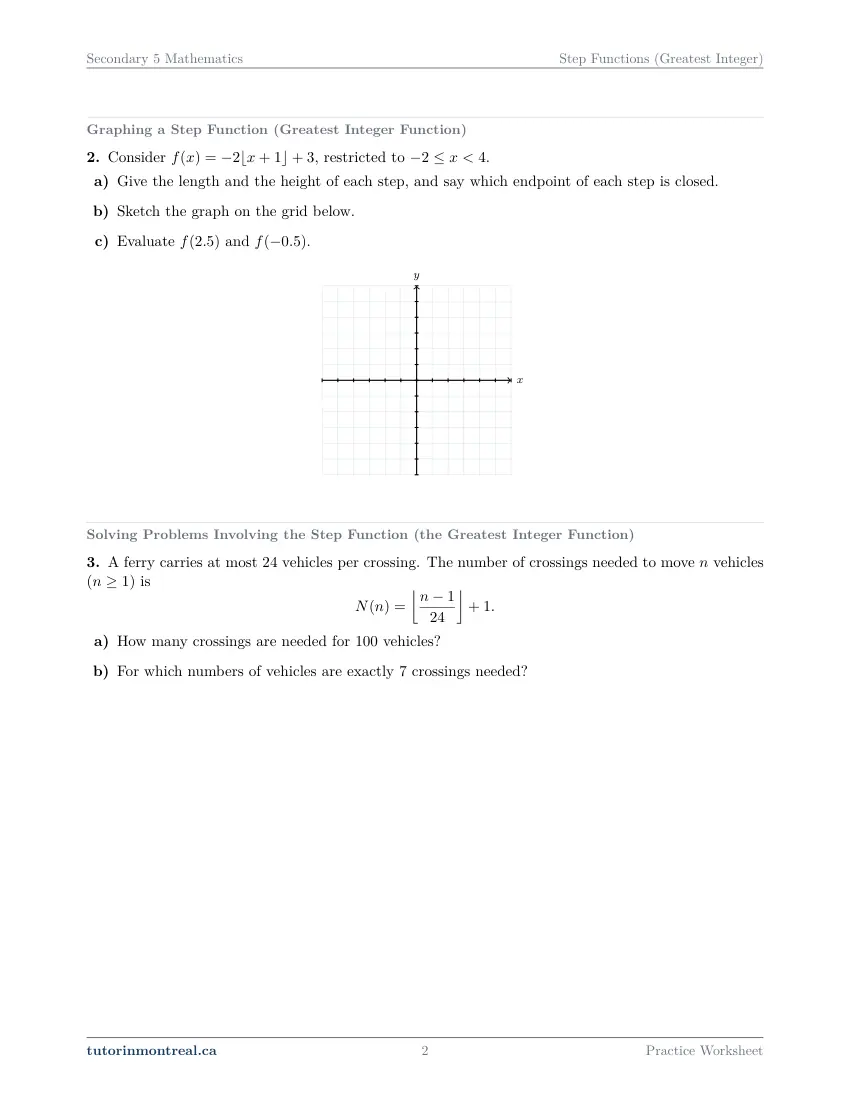
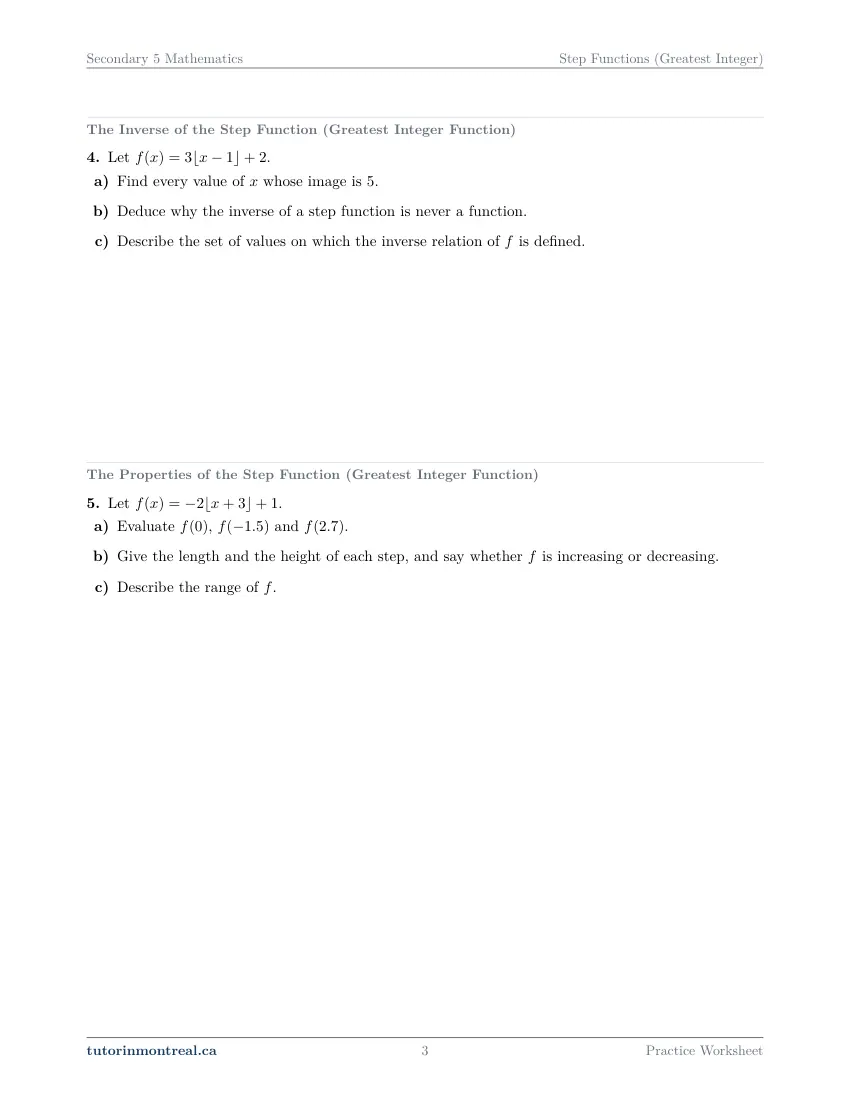
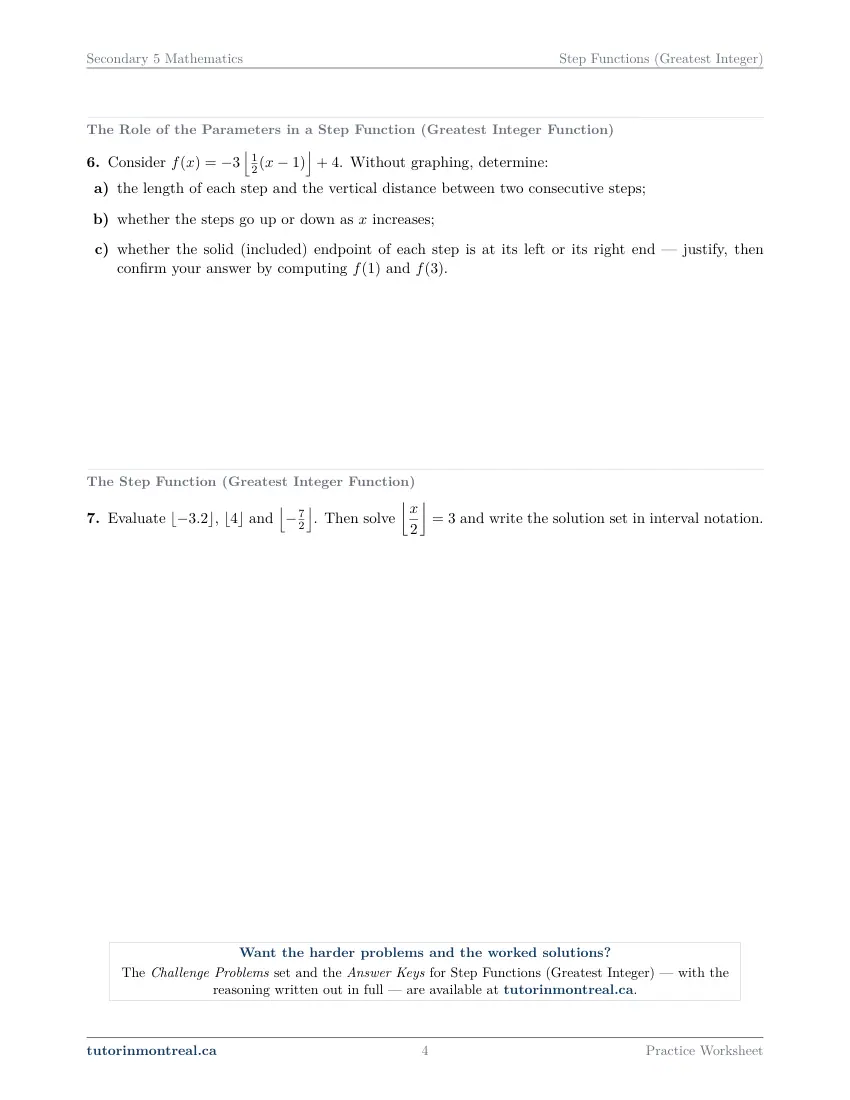
Preview all 4 pages
Click any page to open the full PDF.
Getting the most out of it
Do every negative bracket twice
Whenever a bracket's argument comes out negative, write the two integers on either side of it and pick the smaller one deliberately. Negative arguments are where nearly all lost marks on this topic live, and they turn up inside otherwise easy evaluation questions.
Write the double inequality before you touch x
On every floor equation, get to the line "n ≤ argument < n + 1" before doing any algebra on x. Once that line is on the page the rest is ordinary solving, and you cannot accidentally produce a single number as your answer.
Describe a graph in four sentences from memory
After Q6, cover the sheet and say the four facts about a staircase — length, height, direction, which dot is filled — and which parameter each comes from. Exams ask for those four in words far more often than they ask for a sketch.
Want the solutions, or something more challenging?
The worksheet, the questions above and every explanation on this page stay free permanently. Three more PDFs exist for this topic — the worked answer key, a harder problem set, and the answer key to that. They come with the Secondary 5 Math Solutions Bundle, which is what keeps the rest of the series free.
What else exists for Step Functions (Greatest Integer)
Three PDFs · 7 pages · all three are in the bundle below.
- Answer key — 2 pages. All 7 questions worked step by step, including the restrictions and the justifications. Not a list of final answers.
- Challenge problems — 3 pages, 5 problems. A separate sheet at exam-plus difficulty covering the same 7 concepts. Harder than anything on the free sheet.
- Challenge answer key — 2 pages. Every challenge problem worked to the same standard, with the checks shown.
- PDF, letter size, print-ready.
The one thing that's for sale
Every Secondary 5 Math topic — the complete Solutions Bundle
One download, one payment, the whole program. Every answer key and every challenge set for all 21 Secondary 5 Math worksheet sets — including this one.
- Worked solutions, not answer lists — every step written out
- Covers the whole year's program at this level
- Less than the price of one hour of tutoring — for the entire year's solutions
Taking Secondary 1 Math as well? The Secondary 1 Math bundle covers all 15 of its sets — 45 PDFs, 182 pages — on the same terms.
Taking Secondary 2 Math as well? The Secondary 2 Math bundle covers all 14 of its sets — 42 PDFs, 181 pages — on the same terms.
Taking Secondary 3 Math as well? The Secondary 3 Math bundle covers all 11 of its sets — 33 PDFs, 154 pages — on the same terms.
Taking Secondary 4 Math as well? The Secondary 4 Math bundle covers all 17 of its sets — 51 PDFs, 154 pages — on the same terms.
Taking CEGEP Calculus I as well? The CEGEP Calculus I bundle covers all 8 of its sets — 24 PDFs, 82 pages — on the same terms.
Taking CEGEP Calculus II as well? The CEGEP Calculus II bundle covers all 8 of its sets — 24 PDFs, 90 pages — on the same terms.
Taking CEGEP Linear Algebra as well? The CEGEP Linear Algebra bundle covers all 7 of its sets — 21 PDFs, 82 pages — on the same terms.
Taking AP Calculus AB as well? The AP Calculus AB bundle covers all 8 of its sets — 24 PDFs, 126 pages — on the same terms.
Common questions
Is this worksheet really free?
Yes — the questions are on this page to read, and the PDF downloads directly, no email and no account. The one paid item is optional: the complete Secondary 5 Solutions Bundle, which covers every set at this level.
Why is the greatest integer of −3.2 equal to −4?
Because the bracket takes the greatest integer that is less than or equal to the number, and −3 is greater than −3.2, so it is not allowed. Rounding down always means moving left on the number line. Truncating the decimals gives the right answer for positive numbers only.
How do I find the length and height of each step?
The length is 1 divided by the absolute value of b, because the argument of the bracket moves b times as fast as x. The height is the absolute value of a, because the bracket jumps by exactly 1 at each boundary and a multiplies that jump.
Which end of each step gets the filled dot?
The sign of b decides it, and it is the same for every step in the graph. A positive b means the steps are closed on the left and open on the right; a negative b reverses the input order, so they are closed on the right. The sign of a only flips the staircase vertically.
Why does a step function equation have infinitely many solutions?
Because a whole interval of inputs shares one output. Isolate the bracket, then use the fact that the floor of something equals n exactly when that something lies from n up to but not including n + 1. The solution is that interval, closed at the left end and open at the right.
How do I write the range of a step function?
As a discrete set, not an interval. The bracket takes every integer value, so the function takes the values a·n + k for integer n — evenly spaced, with a gap equal to the absolute value of a between consecutive values. Set-builder notation or a listing with dots is what is wanted.
Can teachers use this in class?
Yes. Print and photocopy it for your own classes freely — I just ask that the tutorinmontreal.ca footer stays on the page.
I'm stuck on one question. Can you help?
Yes — through one-on-one tutoring, in Montreal or online. Get in touch to arrange a session, or see the current rates.
← All 21 Secondary 5 Math worksheets · Secondary 1 Math series (15 sheets) → · Secondary 2 Math series (14 sheets) → · Secondary 3 Math series (11 sheets) → · Secondary 4 Math series (17 sheets) → · CEGEP Calculus I series (8 sheets) → · CEGEP Calculus II series (8 sheets) → · CEGEP Linear Algebra series (7 sheets) → · AP Calculus AB series (8 sheets) →
The same topic at the other level: Secondary 4 Math · Step Functions (Greatest Integer).