Secondary 5 Quadratic Functions Worksheet
The parabola from every angle Secondary 5 asks for — moving between general, vertex and factored form, completing the square, zeroes and what the discriminant predicts about them, range and intervals of variation, the job each of a, h and k performs, the inverse and the restriction it needs, and a modelling problem where the vertex is the answer. Each method is written out below the questions, and the PDF is free to print.
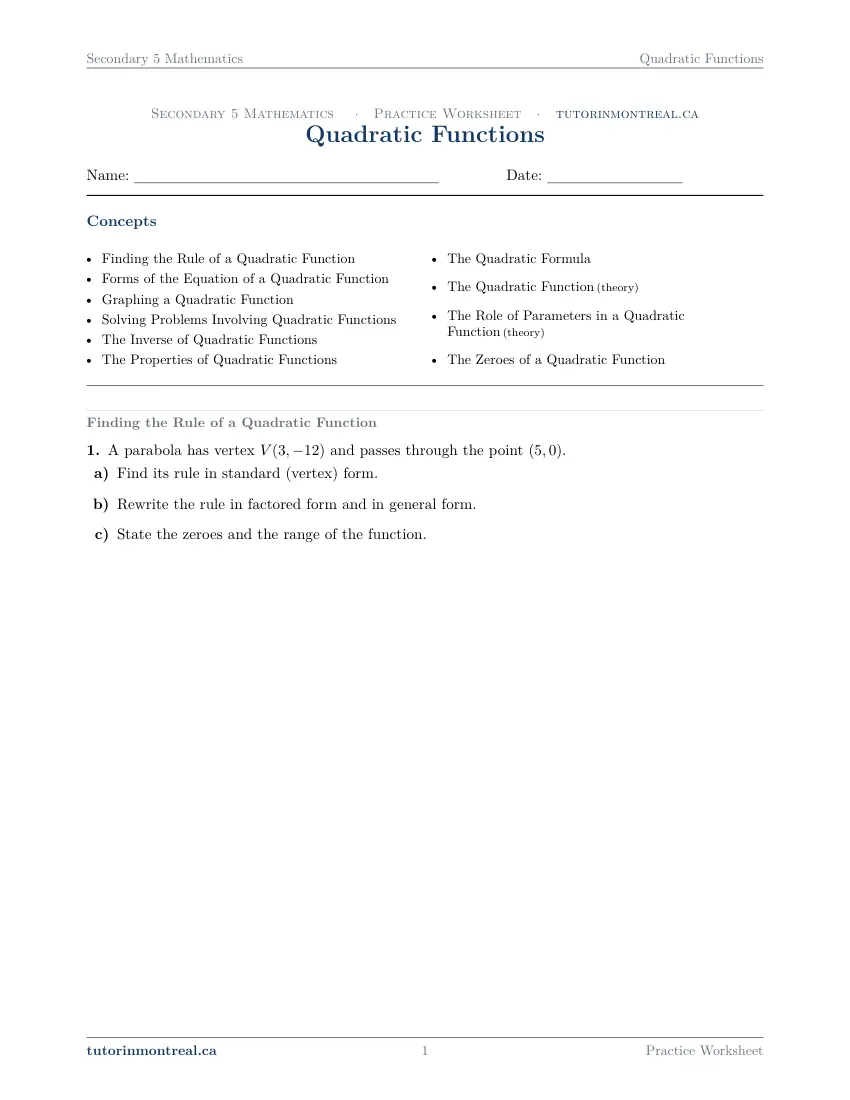
Practice worksheet — free PDF
No email, no account, no watermark. Teachers: photocopy it for your classes freely. Worked solutions and 10 harder problems come with the Secondary 5 Math bundle.
All 10 questions
Each question targets one named concept from the sheet. Read them here, or print the PDF — it has working space under each one.
-
Q1Finding the Rule of a Quadratic Function
A parabola has vertex and passes through the point .
- Find its rule in standard (vertex) form.
- Rewrite the rule in factored form and in general form.
- State the zeroes and the range of the function.
-
Q2Forms of the Equation of a Quadratic Function
Consider .
- Write in standard (vertex) form and state the vertex.
- Write in factored form and state the zeroes.
- Which of the three forms lets you read off the -intercept fastest, and what is it?
-
Q3Graphing a Quadratic Function
Consider .
- State the vertex, the axis of symmetry, the zeroes and the -intercept.
- Sketch the parabola on the grid below.
- Give the range of and the interval over which is decreasing.
A blank Cartesian grid for this question is on the printable PDF.
-
Q4Solving Problems Involving Quadratic Functions
The water jet of a fountain follows the curve , where is the horizontal distance from the nozzle and the height, both in metres.
- Find the maximum height of the jet and where it is reached.
- For which horizontal distances is the jet at least m high?
-
Q5The Inverse of Quadratic Functions
The function is restricted to the domain . Find the rule of and state its domain.
-
Q6The Properties of Quadratic Functions
Let . Give the coordinates of the vertex, the equation of the axis of symmetry, the zeroes, the extremum, the range, and the intervals over which is increasing and decreasing.
-
Q7The Quadratic Formula
Solve . Give the exact solutions, then a decimal approximation to the nearest hundredth.
-
Q8The Quadratic Function
Four rules are given below. State which ones define a quadratic function, and justify your decision in each case.
-
Q9The Role of Parameters in a Quadratic Function
A quadratic function is written with , and . Without choosing any numerical values, determine the quadrant containing the vertex, the number of zeroes of , and the range of . Justify each answer using the parameters alone.
-
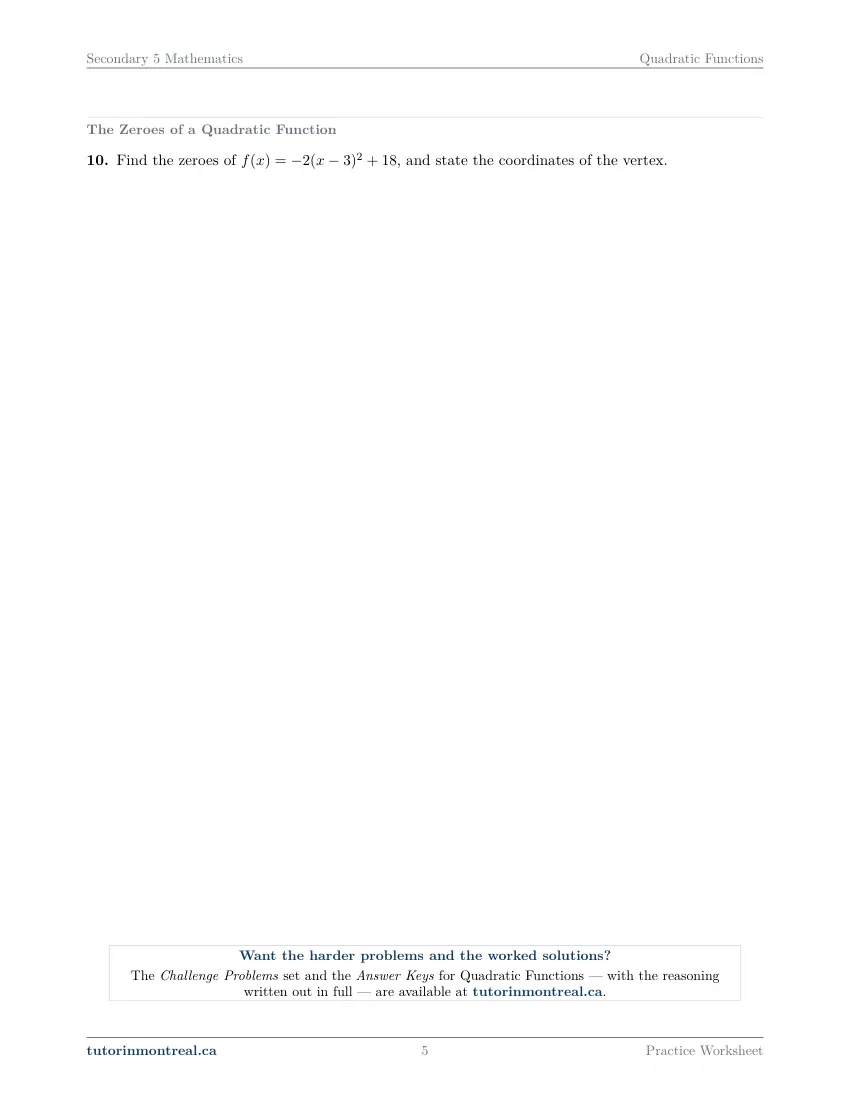
Q10The Zeroes of a Quadratic Function
Find the zeroes of , and state the coordinates of the vertex.
The 10 challenge problems for this topic are a separate, paid sheet and are not reproduced here.
Which stream is this for? This sheet is built for SN. It assumes you move between the three forms in both directions, complete the square when the leading coefficient is not 1, and can restrict a parabola so that its inverse is a function, and it goes to the depth that program expects.
How to do every concept on this sheet
This is the part worksheet sites usually leave out. Below is the actual reasoning behind each group of questions — not a full solution set, the decisions that get you to one. Read it before you start, or after you get stuck.
Three forms, and what each one hands you for free
Q2 asks which form gives a particular feature fastest, and that is the question behind the whole sheet. The three forms describe the same parabola; they differ only in what they let you read without doing any work.
General form, f(x) = ax² + bx + c — the constant term is the y-intercept, since f(0) = c. The vertex costs one computation, x = −b⁄2a.
Vertex (standard) form, f(x) = a(x − h)² + k — the vertex is (h, k) on sight, and with it the axis of symmetry, the extremum, the range and the two intervals of variation.
Factored form, f(x) = a(x − x₁)(x − x₂) — the zeroes are visible, and the vertex is halfway between them, since a parabola is symmetric about its axis.
Q1 walks you through all three for one parabola, which is the exercise worth repeating: given any one form, produce the other two. Note that only two of the three always exist — a parabola with no real zero has no factored form at all, while every parabola has a general and a vertex form.
Completing the square, including the case that goes wrong (Q1, Q2)
Converting from general to vertex form is the one genuinely technical manipulation on the sheet. Factor the leading coefficient out of the first two terms only, halve the coefficient of x inside the bracket, square it, then add and subtract it inside that bracket:
3x² + 12x + 5 = 3(x² + 4x) + 5 = 3[(x + 2)² − 4] + 5 = 3(x + 2)² − 7The mistake: subtracting the completing number outside the bracket without multiplying it by a. In the line above, the −4 sits inside a bracket that is multiplied by 3, so what actually leaves the bracket is −12, and the constant becomes 5 − 12 = −7. Write the intermediate line with the square brackets rather than doing it in your head, and the factor cannot be lost.
Two checks, either of which is enough. Expand your vertex form back to general form. Or substitute x = 0 into both: they must agree on the y-intercept.
Finding a rule from what you are given (Q1)
Choose the form that matches the information
Write down the form first, then substitute the extra point to find a. The value of a is never optional.
- 1A vertex and one other point → vertex form
Put the vertex into
a(x − h)² + k, substitute the point's coordinates, solve for a. This is Q1, and it is the most common exam version. - 2Two zeroes and one other point → factored form
Put the zeroes into
a(x − x₁)(x − x₂)and use the extra point for a. If instead of a point you are told the extremum, use the fact that the vertex sits at the midpoint of the zeroes. - 3Three arbitrary points → general form
Substituting each point into
ax² + bx + cgives three linear equations in a, b and c. Slower, and only necessary when neither the vertex nor the zeroes are known. - 4Then convert, and check
Whatever form the answer is wanted in, verify it against a point you were given rather than against your own algebra.
Zeroes, and how many there are (Q10, Q7)
From vertex form, isolate the square and take square roots — both of them. The ± is where the marks are:
a(x − h)² + k = 0 → (x − h)² = −k ⁄ a → x = h ± √(−k ⁄ a)From general form, use the quadratic formula, and read the discriminant before anything else: Δ = b² − 4ac. If Δ > 0 there are two distinct zeroes, if Δ = 0 there is one (a double zero, and the vertex sits on the x-axis), and if Δ < 0 there is none and the parabola stays entirely on one side of the axis.
Exact before approximate. Q7 asks for both, in that order. Simplify the radical and reduce the fraction — √40 = 2√10, and the common factor then cancels — before reaching for a decimal. An exact form that has not been simplified usually costs a mark, and a decimal written before simplification hides the fact that the two zeroes are symmetric about the axis.
The free check: the two zeroes must be equidistant from the axis of symmetry, so their average is the vertex abscissa, which is also −b⁄2a. Any pair of zeroes failing that test is wrong.
Reading every property off the rule (Q3, Q6)
Q6 asks for the full inventory in one go: vertex, axis of symmetry, zeroes, extremum, range, intervals of increase and decrease. They come in a fixed order, because each one feeds the next.
Vertex (h, k) → axis of symmetry is the vertical line x = h (an equation, not a number) → extremum is k, a maximum when a < 0 and a minimum when a > 0 → range is ]−∞, k] or [k, +∞[ accordingly → variation changes at x = h.
The mix-up worth drilling: the range is a set of y-values, while the intervals of increase and decrease are sets of x-values. They are both written as intervals, they both involve the vertex, and they are constantly swapped. The range is bounded by k; the intervals of variation are split at h, and by convention each of them includes h itself.
The y-intercept is not the same object as the zeroes: it is f(0), a single point on the vertical axis, whereas the zeroes are the values of x where f is 0. Q3 asks for both in the same breath precisely because they get confused.
What the parameters do (Q9)
Q9 gives no numbers at all — only the signs of a, h and k — and expects conclusions. That is a fair exam question because each parameter controls one thing:
a — its sign opens the parabola upward or downward and therefore decides maximum against minimum; its absolute value decides how narrow the curve is.
h — a horizontal translation, and the sign trap of the whole unit: (x − h) with h positive moves the curve to the right.
k — a vertical translation, and the height of the vertex.
Put together, the signs of h and k place the vertex in a quadrant, and the signs of a and k decide the number of zeroes without any computation: a downward parabola whose maximum is already below the axis can never reach it.
Is it even quadratic? (Q8)
A quadratic function is one that can be written ax² + bx + c with a ≠ 0, defined on all of ℝ. So the test is not "does an x² appear?" but "does an x² survive?" — expand first, and check whether the squared terms cancel. A missing bx term is fine; a missing or cancelled x² term is fatal. And an expression with the variable in a denominator is not a polynomial at all: its domain has a hole in it, so it fails on two counts.
The inverse of a parabola (Q5)
Swap x and y, then isolate y. Isolating means taking a square root, which produces ±, and the restriction stated in the question is what tells you which sign to keep: on the branch to the right of the vertex the quantity y − h is ≥ 0, so the positive root is the one that survives.
Why a restriction is needed at all. A parabola over ℝ takes almost every one of its values twice, at two points symmetric about the axis. Reflecting the whole curve in the line y = x therefore gives a sideways parabola, which assigns two images to a single x — a relation, not a function. Restricting f to one side of its vertex leaves a single branch, and its reflection is one branch of a square root function.
Domain and range swap. The domain of f⁻¹ is the range of f, and its range is the restricted domain of f. That is how the answer is checked: pick a point on f, reverse its coordinates, and confirm the reversed point satisfies f⁻¹.
The modelling question (Q4)
A jet of water is a parabola, and the two questions asked about it are the two questions always asked. "What is the maximum, and where?" is the vertex — found by completing the square, or faster here by averaging the two zeroes, since the rule factors on sight.
"For which values is the height at least 6 m?" is a second-degree inequality: bring everything to one side, factor, and take the region between the two roots, because the parabola opens downward and is therefore above the line only between its crossings. Finish in context — the answer is an interval of horizontal distances with a unit, and it must lie inside the stretch where the jet is actually in the air. An answer containing a negative distance means the interval was read from the wrong side of the roots.
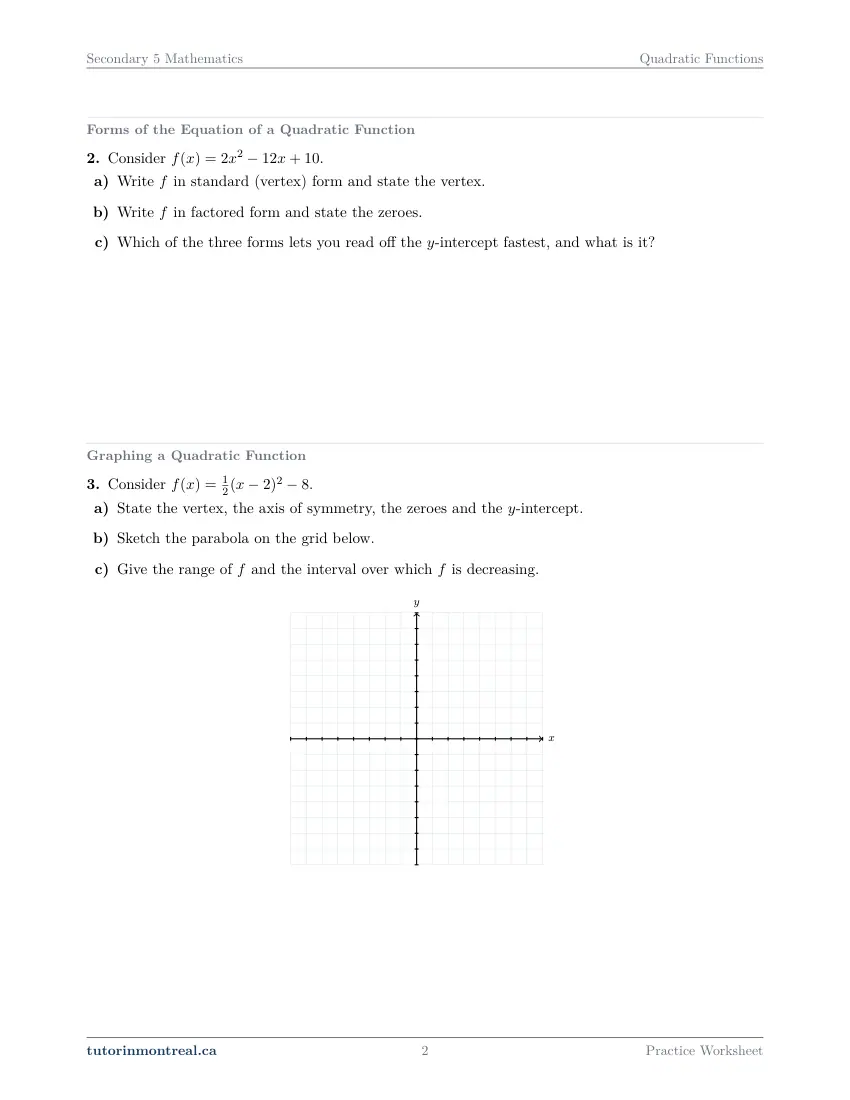
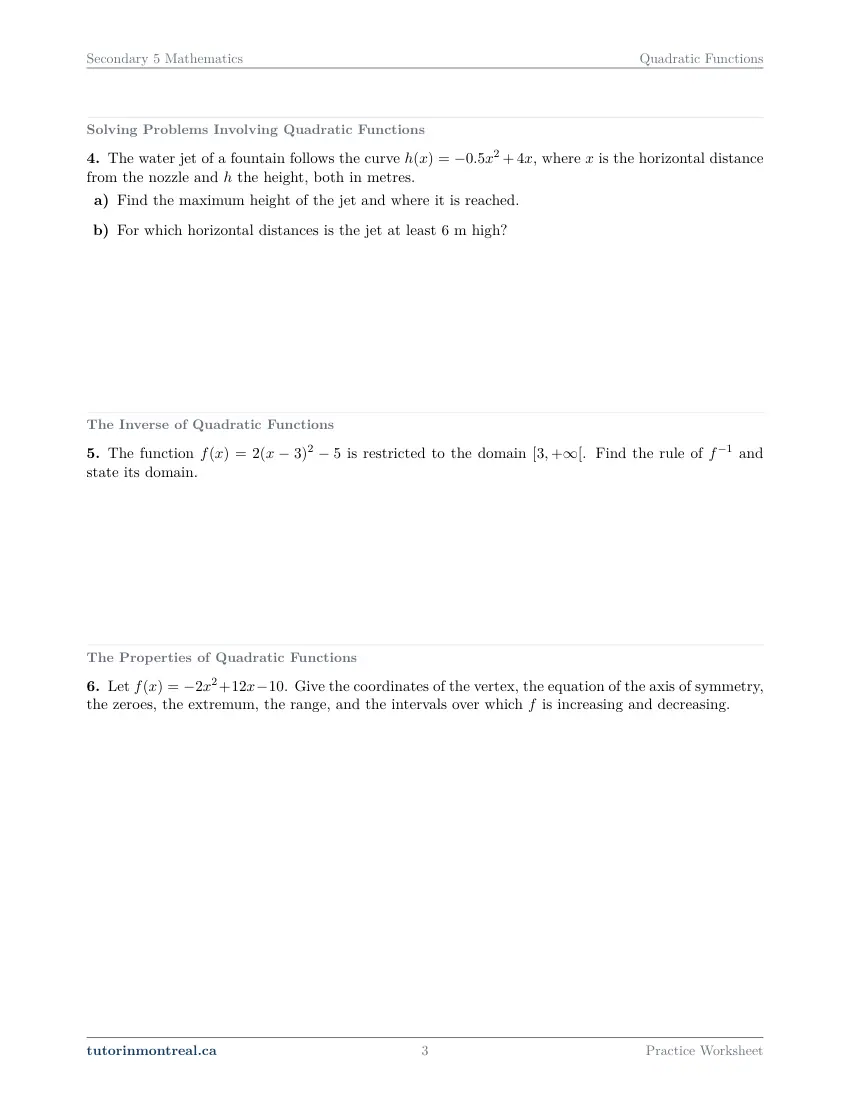
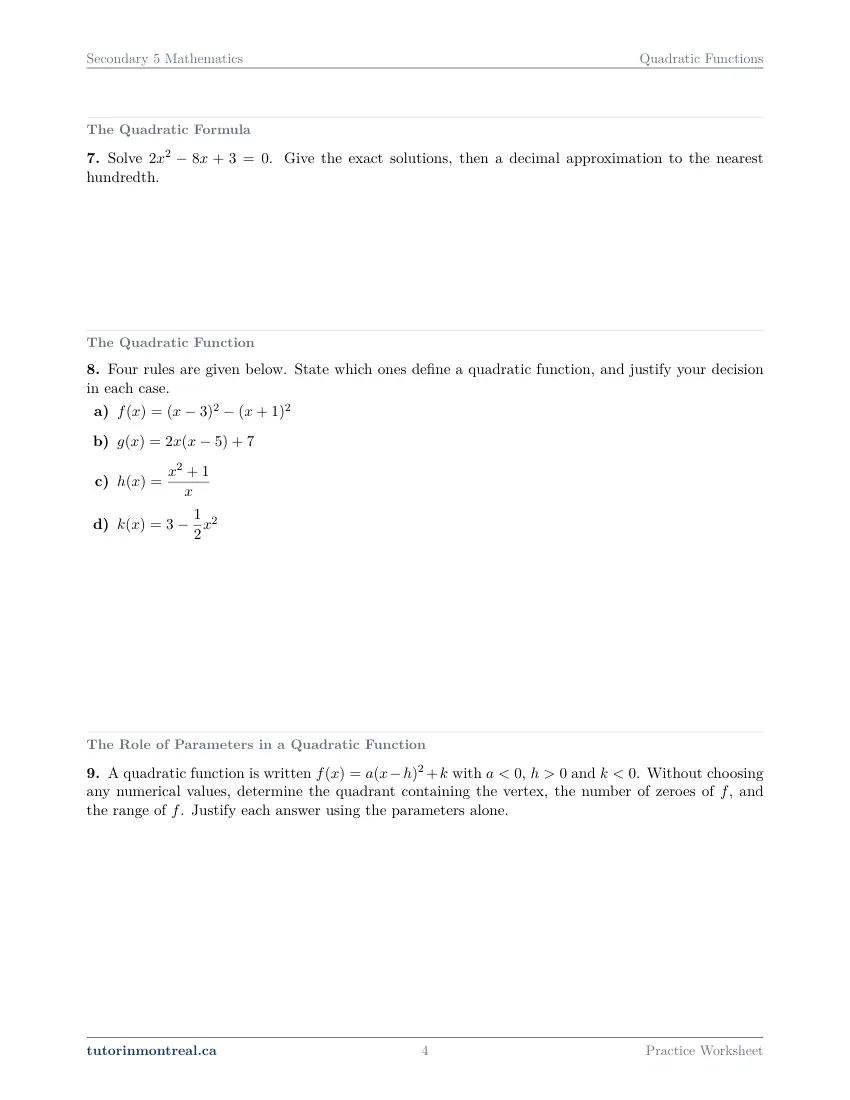
Preview all 5 pages
Click any page to open the full PDF.
Getting the most out of it
Sketch the parabola before answering anything about it
Vertex, direction of opening, and the two zeroes if they exist: thirty seconds of drawing makes the range, the variation and the sign of the function obvious, and it catches an impossible answer — a minimum above a zero, an interval of variation on the wrong side — before it is written down.
Convert one rule into all three forms, from memory
Take any rule on this sheet and produce the other two forms without looking back. Going from general to vertex form by completing the square is the direction that decays fastest, and it is the one every exam relies on.
Say what each interval is an interval of
Every time you write one, label it out loud: "range, so y-values" or "decreasing over, so x-values". This is the most frequent avoidable error in the whole unit, and naming the variable is what stops it.
Want the solutions, or something more challenging?
The worksheet, the questions above and every explanation on this page stay free permanently. Three more PDFs exist for this topic — the worked answer key, a harder problem set, and the answer key to that. They come with the Secondary 5 Math Solutions Bundle, which is what keeps the rest of the series free.
What else exists for Quadratic Functions
Three PDFs · 14 pages · all three are in the bundle below.
- Answer key — 2 pages. All 10 questions worked step by step, including the restrictions and the justifications. Not a list of final answers.
- Challenge problems — 8 pages, 10 problems. A separate sheet at exam-plus difficulty covering the same 10 concepts. Harder than anything on the free sheet.
- Challenge answer key — 4 pages. Every challenge problem worked to the same standard, with the checks shown.
- PDF, letter size, print-ready.
The one thing that's for sale
Every Secondary 5 Math topic — the complete Solutions Bundle
One download, one payment, the whole program. Every answer key and every challenge set for all 21 Secondary 5 Math worksheet sets — including this one.
- Worked solutions, not answer lists — every step written out
- Covers the whole year's program at this level
- Less than the price of one hour of tutoring — for the entire year's solutions
Taking Secondary 1 Math as well? The Secondary 1 Math bundle covers all 15 of its sets — 45 PDFs, 182 pages — on the same terms.
Taking Secondary 2 Math as well? The Secondary 2 Math bundle covers all 14 of its sets — 42 PDFs, 181 pages — on the same terms.
Taking Secondary 3 Math as well? The Secondary 3 Math bundle covers all 11 of its sets — 33 PDFs, 154 pages — on the same terms.
Taking Secondary 4 Math as well? The Secondary 4 Math bundle covers all 17 of its sets — 51 PDFs, 154 pages — on the same terms.
Taking CEGEP Calculus I as well? The CEGEP Calculus I bundle covers all 8 of its sets — 24 PDFs, 82 pages — on the same terms.
Taking CEGEP Calculus II as well? The CEGEP Calculus II bundle covers all 8 of its sets — 24 PDFs, 90 pages — on the same terms.
Taking CEGEP Linear Algebra as well? The CEGEP Linear Algebra bundle covers all 7 of its sets — 21 PDFs, 82 pages — on the same terms.
Taking AP Calculus AB as well? The AP Calculus AB bundle covers all 8 of its sets — 24 PDFs, 126 pages — on the same terms.
Common questions
Is this worksheet really free?
Yes — the questions are on this page to read, and the PDF downloads directly, no email and no account. The one paid item is optional: the complete Secondary 5 Solutions Bundle, which covers every set at this level.
Why does completing the square go wrong when a is not 1?
Because the number you add and subtract sits inside a bracket that is multiplied by a, so what leaves the bracket is that number times a. Factor a out of the first two terms only, complete the square inside the bracket, and keep the square brackets on the page until you have multiplied through.
How do I know how many zeroes a parabola has without solving it?
Compute the discriminant b² − 4ac: positive gives two zeroes, zero gives one double zero, negative gives none. From vertex form you can often skip even that — if a and k have the same sign, the curve never reaches the x-axis.
What is the difference between the range and the interval where the function decreases?
The range is a set of y-values, bounded by the extremum k. The intervals of increase and decrease are sets of x-values, split at the vertex abscissa h. Both are written as intervals and both mention the vertex, which is exactly why they get swapped.
Why does a quadratic function need a restricted domain to have an inverse?
Because over all of the reals it takes nearly every value twice, at two points symmetric about its axis. Reflecting it in the line y = x then gives two images for one x, which is not a function. Restrict it to one side of the vertex and the inverse becomes a single square root branch.
Which Secondary 5 stream is this for?
It is built for SN. The sheet expects you to move between the three forms in both directions, complete the square with any leading coefficient and handle the inverse of a restricted parabola, at the depth that program requires.
Can teachers use this in class?
Yes. Print and photocopy it for your own classes freely — I just ask that the tutorinmontreal.ca footer stays on the page.
I'm stuck on one question. Can you help?
Yes — through one-on-one tutoring, in Montreal or online. Get in touch to arrange a session, or see the current rates.
← All 21 Secondary 5 Math worksheets · Secondary 1 Math series (15 sheets) → · Secondary 2 Math series (14 sheets) → · Secondary 3 Math series (11 sheets) → · Secondary 4 Math series (17 sheets) → · CEGEP Calculus I series (8 sheets) → · CEGEP Calculus II series (8 sheets) → · CEGEP Linear Algebra series (7 sheets) → · AP Calculus AB series (8 sheets) →
The same topic at the other level: Secondary 4 Math · Quadratic Functions.