Secondary 5 Square Root Functions Worksheet
A full pass through the radical unit: locating the endpoint of the branch, deciding from the signs of a and b whether it opens left or right and climbs or falls, writing the domain and the half-line range, finding the zero and the sign intervals, judging whether a y-intercept exists at all, and inverting the function into a restricted parabola. The four sign combinations are worth memorising, and the explanations below lay them out. Free to print, no sign-up.
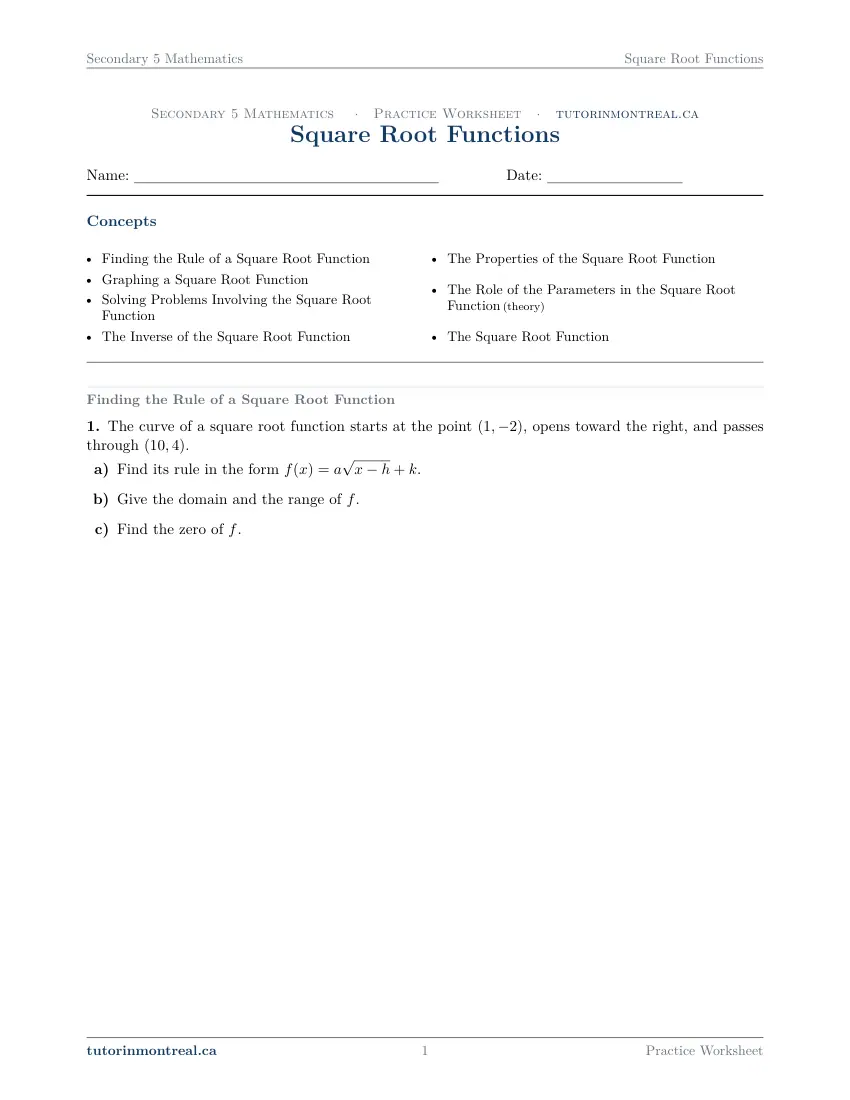
Practice worksheet — free PDF
No email, no account, no watermark. Teachers: photocopy it for your classes freely. Worked solutions and 6 harder problems come with the Secondary 5 Math bundle.
All 7 questions
Each question targets one named concept from the sheet. Read them here, or print the PDF — it has working space under each one.
-
Q1Finding the Rule of a Square Root Function
The curve of a square root function starts at the point , opens toward the right, and passes through .
- Find its rule in the form .
- Give the domain and the range of .
- Find the zero of .
-
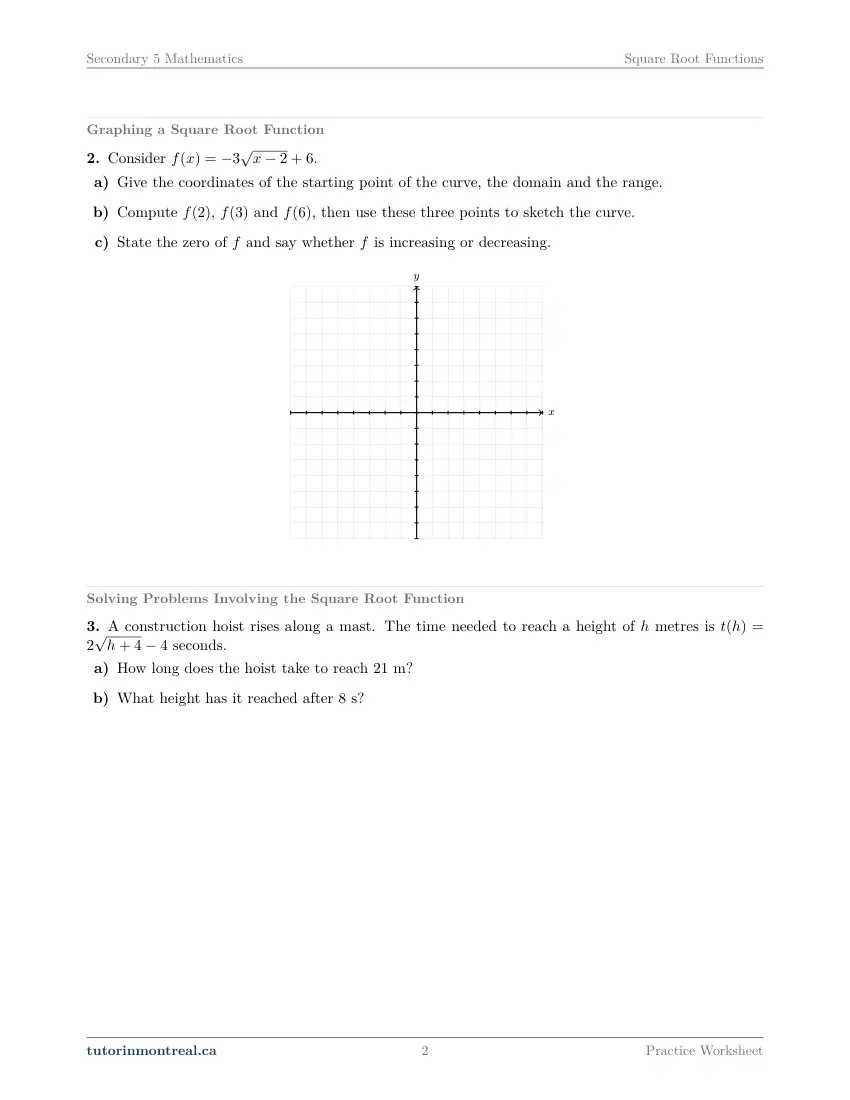
Q2Graphing a Square Root Function
Consider .
- Give the coordinates of the starting point of the curve, the domain and the range.
- Compute , and , then use these three points to sketch the curve.
- State the zero of and say whether is increasing or decreasing.
-
Q3Solving Problems Involving the Square Root Function
A construction hoist rises along a mast. The time needed to reach a height of metres is seconds.
- How long does the hoist take to reach m?
- What height has it reached after s?
-
Q4The Inverse of the Square Root Function
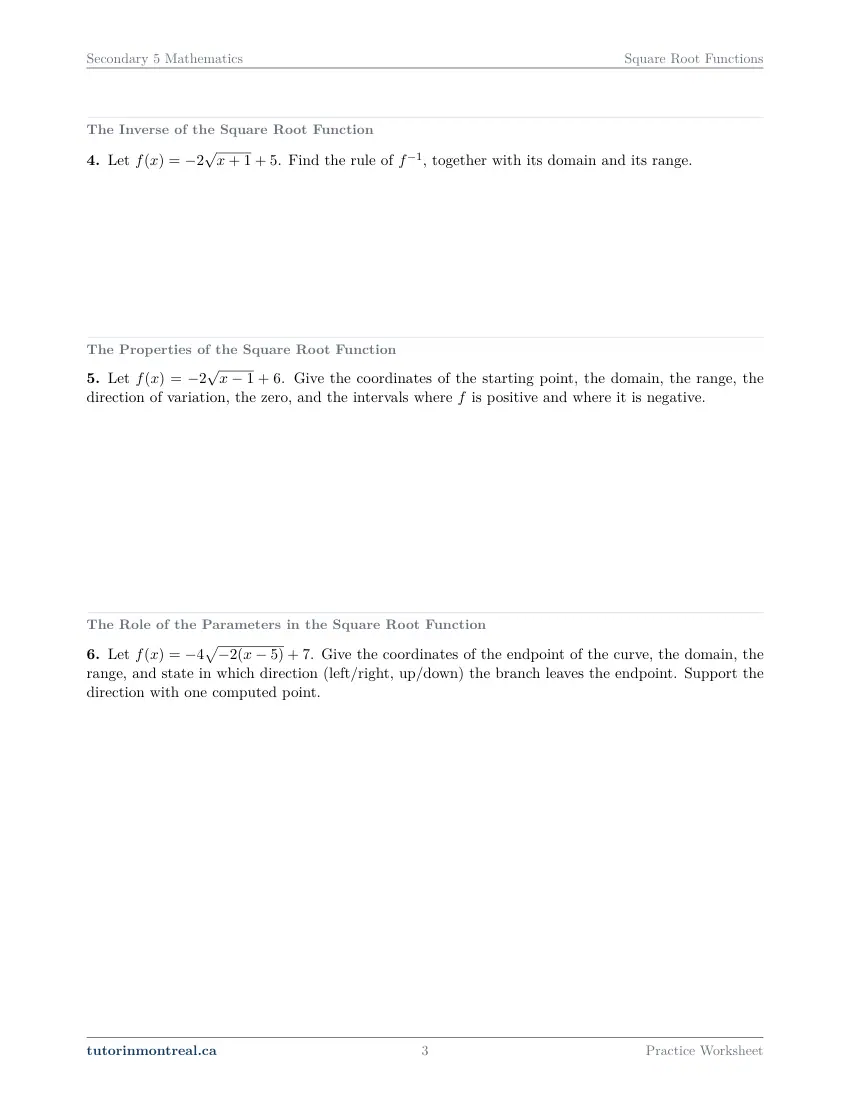
Let . Find the rule of , together with its domain and its range.
-
Q5The Properties of the Square Root Function
Let . Give the coordinates of the starting point, the domain, the range, the direction of variation, the zero, and the intervals where is positive and where it is negative.
-
Q6The Role of the Parameters in the Square Root Function
Let . Give the coordinates of the endpoint of the curve, the domain, the range, and state in which direction (left/right, up/down) the branch leaves the endpoint. Support the direction with one computed point.
-
Q7The Square Root Function
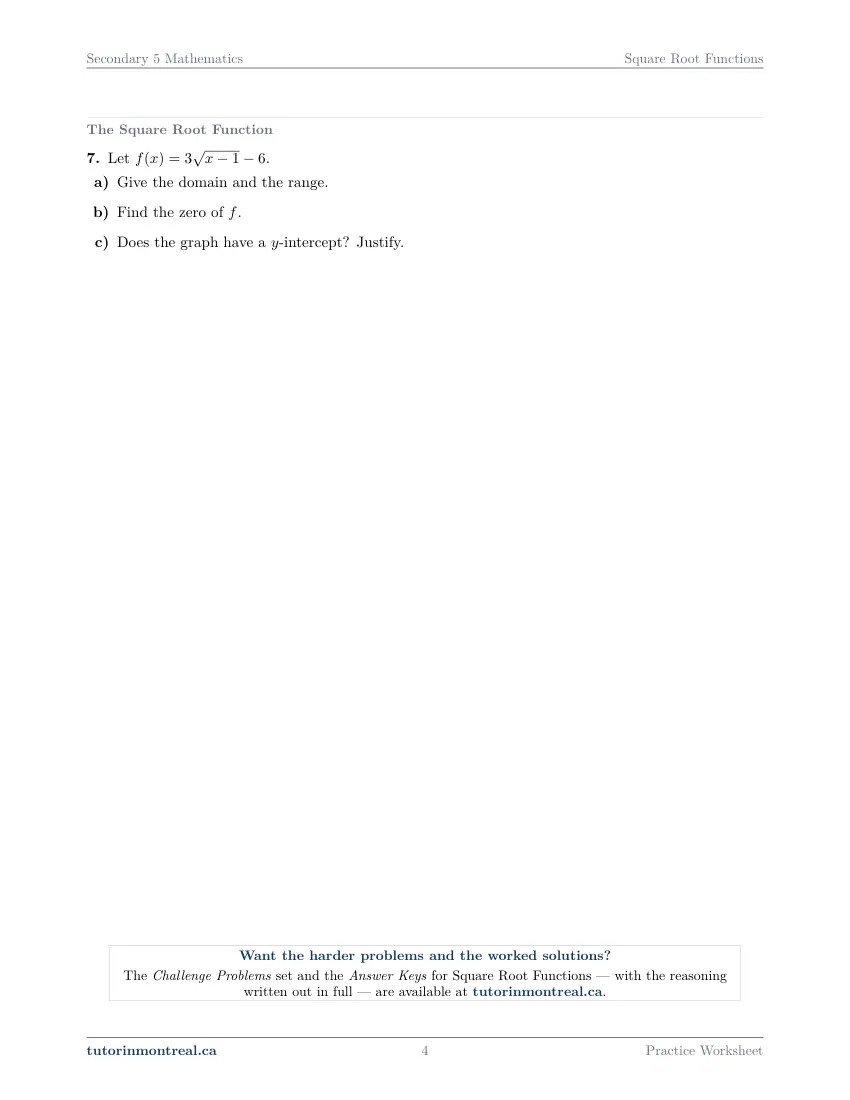
Let .
- Give the domain and the range.
- Find the zero of .
- Does the graph have a -intercept? Justify.
The 6 challenge problems for this topic are a separate, paid sheet and are not reproduced here.
Which stream is this for? This sheet is built for SN. It assumes you work with the full form a√(b(x − h)) + k including a coefficient inside the radical, write domains and ranges in interval notation, and construct inverses with their restrictions, and it goes to the depth that program expects.
How to do every concept on this sheet
This is the part worksheet sites usually leave out. Below is the actual reasoning behind each group of questions — not a full solution set, the decisions that get you to one. Read it before you start, or after you get stuck.
Two signs, two independent jobs
Every question on this sheet is governed by the same rule shape:
f(x) = a √( b(x − h) ) + kThe branch starts at the endpoint (h, k), which is the one point where the radical is zero, and from there it goes in exactly one of four directions. Which one is decided by two signs that do not interfere with each other:
b decides left or right. The radicand must be non-negative, so b(x − h) ≥ 0. A positive b forces x ≥ h and the branch is drawn to the right of the endpoint; a negative b forces x ≤ h and it is drawn to the left. This is the domain.
a decides up or down. A square root is never negative, so a·√(…) keeps the sign of a forever. A positive a sends the branch up from k, a negative a sends it down. This is the range.
The mistake worth naming: deciding the direction of opening from the sign of a. It does not touch the domain. a multiplies the output of the radical, so it can only move points vertically; the set of x values that are even allowed was settled by b before a got involved. In Q6 both parameters are negative — the branch opens left and falls — and the question asks for those two facts separately on purpose.
Reading any radical rule, in order
Five lines that answer Q2(a), Q5, Q6 and Q7(a) before you have solved anything.
- 1Factor b out of the radicand first
Read h only once the radicand is in the shape
b(x − h). From√(−2x + 8)you must factor to√(−2(x − 4)), so h is 4 — reading 8 off the constant term is only legitimate when the coefficient is 1. Q6 hands you the factored form already; an exam often will not. - 2Endpoint = (h, k)
Set the radicand to zero; that is the only x where the radical contributes nothing, so the value there is k. It is a genuine endpoint, not an asymptote — the curve reaches it and stops.
- 3Domain: solve radicand ≥ 0
The bracket at h is closed, because √0 exists and equals 0. So the domain is
[h, +∞[or]−∞, h]— square at the endpoint, reversed at infinity. - 4Range: a half-line starting at k
[k, +∞[when a > 0,]−∞, k]when a < 0, always closed at k since the endpoint is attained. It is never all of ℝ, and never a bounded interval. - 5Variation: one direction, the whole way
A radical branch never turns. It is increasing on its entire domain or decreasing on its entire domain, so k is a genuine minimum or maximum and there is at most one zero.
Why the range can never be all the reals
This is worth being able to argue, because it is the kind of justification an exam asks for in words. The radical symbol denotes the principal square root, which is non-negative by definition. So √(b(x − h)) ≥ 0 for every admissible x. Multiplying by a gives a quantity that is entirely ≥ 0 or entirely ≤ 0 depending on the sign of a, and adding k then places every value of the function on one side of k. The values are trapped in a half-line, whatever the parameters do.
Finding the rule from an endpoint and one point (Q1)
The endpoint hands you h and k at once, so a single further point fixes the last unknown. Substitute it, evaluate the radical to a plain number, and solve the one-step equation:
a √(10 − 1) − 2 = 4 ⟹ 3a = 6 ⟹ a = 2Notice the numbers were chosen so the radicand is a perfect square — that is true of every point a well-set question gives you, and it is a useful sanity check: if the radical is not coming out whole, you have probably read h wrongly.
When a question describes the curve in words instead, translate each phrase into a sign before computing anything. "Opens toward the right" means b > 0; a range with a highest value means a < 0; a given point sitting to the left of the endpoint means b < 0. Also worth knowing: a and b cannot both be recovered from a graph, since √(b(x − h)) can always be rewritten as √|b| · √(±(x − h)), folding the size of b into a. Only the sign of b carries information a graph can see, which is why questions fix b at ±1 by convention.
Finding the zero: isolate, then square
Q1(c), Q2(c), Q5 and Q7(b) all run the same three steps. Move k across, divide by a so the radical is alone, then square both sides.
Squaring is only safe when the radical is alone and the other side is non-negative. Squaring −2√(x − 1) + 6 = 0 in place, before isolating, gives a completely different equation. Isolate first, then look at what the radical equals: if it is a negative number, there is no zero, and that is the answer — the branch simply never reaches the x-axis. This happens whenever a and k have the same sign, since the branch then leaves k travelling away from the axis.
Because a radical branch is monotone, there is never more than one zero. Two answers to a zero question means an error, usually a stray ± introduced by squaring.
Sign intervals, and the bracket that is different here (Q5)
Since the function is monotone and has at most one zero, the sign question needs no table: the domain splits into exactly two pieces at the zero, and the direction of variation says which piece is positive.
The detail that separates this family from the rational and logarithmic ones is the bracket at the endpoint. The endpoint is in the domain, so the interval touching it is closed there. For a decreasing branch with endpoint at x = h and zero at x = z, the function is positive on [h, z[ and negative on ]z, +∞[ — square bracket at h, reversed at z because the function is zero rather than positive there. Writing ]h, z[ out of habit loses a mark for a point that genuinely exists.
Does a y-intercept even exist? (Q7)
Q7(c) looks like a trick and is not: it is checking that you know the domain constrains what you are allowed to substitute. A y-intercept requires x = 0 to be in the domain. For a branch that starts at x = 1 and opens right, zero is simply not available, so there is no y-intercept and the justification is the domain, stated explicitly.
This is a habit worth generalising: before evaluating f at any value, confirm the value is in the domain. Every other function family on the Secondary 5 course accepts 0 or tells you loudly when it does not; a radical quietly produces a negative radicand and a calculator error.
Sketching a branch (Q2)
Mark the endpoint, then pick x values that make the radicand a perfect square — 1, 4, 9, 16 units from the endpoint, which give radicals of 1, 2, 3, 4. That is why Q2 names f(2), f(3) and f(6): they land on the endpoint and on radicands of 1 and 4.
Then draw a curve that leaves the endpoint steeply and flattens as it goes, because each further unit of radicand adds less to the root than the one before. Three things markers check: the curve must stop dead at the endpoint with nothing drawn beyond it, it must curve rather than run straight, and there must be only one branch. A shape symmetric about a vertical axis is a parabola, not a square root function.
Radical models in context (Q3)
Square root models describe quantities with diminishing returns — each extra metre of height in Q3 costs less additional time than the previous one, which is what makes the graph flatten. Part (a) is a substitution chosen to give a perfect square. Part (b) reverses the model and is the isolate-and-square method again.
Two context habits. Read what the variable actually stands for before answering: in Q3 the input is a height and the output is a time, so "after 8 s" is a value of the output and the question is asking you to work backwards. And check the answer sits in the model's domain — a negative height or a time before the start is a value the algebra will happily produce and the situation will not accept.
The inverse is half a parabola (Q4)
Swap x and y, isolate the radical, and square. Squaring is what turns a radical into a quadratic, so the inverse of a square root function is a parabola rule — and here is the part that carries the marks: only half of that parabola is the inverse.
The restriction is not optional; it is part of the function. The domain of f−1 is the range of f, which was a half-line, so the parabola rule is kept only on that half-line. Written without its restriction, the rule describes a full parabola, which fails the definition of a function's inverse because it would send two inputs of f−1 back to the same place. Q4 asks for the domain and the range alongside the rule for exactly this reason.
Practical route: write down the domain and range of f before you start inverting, then swap them. That way the restriction is already on the page when you finish the algebra, rather than being remembered afterwards.
A single numerical check closes the question: evaluate f at a convenient input, feed the result into your f−1, and you should return to the input you started from.
Preview all 4 pages
Click any page to open the full PDF.
Getting the most out of it
Say the two signs out loud before touching the algebra
On each question, state "b is negative, so it opens left" and "a is negative, so it falls" before you compute anything. Those two sentences produce the domain, the range, the variation and the shape of the sketch, and separating them is what stops the classic mix-up.
Factor the radicand, every single time
Even when the coefficient inside is already 1, write the radicand as b(x − h) explicitly. It costs one line and it makes the endpoint impossible to misread on the day a question hands you an unfactored radicand instead.
Choose your own points to be perfect squares
When a question lets you pick where to evaluate, pick values 1, 4, 9 or 16 units from the endpoint. Exact coordinates make a sketch accurate and make an arithmetic slip visible immediately — if a root is not coming out whole, check h before you check your calculator.
Want the solutions, or something more challenging?
The worksheet, the questions above and every explanation on this page stay free permanently. Three more PDFs exist for this topic — the worked answer key, a harder problem set, and the answer key to that. They come with the Secondary 5 Math Solutions Bundle, which is what keeps the rest of the series free.
What else exists for Square Root Functions
Three PDFs · 8 pages · all three are in the bundle below.
- Answer key — 2 pages. All 7 questions worked step by step, including the restrictions and the justifications. Not a list of final answers.
- Challenge problems — 4 pages, 6 problems. A separate sheet at exam-plus difficulty covering the same 7 concepts. Harder than anything on the free sheet.
- Challenge answer key — 2 pages. Every challenge problem worked to the same standard, with the checks shown.
- PDF, letter size, print-ready.
The one thing that's for sale
Every Secondary 5 Math topic — the complete Solutions Bundle
One download, one payment, the whole program. Every answer key and every challenge set for all 21 Secondary 5 Math worksheet sets — including this one.
- Worked solutions, not answer lists — every step written out
- Covers the whole year's program at this level
- Less than the price of one hour of tutoring — for the entire year's solutions
Taking Secondary 1 Math as well? The Secondary 1 Math bundle covers all 15 of its sets — 45 PDFs, 182 pages — on the same terms.
Taking Secondary 2 Math as well? The Secondary 2 Math bundle covers all 14 of its sets — 42 PDFs, 181 pages — on the same terms.
Taking Secondary 3 Math as well? The Secondary 3 Math bundle covers all 11 of its sets — 33 PDFs, 154 pages — on the same terms.
Taking Secondary 4 Math as well? The Secondary 4 Math bundle covers all 17 of its sets — 51 PDFs, 154 pages — on the same terms.
Taking CEGEP Calculus I as well? The CEGEP Calculus I bundle covers all 8 of its sets — 24 PDFs, 82 pages — on the same terms.
Taking CEGEP Calculus II as well? The CEGEP Calculus II bundle covers all 8 of its sets — 24 PDFs, 90 pages — on the same terms.
Taking CEGEP Linear Algebra as well? The CEGEP Linear Algebra bundle covers all 7 of its sets — 21 PDFs, 82 pages — on the same terms.
Taking AP Calculus AB as well? The AP Calculus AB bundle covers all 8 of its sets — 24 PDFs, 126 pages — on the same terms.
Common questions
Is this worksheet really free?
Yes — the questions are on this page to read, and the PDF downloads directly, no email and no account. The one paid item is optional: the complete Secondary 5 Solutions Bundle, which covers every set at this level.
Which parameter decides whether the branch opens left or right?
The sign of b, the coefficient inside the radical. The radicand has to be non-negative, so a positive b forces x to be at least h and the branch goes right, while a negative b forces x to be at most h and it goes left. The sign of a only decides whether the branch rises or falls.
Why is the bracket closed at the endpoint but reversed at infinity?
Because the endpoint is a value the function actually attains — the square root of zero is zero, so f(h) exists and equals k. Infinity is never reached, so it always takes a reversed bracket. That gives domains like [h, +∞[ and ranges like ]−∞, k].
Can a square root function have no zero?
Yes. Isolate the radical, and if it has to equal a negative number there is no solution, because a principal square root is never negative. That happens whenever the branch leaves its endpoint travelling away from the x-axis, and stating that is the full answer.
Why does the graph sometimes have no y-intercept?
Because a y-intercept needs x = 0 to be in the domain, and a radical branch only covers one side of its endpoint. If the branch starts to the right of the y-axis, or to the left of it in the mirrored case, the value f(0) simply does not exist.
Why does the inverse have to be a restricted parabola?
Squaring turns the radical into a quadratic rule, but only the half of that parabola matching the range of the original function is the inverse. Written without its restriction the rule describes the whole parabola, which is not a function's inverse, so the domain has to be stated alongside the rule.
Can teachers use this in class?
Yes. Print and photocopy it for your own classes freely — I just ask that the tutorinmontreal.ca footer stays on the page.
I'm stuck on one question. Can you help?
Yes — through one-on-one tutoring, in Montreal or online. Get in touch to arrange a session, or see the current rates.
← All 21 Secondary 5 Math worksheets · Secondary 1 Math series (15 sheets) → · Secondary 2 Math series (14 sheets) → · Secondary 3 Math series (11 sheets) → · Secondary 4 Math series (17 sheets) → · CEGEP Calculus I series (8 sheets) → · CEGEP Calculus II series (8 sheets) → · CEGEP Linear Algebra series (7 sheets) → · AP Calculus AB series (8 sheets) →
The same topic at the other level: Secondary 4 Math · Square Root Functions.