Secondary 5 Analytic Geometry Worksheet
Two halves in one sheet. The conics first — circle, ellipse, parabola and hyperbola written in standard form and read for centre, vertices, foci and asymptotes, then intersected with a line — and after them the transformations of the plane: translations, reflections, rotations, dilations, and what changes when you compose them in the other order. Have a read before you print; the PDF is free and asks nothing of you.
Practice worksheet — free PDF
No email, no account, no watermark. Teachers: photocopy it for your classes freely. Worked solutions and 17 harder problems come with the Secondary 5 Math bundle.
All 16 questions
Each question targets one named concept from the sheet. Read them here, or print the PDF — it has working space under each one.
-
Q1Analytic Geometry
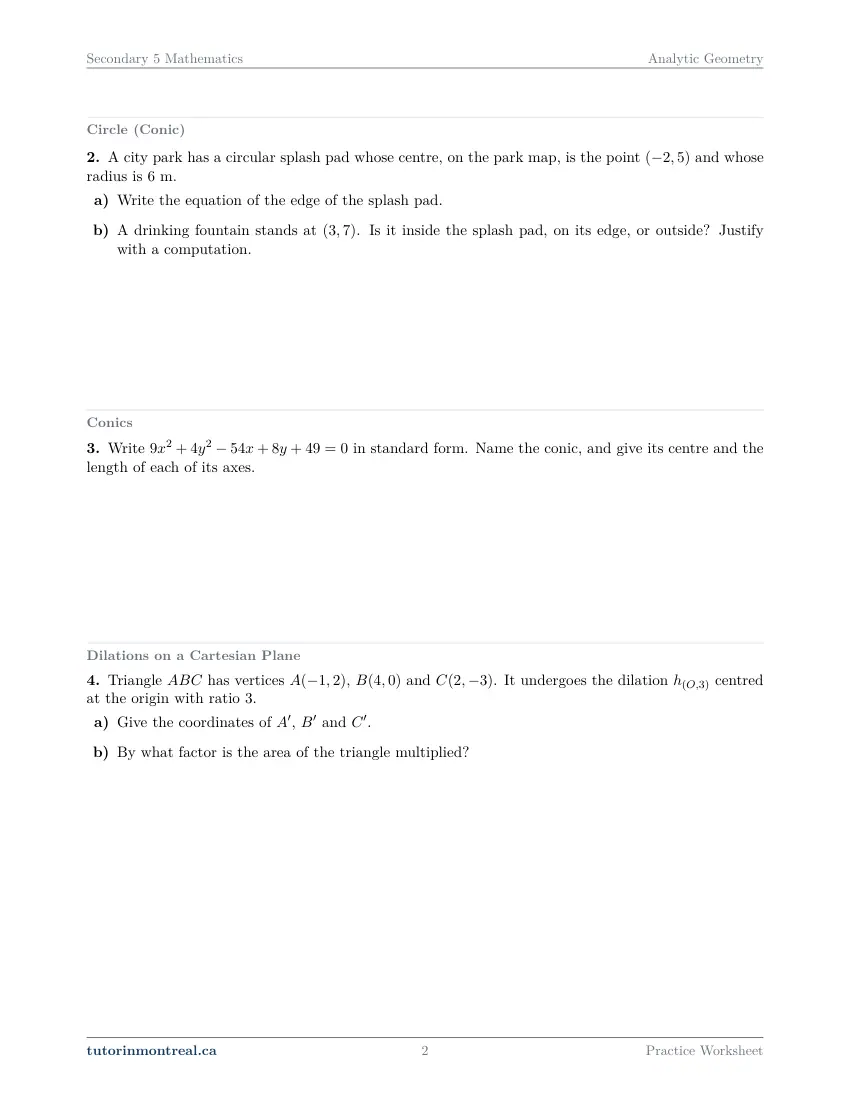
Analytic geometry describes a geometric object by an equation on the Cartesian plane. For each equation below, name the curve it represents (line, circle, ellipse, parabola or hyperbola) and give the one feature of the equation that settles your choice.
-
Q2Circle (Conic)
A city park has a circular splash pad whose centre, on the park map, is the point and whose radius is ~m.
- Write the equation of the edge of the splash pad.
- A drinking fountain stands at . Is it inside the splash pad, on its edge, or outside? Justify with a computation.
-
Q3Conics
Write in standard form. Name the conic, and give its centre and the length of each of its axes.
-
Q4Dilations on a Cartesian Plane
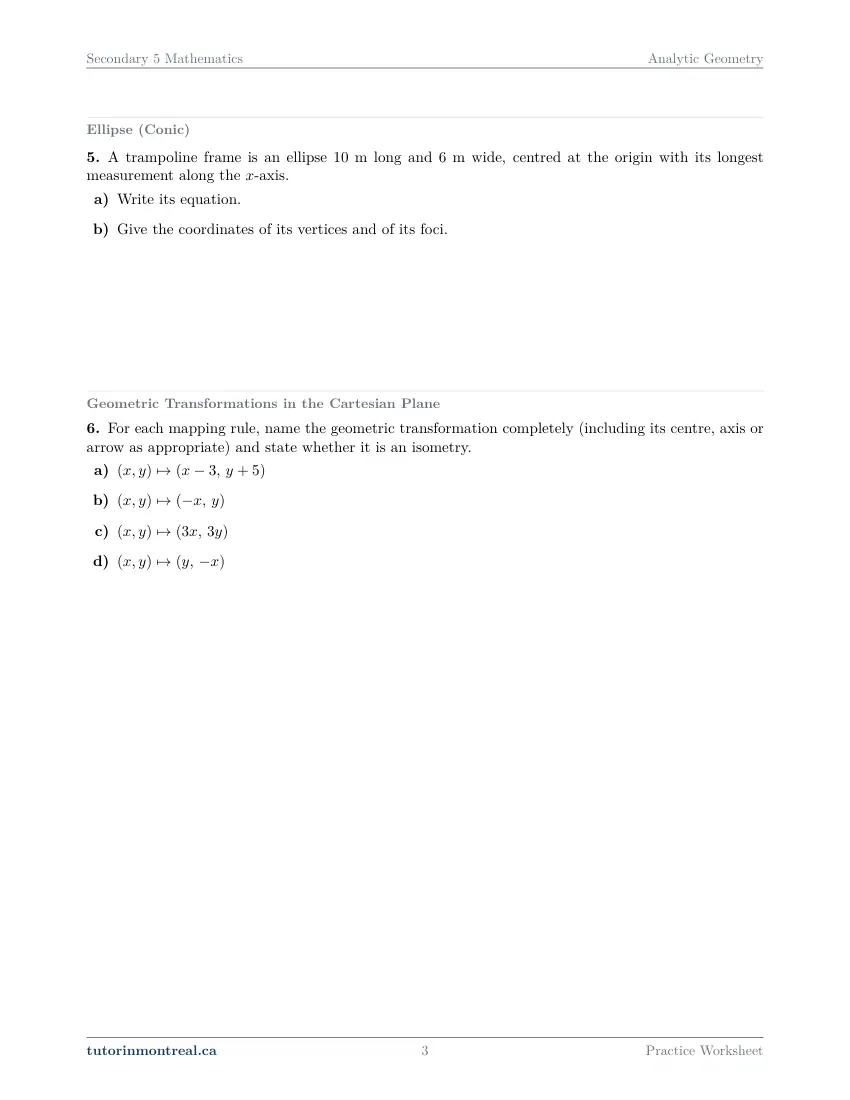
Triangle has vertices , and . It undergoes the dilation centred at the origin with ratio .
- Give the coordinates of , and .
- By what factor is the area of the triangle multiplied?
-
Q5Ellipse (Conic)
A trampoline frame is an ellipse ~m long and ~m wide, centred at the origin with its longest measurement along the -axis.
- Write its equation.
- Give the coordinates of its vertices and of its foci.
-
Q6Geometric Transformations in the Cartesian Plane
For each mapping rule, name the geometric transformation completely (including its centre, axis or arrow as appropriate) and state whether it is an isometry.
-
Q7Hyperbola (Conic)
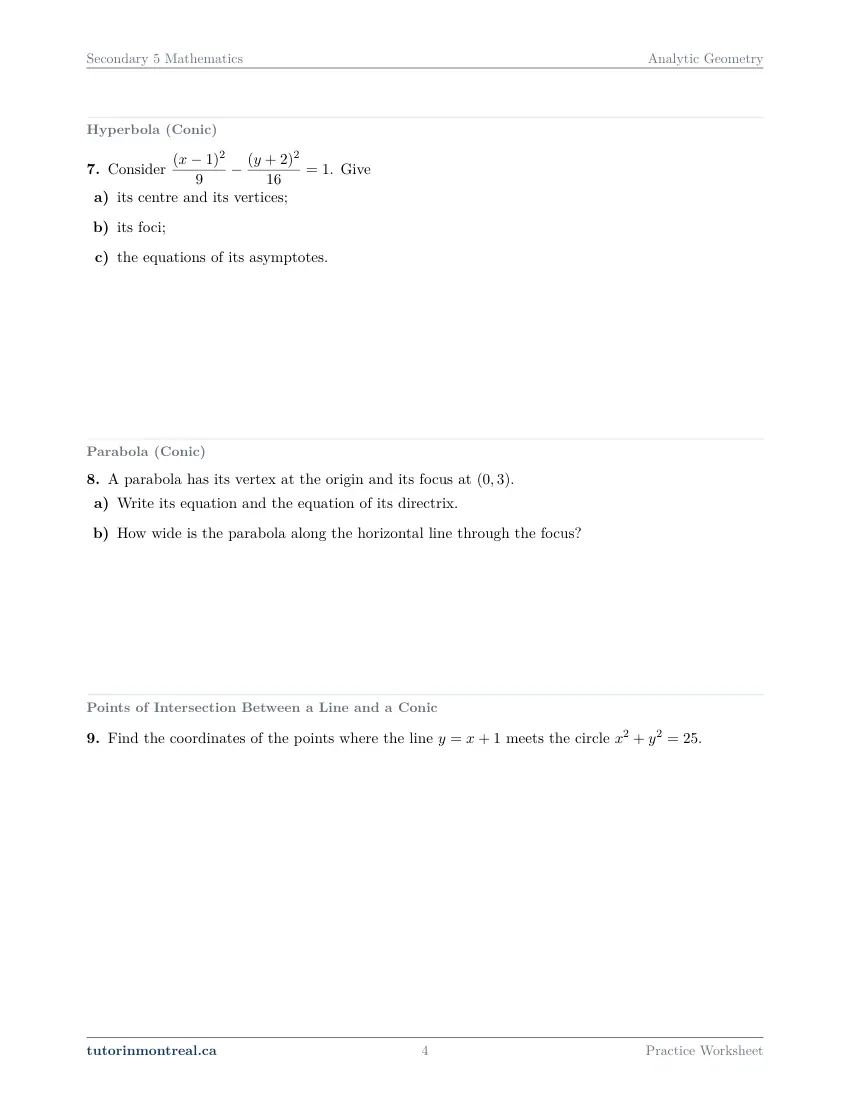
Consider . Give
- its centre and its vertices;
- its foci;
- the equations of its asymptotes.
-
Q8Parabola (Conic)
A parabola has its vertex at the origin and its focus at .
- Write its equation and the equation of its directrix.
- How wide is the parabola along the horizontal line through the focus?
-
Q9Points of Intersection Between a Line and a Conic
Find the coordinates of the points where the line meets the circle .
-
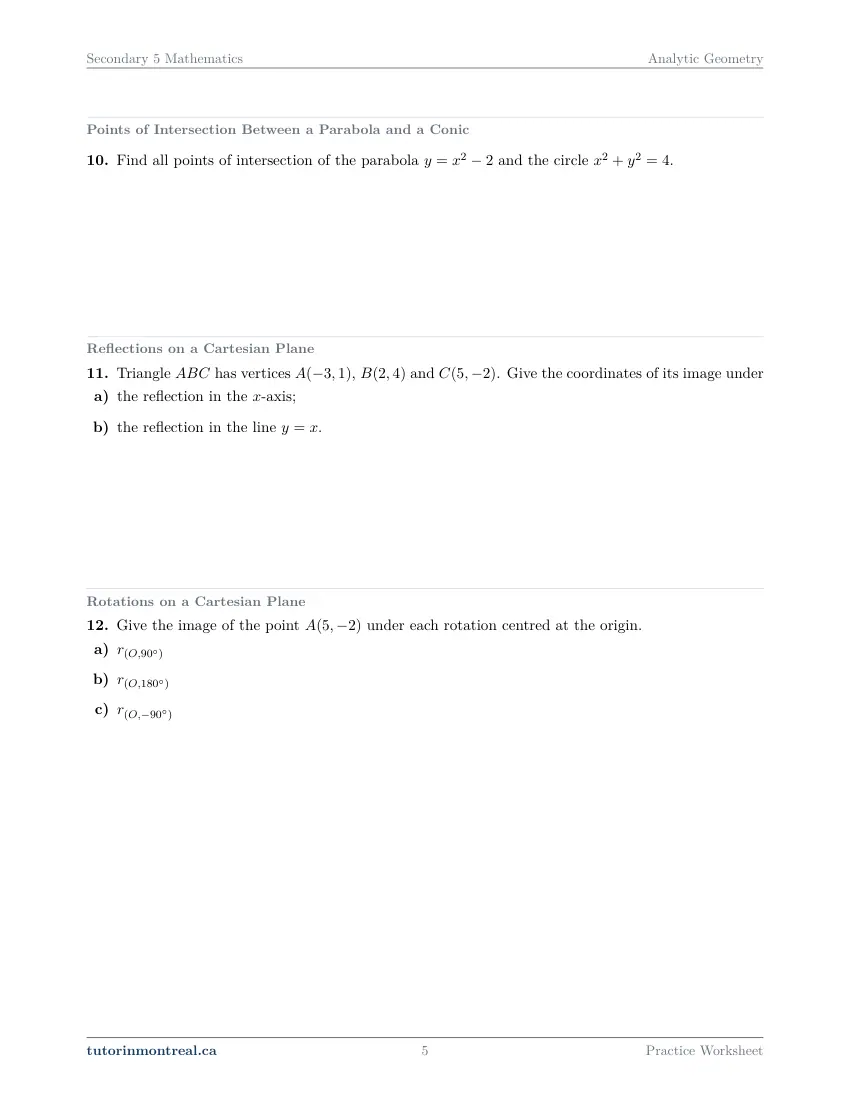
Q10Points of Intersection Between a Parabola and a Conic
Find all points of intersection of the parabola and the circle .
-
Q11Reflections on a Cartesian Plane
Triangle has vertices , and . Give the coordinates of its image under
- the reflection in the -axis;
- the reflection in the line .
-
Q12Rotations on a Cartesian Plane
Give the image of the point under each rotation centred at the origin.
-
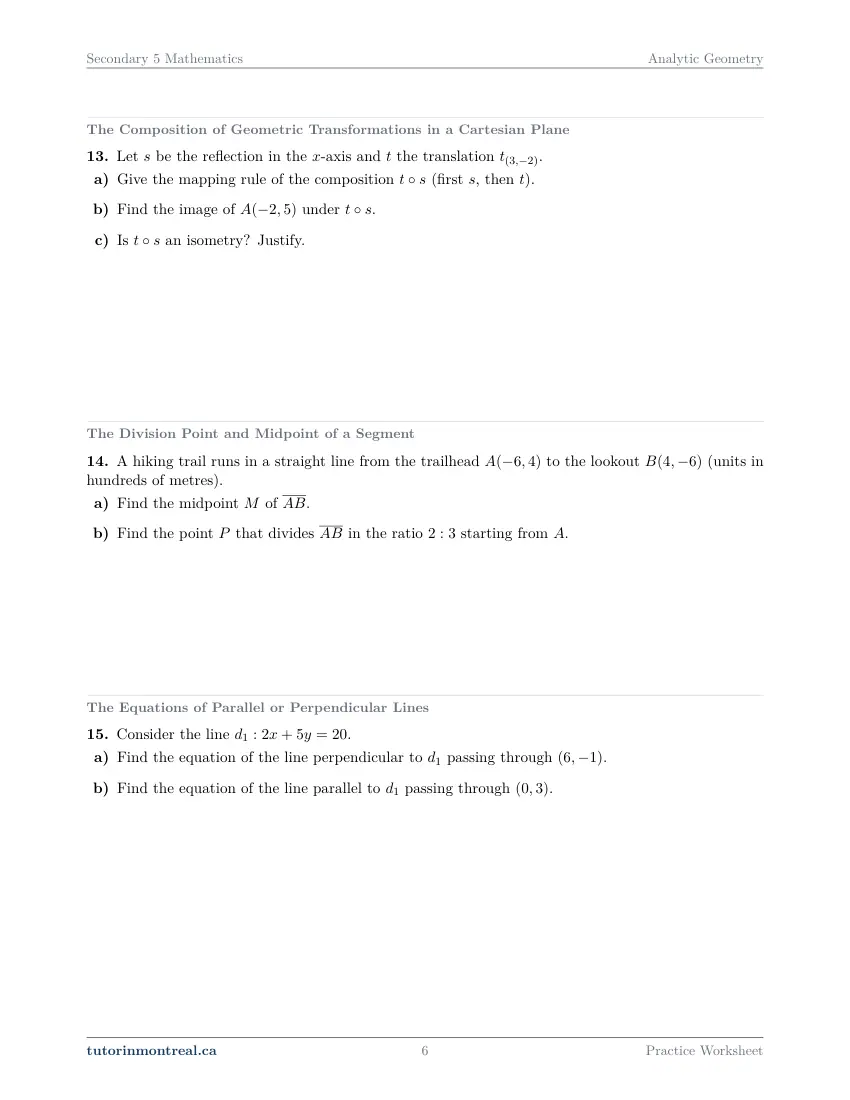
Q13The Composition of Geometric Transformations in a Cartesian Plane
Let be the reflection in the -axis and the translation .
- Give the mapping rule of the composition (first , then ).
- Find the image of under .
- Is an isometry? Justify.
-
Q14The Division Point and Midpoint of a Segment
A hiking trail runs in a straight line from the trailhead to the lookout (units in hundreds of metres).
- Find the midpoint of .
- Find the point that divides in the ratio starting from .
-
Q15The Equations of Parallel or Perpendicular Lines
Consider the line .
- Find the equation of the line perpendicular to passing through .
- Find the equation of the line parallel to passing through .
-
Q16Translations on a Cartesian Plane
A design is moved by the translation .
- Find the image of the point .
- A circular hole in the design has equation . Give the equation of its image, and state the image's centre and radius.
The 17 challenge problems for this topic are a separate, paid sheet and are not reproduced here.
Which stream is this for? This sheet is built for SN. It assumes you complete the square on a general second-degree equation, work with foci and asymptotes, and solve a system of a line and a conic — the depth that program expects.
How to do every concept on this sheet
This is the part worksheet sites usually leave out. Below is the actual reasoning behind each group of questions — not a full solution set, the decisions that get you to one. Read it before you start, or after you get stuck.
Naming a conic from its equation, in four seconds
Q1 gives five equations and asks which curve each one is, plus the single feature that settles it. That "single feature" phrasing is deliberate: you are not meant to complete the square five times. You are meant to look at the squared terms.
The conic decision order
Look only at the terms in x² and y². Stop at the first match.
- 1No squared term at all → a line
Both variables appear to the first power only.
3x − 5y = 15is a line, nothing more. - 2Exactly one variable squared → a parabola
y = −2(x − 3)² + 5squares x and not y, so the curve opens vertically. If it were y that were squared, it would open horizontally. - 3Both squared, same coefficient, same sign → a circle
The two squared terms must match exactly, not merely have the same sign. In standard form that means equal denominators.
- 4Both squared, added, different coefficients → an ellipse
A sum of two squares equal to 1, with different denominators. Equal denominators would have made it a circle — a circle is the ellipse whose two axes are the same length.
- 5Both squared, subtracted → a hyperbola
A difference of two squares equal to 1. The variable carrying the plus sign is the one whose axis is the transverse axis — that is decided by the sign, never by which denominator is larger.
Completing the square is the engine of this whole topic
Q2 and Q3 both live or die on it, and so does part of Q13's family of questions. An equation given in general form tells you almost nothing; the same equation in standard form hands you the centre, the radius or the axes by inspection. On my own example:
x² + y² + 10x − 4y − 20 = 0Group the x terms and the y terms, halve each linear coefficient, square it, and add it to both sides:
(x² + 10x + 25) + (y² − 4y + 4) = 20 + 25 + 4 (x + 5)² + (y − 2)² = 49 → centre (−5, 2), radius 7Where it goes wrong when the squared terms have coefficients. In an ellipse or hyperbola question such as Q3 you must factor the coefficient out of each pair of terms before halving anything. Once you complete the square inside a bracket that has a 9 in front of it, the constant you added is not what you wrote inside — it is nine times that. Writing the compensation on the same line as the factoring, rather than a step later, is what keeps this straight.
The sign trap is smaller and just as costly: (x + 5)² gives a centre at x = −5. The standard form is written with a minus, so a plus inside the bracket means a negative coordinate.
Q2 also asks whether a given point is inside, on, or outside a circle. Two equally valid methods: compute the distance from the centre and compare it with the radius, or substitute the point into the left side of the standard-form equation and compare the result with r². Smaller means inside, equal means on the edge, larger means outside. The second method avoids a square root entirely.
a, b and c: the one relation that flips between ellipse and hyperbola
Q5 and Q7 both ask for foci, and they use opposite formulas. This is the fact most worth having cold:
ellipse: c² = a² − b² hyperbola: c² = a² + b²For an ellipse, a is always the larger of the two, the major axis is the one it belongs to, and the foci sit on that major axis, inside the curve. A trampoline 10 m long and 6 m wide has a = 5 and b = 3 — half-lengths, not full lengths, which is the trap in Q5: the equation wants semi-axes while the situation gives you widths.
For a hyperbola, a is the denominator of the positive term whether or not it is larger, the transverse axis follows that variable, the vertices are a from the centre along it, and the foci are c from the centre along the same line — always further out than the vertices, since c > a.
The asymptotes in Q7(c) come straight from the standard form: replace the 1 on the right by 0 and solve. For a centre at (h, k) and a horizontal transverse axis that gives
y − k = ± (b ⁄ a)(x − h)with the fraction inverted when the transverse axis is vertical. Give them as two separate equations of lines unless the question accepts the ± form, and remember the curve approaches them without ever touching — a point lying exactly on an asymptote cannot be on the hyperbola.
The parabola as a conic: 4c does three jobs
Q8 treats the parabola the conic way — by its focus and directrix rather than its vertex form. With the vertex at the origin and an upward opening:
x² = 4cy, focus (0, c), directrix y = −cThe same c is the distance from the vertex up to the focus and down to the directrix, and 4c is the width of the curve measured along the horizontal line through the focus. So a single given — a focus, a directrix, or one rim point — determines everything else. If the parabola opens sideways, the roles of x and y swap: y² = 4cx.
Intersections: substitute, and be ready to reject a root
Q9 crosses a line with a circle, Q10 crosses a parabola with a circle. Both are solved by substitution, but the substitution to choose is different, and choosing well is most of the work.
Line and conic (Q9): the line gives y in terms of x. Put that expression into the conic, expand, and you are left with a quadratic in x. Solve it, then feed each root back through the line to get its y — the line is the simpler of the two rules and cannot introduce a false partner. The number of real roots is the number of intersection points: two, one (tangent), or none.
Parabola and circle (Q10): do not substitute y = x² − 2 into the circle — that produces a fourth-degree equation. Substitute the other way: read x² off the parabola and replace x² in the circle. The system collapses to a quadratic in y.
Then check every root before you keep it. Each y you find has to give back a legitimate x through x² = …, and a negative right-hand side there means no real x exists — that root is rejected, and saying why is part of the answer. Geometrically it is a height at which the parabola simply has no points.
The mirror-image slip is forgetting that one y usually yields two values of x, symmetric about the axis. An answer to an intersection question is a list of coordinate pairs, never a list of x values.
The transformations, as point rules
Q4, Q6, Q11, Q12, Q13 and Q16 all reduce to a handful of mappings. Learn them as what they do to (x, y), not as sentences:
t(a,b): (x, y) ⟼ (x + a, y + b) reflection in the x-axis: (x, −y) in the y-axis: (−x, y) in y = x: (y, x) rotation about O: 90° → (−y, x) 180° → (−x, −y) −90° → (y, −x) dilation h(O, k): (kx, ky)Translations, reflections and rotations preserve every distance — they are isometries, which is what Q6 and Q13 are asking you to decide. A dilation with k ≠ ±1 is not: it multiplies every length by |k| and every area by k², which is the whole of Q4(b). It is still a similarity, so angles survive unchanged.
When the centre of the dilation or rotation is not the origin, work with vectors from the centre. For a dilation of ratio k centred at C, the image of P is the point with CP′ = k · CP; a negative k puts the image on the opposite side of C. For a rotation, the same subtraction gets you to a rotation about the origin, which you then undo by adding C back.
A composition such as Q13's t ∘ s is read right to left: s acts first. Substitute the first rule into the second and simplify to a single mapping. Composition of transformations is not commutative — swapping the order generally moves the image — and a composition of isometries is again an isometry, which answers the "is it an isometry?" part without any computation.
Transforming a curve: the substitution goes the other way
Q16 applies a translation to a circle rather than to a point, and this is where almost everyone signs the wrong way. To translate a curve by (a, b), replace x by x − a and y by y − b in its equation.
Why the minus. A point (x, y) lies on the image exactly when it came from a point of the original — that is, when (x − a, y − b) satisfies the original equation. The rule for points adds; the rule for equations subtracts. Two checks that never fail: the centre of a translated circle must be the old centre plus the arrow, and the radius must be unchanged, because a translation is an isometry.
Midpoint, division point, parallel and perpendicular
Q14 asks for a midpoint and then for a point dividing a segment in a given ratio. The midpoint is the average of the coordinates. The division point in the ratio r : s starting from A is
P = A + [ r ⁄ (r + s) ] · ABwith AB the vector from A to B. Note the denominator: a ratio of 2 : 3 means two parts out of five, not out of three. The starting endpoint matters too — dividing from B instead of A in the same ratio lands somewhere else entirely.
Q15 needs one fact and one formula. From a line written Ax + By = C, the slope is −A ⁄ B; parallel lines share it, and perpendicular lines have slopes whose product is −1, so you take the negative reciprocal. Then use the point-slope form y − y₁ = m(x − x₁) and simplify. The one case the rule does not cover is a vertical line, whose slope does not exist and whose perpendiculars are horizontal — worth a sentence if it ever comes up.
Preview all 7 pages
Click any page to open the full PDF.
Getting the most out of it
Draw it, even badly
A rough sketch with the centre marked and the axes labelled catches sign errors that algebra hides. On the intersection questions it also tells you in advance how many points to expect, so an answer with the wrong count is caught immediately.
Put every conic in standard form before answering anything
Centre, semi-axes, foci and asymptotes are all read off the standard form and none of them are visible in the general form. Make it a reflex: complete the square first, answer the question second.
Drill the transformation rules as point-images
Write the ten mappings above on a card and test yourself by applying each to a single point such as (3, −1). Recognising a rule from its effect is exactly what Q6 asks for, and it is recall, not reasoning.
Want the solutions, or something more challenging?
The worksheet, the questions above and every explanation on this page stay free permanently. Three more PDFs exist for this topic — the worked answer key, a harder problem set, and the answer key to that. They come with the Secondary 5 Math Solutions Bundle, which is what keeps the rest of the series free.
What else exists for Analytic Geometry
Three PDFs · 16 pages · all three are in the bundle below.
- Answer key — 3 pages. All 16 questions worked step by step, including the restrictions and the justifications. Not a list of final answers.
- Challenge problems — 9 pages, 17 problems. A separate sheet at exam-plus difficulty covering the same 16 concepts. Harder than anything on the free sheet.
- Challenge answer key — 4 pages. Every challenge problem worked to the same standard, with the checks shown.
- PDF, letter size, print-ready.
The one thing that's for sale
Every Secondary 5 Math topic — the complete Solutions Bundle
One download, one payment, the whole program. Every answer key and every challenge set for all 21 Secondary 5 Math worksheet sets — including this one.
- Worked solutions, not answer lists — every step written out
- Covers the whole year's program at this level
- Less than the price of one hour of tutoring — for the entire year's solutions
Taking Secondary 1 Math as well? The Secondary 1 Math bundle covers all 15 of its sets — 45 PDFs, 182 pages — on the same terms.
Taking Secondary 2 Math as well? The Secondary 2 Math bundle covers all 14 of its sets — 42 PDFs, 181 pages — on the same terms.
Taking Secondary 3 Math as well? The Secondary 3 Math bundle covers all 11 of its sets — 33 PDFs, 154 pages — on the same terms.
Taking Secondary 4 Math as well? The Secondary 4 Math bundle covers all 17 of its sets — 51 PDFs, 154 pages — on the same terms.
Taking CEGEP Calculus I as well? The CEGEP Calculus I bundle covers all 8 of its sets — 24 PDFs, 82 pages — on the same terms.
Taking CEGEP Calculus II as well? The CEGEP Calculus II bundle covers all 8 of its sets — 24 PDFs, 90 pages — on the same terms.
Taking CEGEP Linear Algebra as well? The CEGEP Linear Algebra bundle covers all 7 of its sets — 21 PDFs, 82 pages — on the same terms.
Taking AP Calculus AB as well? The AP Calculus AB bundle covers all 8 of its sets — 24 PDFs, 126 pages — on the same terms.
Common questions
Is this worksheet really free?
Yes — the questions are on this page to read, and the PDF downloads directly, no email and no account. The one paid item is optional: the complete Secondary 5 Solutions Bundle, which covers every set at this level.
How do I tell a circle, an ellipse and a hyperbola apart at a glance?
Look only at the squared terms. Both squared and added with identical coefficients is a circle; added with different coefficients is an ellipse; subtracted is a hyperbola; only one variable squared is a parabola. You do not have to complete the square to name the curve.
Which formula gives c, and where do the foci actually sit?
For an ellipse, c² = a² − b², and the foci lie on the major axis inside the curve. For a hyperbola, c² = a² + b², and the foci lie on the transverse axis beyond the vertices. The signs are opposite because a hyperbola's foci are further from the centre than its vertices, while an ellipse's are closer.
When I translate a curve, do I add or subtract in the equation?
Subtract. To translate by (a, b), replace x by x − a and y by y − b. The reason is that a point of the image came from the point (x − a, y − b) of the original. Points move by adding; equations move by subtracting.
Which transformations are isometries?
Translations, reflections and rotations — they preserve every length and every angle. A dilation is not an isometry unless its ratio is 1 or −1: it multiplies lengths by the absolute value of the ratio and areas by its square. It is still a similarity, so angles are preserved.
Why does one solution get rejected when a parabola meets a circle?
Because solving the system gives values of y, and each one still has to produce a real x through x² = something. If that something is negative, no real x exists and the root is discarded. Geometrically, the parabola has no points at that height.
Can teachers use this in class?
Yes. Print and photocopy it for your own classes freely — I just ask that the tutorinmontreal.ca footer stays on the page.
I'm stuck on one question. Can you help?
Yes — through one-on-one tutoring, in Montreal or online. Get in touch to arrange a session, or see the current rates.
← All 21 Secondary 5 Math worksheets · Secondary 1 Math series (15 sheets) → · Secondary 2 Math series (14 sheets) → · Secondary 3 Math series (11 sheets) → · Secondary 4 Math series (17 sheets) → · CEGEP Calculus I series (8 sheets) → · CEGEP Calculus II series (8 sheets) → · CEGEP Linear Algebra series (7 sheets) → · AP Calculus AB series (8 sheets) →
The same topic at the other level: Secondary 4 Math · Analytic Geometry.