Secondary 5 Equations and Inequalities Worksheet
Every equation type the Secondary 5 program puts on the table, one after another — logarithmic, exponential, trigonometric, rational, square root, absolute value, greatest integer and second degree — each with its inequality version and the rejection step that catches solutions the algebra invented. The second half is graphical: half-planes, systems of inequalities, the polygon of constraints, and optimizing a function over it. Free to print, and no account is required to get hold of the PDF.
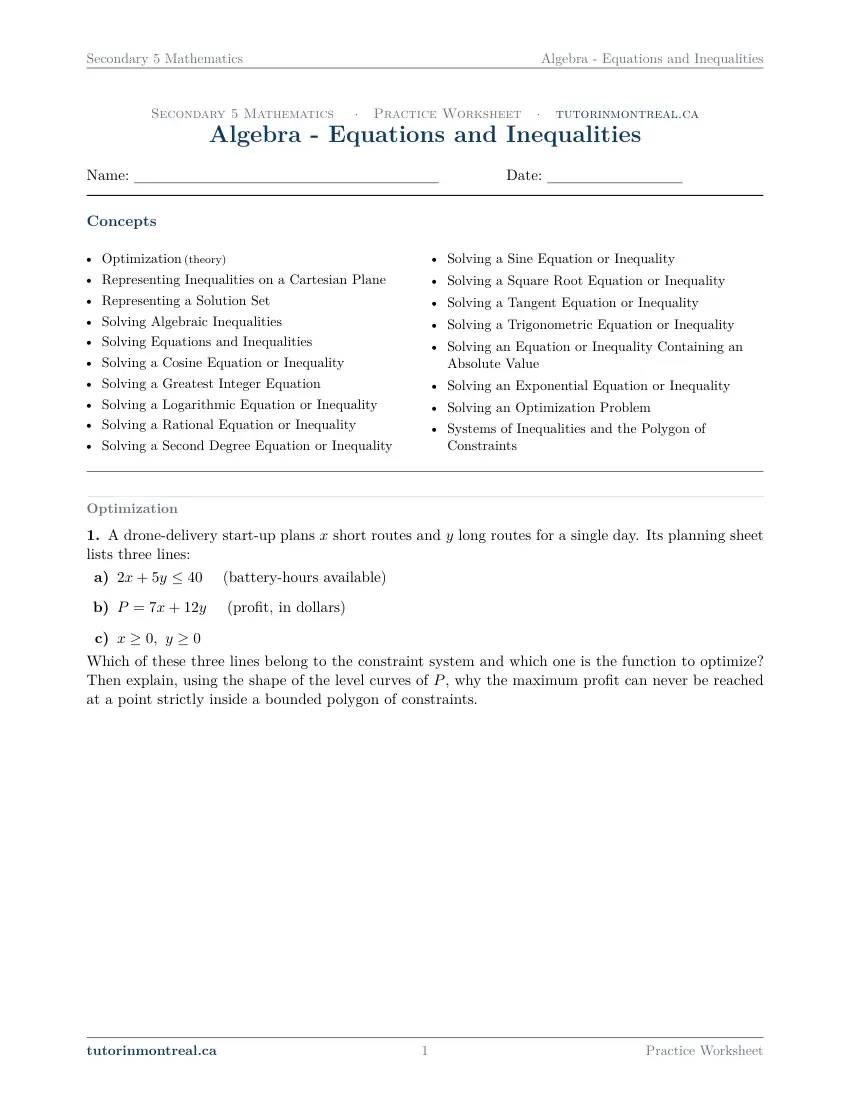
Practice worksheet — free PDF
No email, no account, no watermark. Teachers: photocopy it for your classes freely. Worked solutions and 18 harder problems come with the Secondary 5 Math bundle.
All 19 questions
Each question targets one named concept from the sheet. Read them here, or print the PDF — it has working space under each one.
-
Q1Optimization
A drone-delivery start-up plans short routes and long routes for a single day. Its planning sheet lists three lines:
- (battery-hours available)
- (profit, in dollars)
Which of these three lines belong to the constraint system and which one is the function to optimize? Then explain, using the shape of the level curves of , why the maximum profit can never be reached at a point strictly inside a bounded polygon of constraints.
-
Q2Representing Inequalities on a Cartesian Plane
Represent the solution set of on the Cartesian plane below. State the coordinates of the two intercepts of the boundary, say whether the boundary line is solid or dashed, and give the test point you used.
A blank Cartesian grid for this question is on the printable PDF.
-
Q3Representing a Solution Set
A greenhouse controller logs the difference , in degrees Celsius, between the air temperature and the target temperature. The controller stays idle when is at least but less than , and it raises an alarm when is greater than . Let be the set of readings that are idle or alarming. Express
- in interval notation, using the Québec convention for open ends;
- in set-builder notation.
-
Q4Solving Algebraic Inequalities
Solve and write the solution set in interval notation.
-
Q5Solving Equations and Inequalities
Solve .
-
Q6Solving a Cosine Equation or Inequality
Solve for .
-
Q7Solving a Greatest Integer Equation
Solve and give the solution set in interval notation.
-
Q8Solving a Logarithmic Equation or Inequality
Solve .
-
Q9Solving a Rational Equation or Inequality
Solve , stating the restrictions on .
-
Q10Solving a Second Degree Equation or Inequality
Solve the inequality and write the solution set in interval notation.
-
Q11Solving a Sine Equation or Inequality
Solve for .
-
Q12Solving a Square Root Equation or Inequality
Solve .
-
Q13Solving a Tangent Equation or Inequality
Solve for .
-
Q14Solving a Trigonometric Equation or Inequality
Solve for .
-
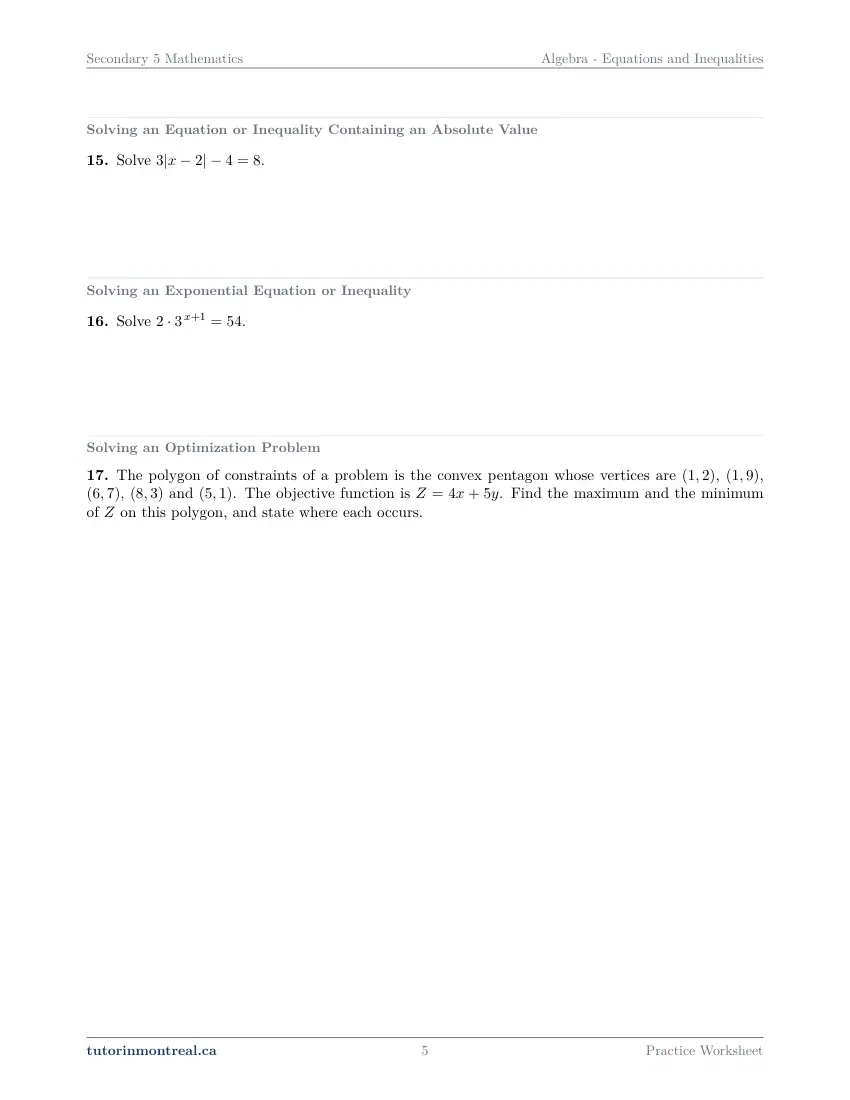
Q15Solving an Equation or Inequality Containing an Absolute Value
Solve .
-
Q16Solving an Exponential Equation or Inequality
Solve .
-
Q17Solving an Optimization Problem
The polygon of constraints of a problem is the convex pentagon whose vertices are , , , and . The objective function is . Find the maximum and the minimum of on this polygon, and state where each occurs.
-
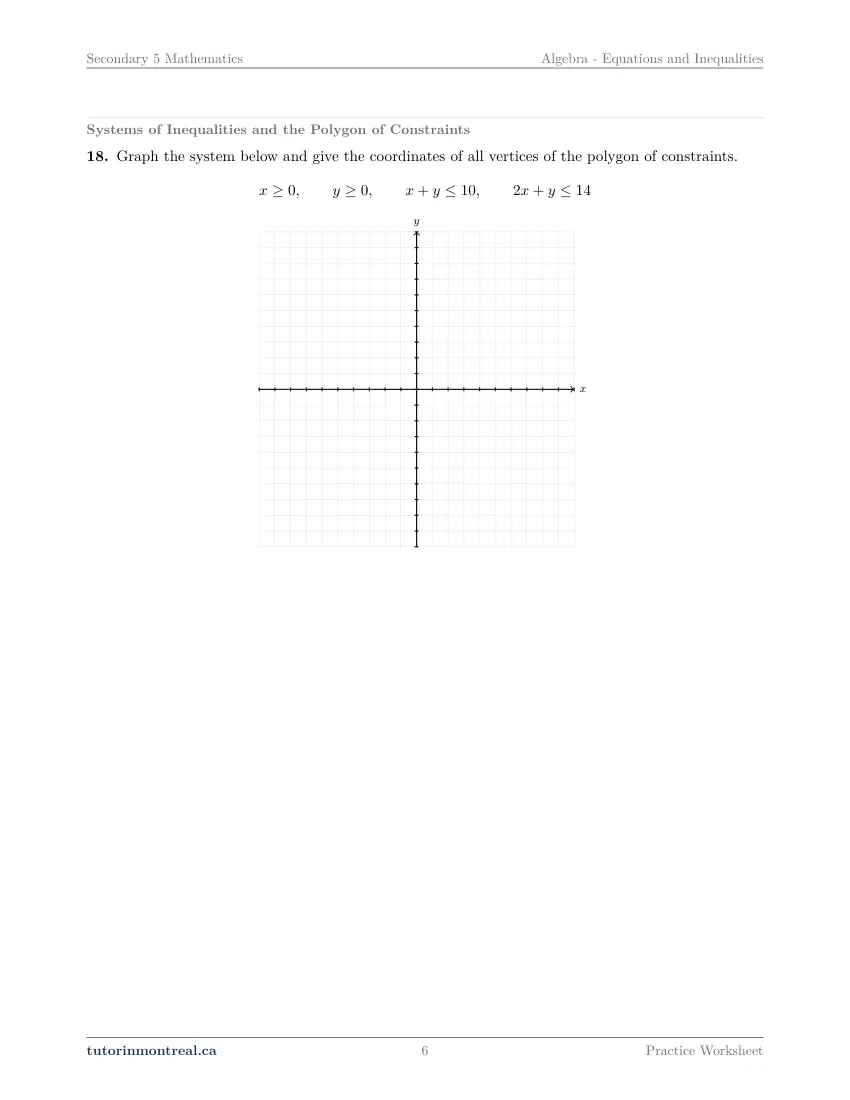
Q18Systems of Inequalities and the Polygon of Constraints
Graph the system below and give the coordinates of all vertices of the polygon of constraints.
A blank Cartesian grid for this question is on the printable PDF.
-
Q19Synthesis — drawing on several sheets in this topic
A workshop makes two models of kite. A box kite uses ~m of ripstop fabric and ~h of sewing; a delta kite uses ~m of fabric and ~h of sewing. This month the workshop has ~m of fabric and ~h of sewing time, and a store has already ordered at least delta kites. The profit is $ per box kite and $ per delta kite.
- Define the variables and write the system of inequalities.
- Determine the vertices of the polygon of constraints.
- How many kites of each model should be made to maximize the profit, and what is that profit?
The 18 challenge problems for this topic are a separate, paid sheet and are not reproduced here.
Which stream is this for? This sheet is built for SN. It assumes you are solving logarithmic, exponential and trigonometric relations, reading solution sets in the Quebec interval notation, and optimizing a linear function over a polygon of constraints, and it goes to the depth that program expects.
How to do every concept on this sheet
This is the part worksheet sites usually leave out. Below is the actual reasoning behind each group of questions — not a full solution set, the decisions that get you to one. Read it before you start, or after you get stuck.
Nine kinds of equation, one habit
The sheet looks like nine unrelated topics and is really one procedure applied nine times: isolate the structure, apply its inverse, then test the answer against the domain. What changes from question to question is only which operation counts as the inverse, and whether that inverse is safe.
Isolate first. Whatever the outer wrapper is — a radical, an absolute value, a power, a logarithm, a floor bracket, a trigonometric ratio — get it alone on one side before undoing it. Every question on this sheet is designed so that the first line is arithmetic, not the interesting step.
Then invert. Square a radical, split an absolute value into two cases, match bases on a power, use the definition of a logarithm, bracket a floor between two integers, find a reference angle for a ratio.
Then check the domain. Some inverses are reversible and some are not. Squaring and combining logarithms can invent solutions; dividing by an expression whose sign or value is unknown can lose them. Those two failure modes account for most of the lost marks on this sheet.
Writing a solution set (Q3)
Q3 asks for the same set twice, in two notations, and each has its own convention. In the Quebec interval notation the bracket turns away from an endpoint that is excluded: [−5, 3[ ∪ ]8, +∞[ reads as "−5 is in, 3 is out, everything past 8 is in but 8 itself is not". Infinity is never an endpoint you can reach, so it always takes the reversed bracket.
Set-builder notation says the same thing in a sentence: { x ∈ ℝ : −5 ≤ x < 3 or x > 8 }
Translate the words, one at a time. "At least −5" is ≥ and gives a square bracket; "less than 3" is < and gives a reversed one; "greater than 8" excludes 8. The word or is a union of two pieces and the word and is an intersection — an answer that merges two disjoint pieces into one interval is the most common error here, and it is a claim that the numbers in between are solutions too.
Linear work: fractions, distribution, and the sense (Q4, Q5)
Q5 clears fractions by multiplying every term by the lowest common denominator — every term, including the one on the right, and including any term that is not a fraction. Q4 distributes a negative across a bracket first. Both are routine, and both are where a careless line poisons an otherwise correct question.
The one rule that separates an inequality from an equation: multiplying or dividing both sides by a negative number reverses the sense. Everything else — adding, subtracting, multiplying by a positive — leaves it alone.
The reason is worth carrying rather than memorising. On a number line, multiplying by a negative reflects every point through zero, and reflection swaps which of two numbers lies further to the right. Starting from 3 < 7 and multiplying by −1 gives −3 and −7, and −3 is now the larger. The same phenomenon reappears twice later on this sheet: with an exponential of base under 1, and with a logarithm of base under 1, both of which are decreasing functions.
Second degree: find the zeroes, then read the sign (Q10)
An equation is finished when you have the zeroes. An inequality is only half finished — the zeroes tell you where the expression changes sign, and the shape of the parabola tells you which side is which.
Factor (or use the quadratic formula), then reason from the leading coefficient. When a > 0 the parabola opens upward, so the expression is negative strictly between the zeroes and positive outside them; when a < 0 the two regions swap. A quick sketch with the two zeroes marked answers "> 0" or "< 0" faster than any sign table, and it makes the shape of the answer obvious: a bounded interval in one case, a union of two unbounded pieces in the other.
If the discriminant is negative there are no zeroes and the expression keeps one sign everywhere — so the solution set is either all of ℝ or empty, and no interval work is needed at all.
Absolute value: isolate, then two cases (Q15)
The bars must be alone before the cases are written. Once |u| = k with k ≥ 0, the two branches are u = k and u = −k; if isolating produces a negative k, stop — a distance is never negative and the equation has no solution. That is why isolating first is not merely tidy: it is the step that reveals whether there is anything to solve.
For an inequality, read the bars as a distance from a point. |x − h| ≤ k means "within k of h", a single interval centred on h; |x − h| ≥ k means "at least k away", a union of two unbounded pieces. Reading it that way also tells you what such an inequality can never produce: a set that is not symmetric about h.
Square root: the verification is part of the method (Q12)
Isolate the radical, square both sides, solve. Then substitute every candidate back into the original equation — not because checking is good practice, but because squaring is not reversible.
From A = B it follows that A² = B², but the converse gives only A = ±B. Squaring therefore hands you the solutions of a second equation, the one with the minus sign, mixed in with the ones you want. It can never lose a solution, so the only risk is extra ones — and the only way to tell them apart is to test them in the equation you started with.
Two conditions are worth writing down before squaring anything: whatever is under the radical must be ≥ 0, and since a square root is never negative, whatever the radical equals must be ≥ 0 as well. That second condition is the one that eliminates false candidates on sight.
Exponential and logarithmic: the same statement, read both ways (Q16, Q8)
logb(u) = c ⟺ u = bcThat equivalence is the entire content of Q8: isolate the logarithm, rewrite it as a power, solve the linear equation left behind. Q16 goes the other way — isolate the power, write both sides with the same base, and equate the exponents, which is legal because an exponential function never takes the same value twice. Knowing the small powers by heart (32 = 2⁵, 27 = 3³, 81 = 3⁴, 125 = 5³) turns most of these into one line.
A logarithm has a domain, and the algebra does not respect it. Every argument must be strictly positive, so check each one at the end against the original equation. Combining two logarithms into one enlarges the domain — the combined expression can be defined where the separate ones were not — so the combined equation may hand you a value that solves it while making an original argument negative. That value is not a solution; it is an artefact of the step, and rejecting it explicitly is part of the answer.
For inequalities, the direction is preserved when the base is greater than 1 and reversed when the base lies between 0 and 1 — the decreasing case again.
Greatest integer: a bracket, not a number (Q7)
The floor of an expression equals k precisely when that expression sits between k and the next integer:
⌊u⌋ = k ⟺ k ≤ u < k + 1Closed on the left, open on the right, always. Substitute your expression for u, then solve the double inequality by doing the same thing to all three parts at once. The answer is an interval, which is the point of the question: a greatest integer equation almost never has a single solution. When the expression inside is 2x − 3, dividing the double inequality by 2 halves the width of the interval — a good reminder that the solution interval is not automatically one unit long.
Rational equations, and when you may not multiply across (Q9)
State the restrictions first, cross-multiply, solve, then confirm the answer is admissible. For an equation that is the whole method.
For a rational inequality, do not multiply by the denominator. Its sign depends on x, so you cannot know whether the sense should flip — and choosing one of the two possibilities silently is exactly how a wrong half-line of solutions appears. Instead move everything to one side, combine into a single quotient, and build a sign table with two kinds of critical value: the zeroes of the numerator, which may be included, and the zeroes of the denominator, which never are.
The exception is worth naming because it appears in context problems: when the multiplier is a quantity the situation guarantees to be positive — a number of items, a length, a time — multiplying across is legitimate, and saying so in a sentence is what justifies the shortcut.
Trigonometric equations: solving is easy, the window is not (Q6, Q11, Q13, Q14)
Four questions here are trigonometric, and they fail in the same place — not at finding an angle, but at finding all the angles the interval asks for.
The procedure, in the order that keeps the solutions
Work on the argument of the function until the very last step.
- 1Isolate the ratio
Get to
sin(…) = k,cos(…) = kortan(…) = k. If a trigonometric function appears squared, as in Q14, substitute a single letter for it, factor the quadratic, and solve each branch — rejecting any value outside [−1, 1] for a sine or cosine. - 2Find the reference angle from |k|
The reference angle is always acute and always positive. Take the inverse trigonometric function of the absolute value of k.
- 3Place it in the right quadrants using the sign
Sine positive in I and II, negative in III and IV. Cosine positive in I and IV, negative in II and III. Tangent positive in I and III, negative in II and IV.
- 4Add the period — to the argument, not to x
Sine and cosine repeat every 2π; tangent repeats every π, which is why a tangent equation has only one family of solutions instead of two.
- 5Only now solve for x, and filter
Convert the general solutions of the argument into values of x, then keep those inside the stated interval — checking whether its endpoints are included.
The mistake that costs half the solutions: filtering too early when the argument is not simply x. In Q11 the argument is 2x, so as x runs over the given interval the argument runs over twice that interval, and the equation has twice as many solutions as the same equation in x would. In Q13 the argument is shifted rather than stretched, so the count is unchanged but the window is displaced. Solve for the argument over its own enlarged interval, and only translate back at the end.
And do not divide by a trigonometric factor. If both sides share a factor of sin x, dividing it out discards every solution where sin x = 0. Move everything to one side and factor instead — that keeps the whole solution set.
From an inequality to a half-plane (Q2)
Three decisions and the graph is finished. The boundary: replace the inequality sign by an equals sign and draw that line, most easily through its two intercepts — set x = 0 for one, y = 0 for the other. The style: solid if the inequality is ≤ or ≥, dashed if it is strict, because a dashed line is how you say the boundary points are not solutions. The side: test one point that is not on the line — the origin whenever the line misses it — and shade the side that made the statement true.
Naming the test point is part of the answer, not scratch work. It is also the only step that never lies: rearranging into y ≤ … and shading "below" works, but a single sign slip during the rearrangement shades the wrong half of the plane with no warning.
Polygon of constraints and optimization (Q1, Q17, Q18, Q19)
Q1 asks for the distinction the rest of the block depends on. The constraints are the inequalities that limit what is possible; each one is a half-plane, and their intersection is the polygon. The objective function is the single equation to be made as large or as small as possible; it is not a constraint and never gets shaded.
Why only the vertices matter. The level curves of a linear objective — the sets where it takes some fixed value — form a family of parallel lines. From any point strictly inside the polygon you can step a short distance perpendicular to those lines, in the direction that improves the value, and still be inside; so no interior point can be optimal. The optimum therefore lies on the boundary, and since a linear function varies monotonically along a straight edge, it is reached at a corner. Evaluating the objective at every vertex is a complete method, not a sampling.
When the level lines happen to be parallel to an edge, both endpoints of that edge give the same value and every point of the edge is optimal — the case worth mentioning if two vertices tie.
Working an optimization problem end to end
Q19 is this list, in this order.
- 1Define the variables in words, with units
"Let x be the number of …". Every later line depends on this sentence, and an exam awards it.
- 2Translate each sentence into one inequality
A resource that is limited gives ≤; a minimum order gives ≥; quantities that cannot be negative give the non-negativity constraints, which are easy to forget because nobody states them out loud.
- 3Graph and find the vertices exactly
Each vertex is the intersection of two boundary lines, so solve those two equations as a system. Never read a corner off the squared paper.
- 4Keep only the admissible corners
Two boundary lines can meet outside the region. Test each intersection against all the other constraints before you use it.
- 5Evaluate the objective at each vertex and answer in a sentence
With units, and with a word about the context — if the variables count objects, a non-integer optimum has to be handled explicitly rather than reported.
Q18 stops at the vertices and Q17 starts from them, which is a good way to practise the two halves separately. Q19 asks for the whole chain on a situation given only in words.
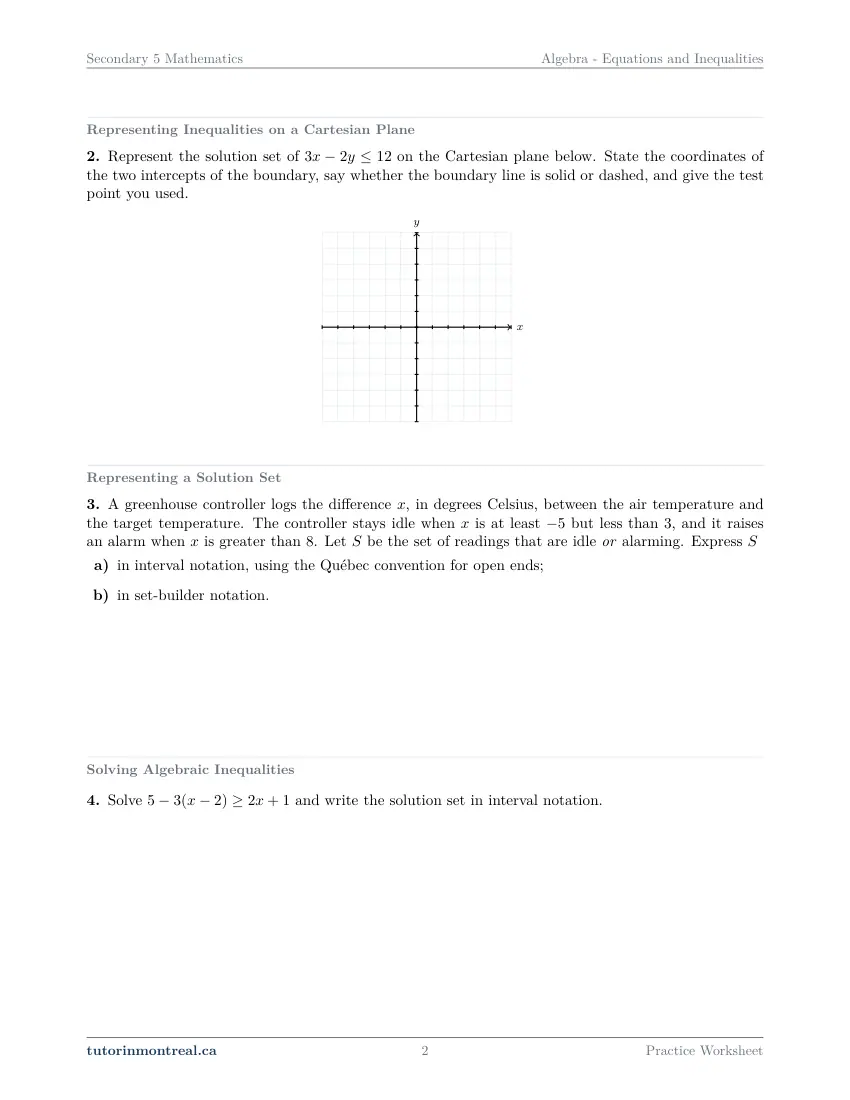
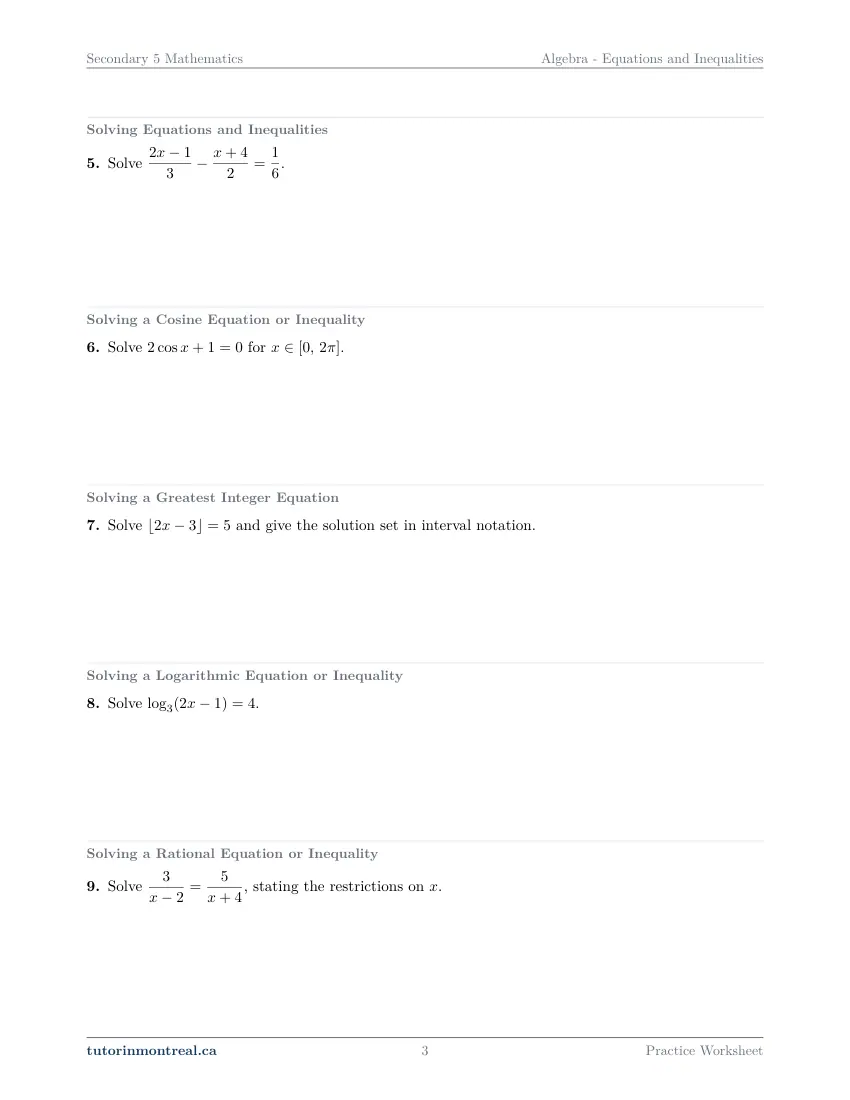
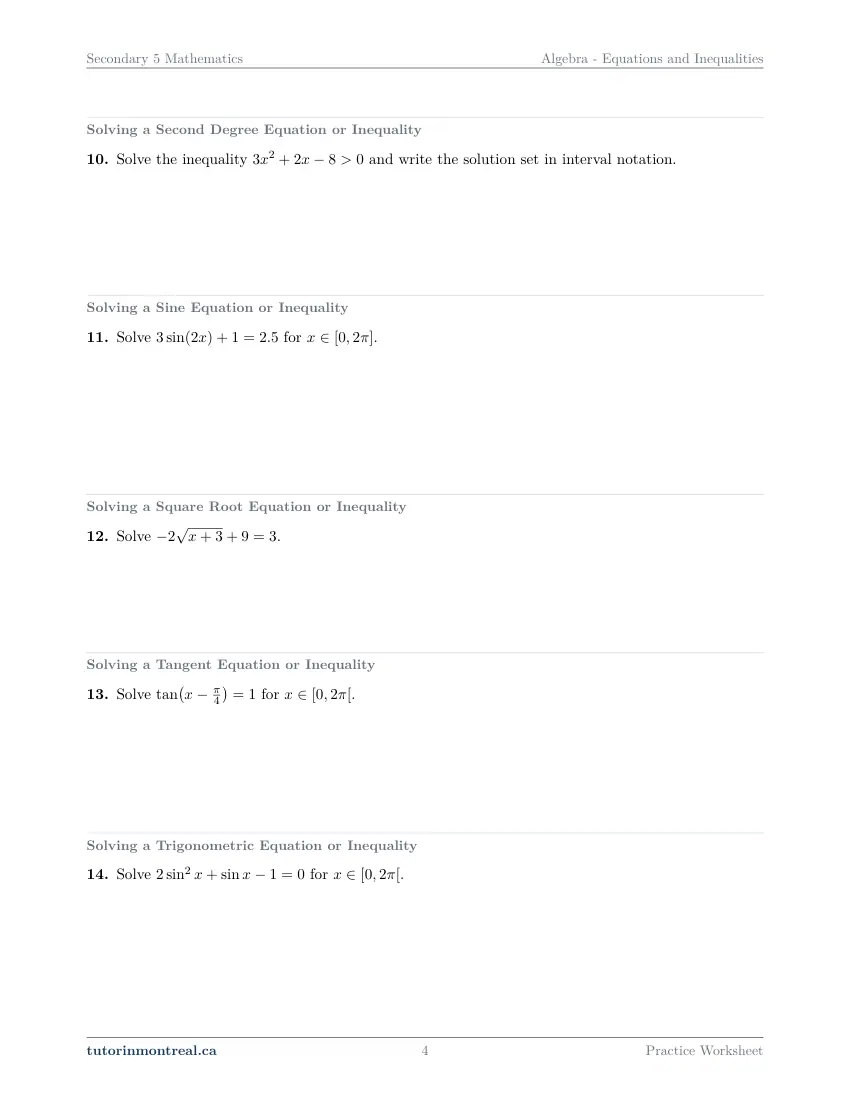
Preview all 7 pages
Click any page to open the full PDF.
Getting the most out of it
Write the domain before you write the first line
Radicand ≥ 0, logarithm arguments > 0, denominators ≠ 0, the interval an angle must lie in. Noting these at the top turns the check at the end into a confirmation instead of a guess, and on the logarithmic and rational questions it is the difference between a complete answer and a plausible one.
Say the sense out loud every time you divide
"By a positive, sense stays; by a negative, sense flips." It feels childish and it is the single highest-value habit on a sheet with this many inequalities — including the two places where it reappears in disguise, with an exponential or logarithmic base below 1.
Group the trigonometric questions and do them in one sitting
Four of these questions are trigonometric with four different arguments — plain, doubled, shifted, and squared. Doing them consecutively is what makes the pattern visible: the method never changes, only the interval the argument has to be solved over.
Want the solutions, or something more challenging?
The worksheet, the questions above and every explanation on this page stay free permanently. Three more PDFs exist for this topic — the worked answer key, a harder problem set, and the answer key to that. They come with the Secondary 5 Math Solutions Bundle, which is what keeps the rest of the series free.
What else exists for Equations and Inequalities
Three PDFs · 19 pages · all three are in the bundle below.
- Answer key — 3 pages. All 19 questions worked step by step, including the restrictions and the justifications. Not a list of final answers.
- Challenge problems — 11 pages, 18 problems. A separate sheet at exam-plus difficulty covering the same 18 concepts. Harder than anything on the free sheet.
- Challenge answer key — 5 pages. Every challenge problem worked to the same standard, with the checks shown.
- PDF, letter size, print-ready.
The one thing that's for sale
Every Secondary 5 Math topic — the complete Solutions Bundle
One download, one payment, the whole program. Every answer key and every challenge set for all 21 Secondary 5 Math worksheet sets — including this one.
- Worked solutions, not answer lists — every step written out
- Covers the whole year's program at this level
- Less than the price of one hour of tutoring — for the entire year's solutions
Taking Secondary 1 Math as well? The Secondary 1 Math bundle covers all 15 of its sets — 45 PDFs, 182 pages — on the same terms.
Taking Secondary 2 Math as well? The Secondary 2 Math bundle covers all 14 of its sets — 42 PDFs, 181 pages — on the same terms.
Taking Secondary 3 Math as well? The Secondary 3 Math bundle covers all 11 of its sets — 33 PDFs, 154 pages — on the same terms.
Taking Secondary 4 Math as well? The Secondary 4 Math bundle covers all 17 of its sets — 51 PDFs, 154 pages — on the same terms.
Taking CEGEP Calculus I as well? The CEGEP Calculus I bundle covers all 8 of its sets — 24 PDFs, 82 pages — on the same terms.
Taking CEGEP Calculus II as well? The CEGEP Calculus II bundle covers all 8 of its sets — 24 PDFs, 90 pages — on the same terms.
Taking CEGEP Linear Algebra as well? The CEGEP Linear Algebra bundle covers all 7 of its sets — 21 PDFs, 82 pages — on the same terms.
Taking AP Calculus AB as well? The AP Calculus AB bundle covers all 8 of its sets — 24 PDFs, 126 pages — on the same terms.
Common questions
Is this worksheet really free?
Yes — the questions are on this page to read, and the PDF downloads directly, no email and no account. The one paid item is optional: the complete Secondary 5 Solutions Bundle, which covers every set at this level.
Why do I lose solutions when the equation has sin(2x) instead of sin(x)?
Because you filtered too early. If x runs over an interval, 2x runs over an interval twice as long, so the equation has twice as many solutions there. Solve for the whole argument over its own enlarged interval, add the period to the argument, and convert back to x only at the last step.
Why is a solution of a logarithmic equation sometimes rejected?
Because combining logarithms enlarges the domain. The combined equation is defined for values where one of the original arguments was negative or zero, so its algebra can produce a number that solves it and not the original. Every candidate has to be tested against the original arguments, all of which must be strictly positive.
Can I multiply both sides of a rational inequality by the denominator?
Not unless you know its sign. Since the denominator's sign depends on x, you cannot tell whether the inequality should reverse. Move everything to one side, combine into a single quotient and use a sign table, with the numerator's zeroes possibly included and the denominator's zeroes always excluded.
Why is it enough to test the vertices of the polygon of constraints?
Because the objective function is linear. Its level curves are parallel lines, so from an interior point you can always move to a better one and still be inside the region; the optimum must lie on the boundary, and along a straight edge a linear function reaches its extreme at an endpoint. That leaves only the corners to check.
Which Secondary 5 stream is this for?
It is built for SN. The sheet assumes logarithmic, exponential and trigonometric relations, solution sets in the Quebec interval notation, and optimization over a polygon of constraints, at the depth that program requires.
Can teachers use this in class?
Yes. Print and photocopy it for your own classes freely — I just ask that the tutorinmontreal.ca footer stays on the page.
I'm stuck on one question. Can you help?
Yes — through one-on-one tutoring, in Montreal or online. Get in touch to arrange a session, or see the current rates.
← All 21 Secondary 5 Math worksheets · Secondary 1 Math series (15 sheets) → · Secondary 2 Math series (14 sheets) → · Secondary 3 Math series (11 sheets) → · Secondary 4 Math series (17 sheets) → · CEGEP Calculus I series (8 sheets) → · CEGEP Calculus II series (8 sheets) → · CEGEP Linear Algebra series (7 sheets) → · AP Calculus AB series (8 sheets) →
The same topic at the other level: Secondary 4 Math · Equations and Inequalities.