Secondary 5 Arithmetic Worksheet
Exact values rather than decimal approximations: the laws of exponents and the laws of logarithms, evaluating a logarithm straight from its definition, rationalizing a denominator with a conjugate, absolute value read as a distance, number sets and interval notation, and scientific notation. This is the toolkit the rest of the year quietly assumes you have. Each rule is explained in words further down, and the file downloads for free.
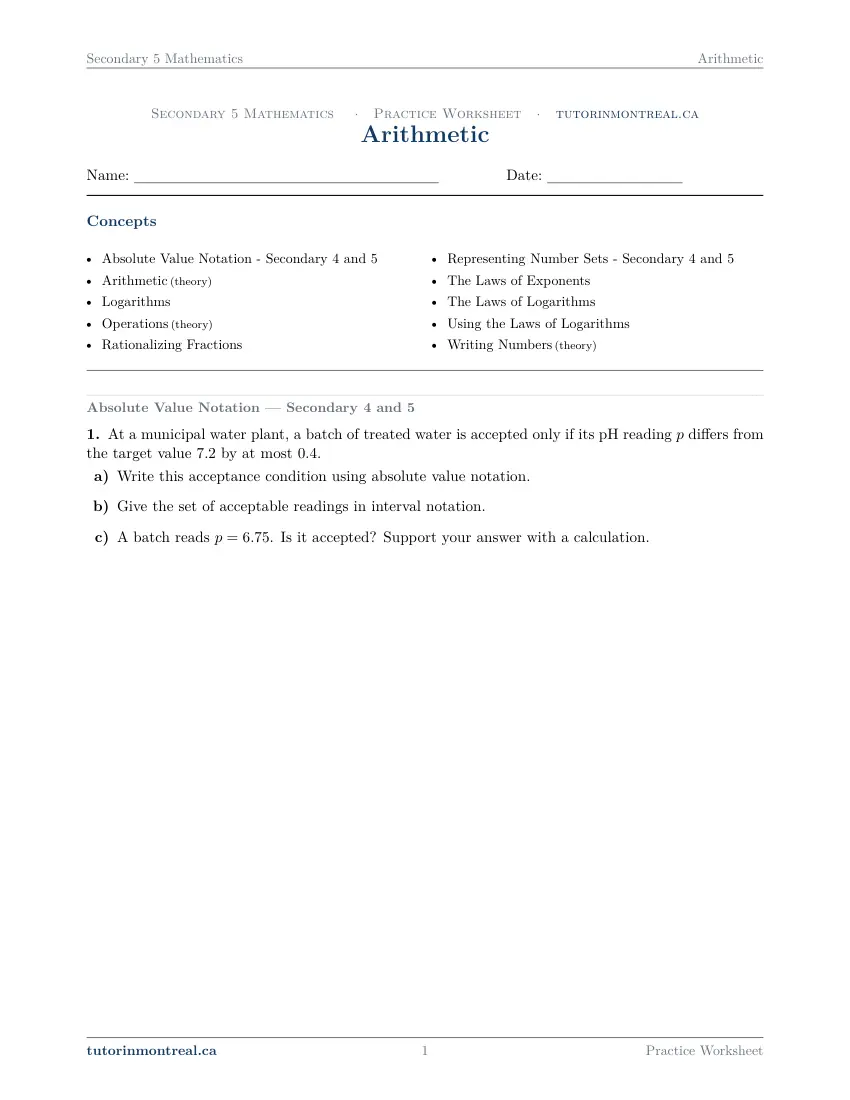
Practice worksheet — free PDF
No email, no account, no watermark. Teachers: photocopy it for your classes freely. Worked solutions and 8 harder problems come with the Secondary 5 Math bundle.
All 11 questions
Each question targets one named concept from the sheet. Read them here, or print the PDF — it has working space under each one.
-
Q1Absolute Value Notation –
At a municipal water plant, a batch of treated water is accepted only if its pH reading differs from the target value by at most .
- Write this acceptance condition using absolute value notation.
- Give the set of acceptable readings in interval notation.
- A batch reads . Is it accepted? Support your answer with a calculation.
-
Q2Arithmetic
Each expression below can be written in a simpler exact form using one main arithmetic tool from this topic (laws of exponents, laws of logarithms, rationalizing a denominator, absolute value). For each one, name the tool you would use and give the simplified exact value.
-
Q3Logarithms
Evaluate without a calculator, showing the exponential form you used in each case.
-
Q4Operations
Evaluate, respecting the priority of operations: Then explain, in one sentence, why and do not have the same value.
-
Q5Rationalizing Fractions
Write each quotient with a rational denominator, in simplest exact form.
-
Q6Representing Number Sets –
A ferry accepts vehicles whose mass is at least t and less than t.
- Write the set of admissible masses (in tonnes) in interval notation and in set-builder notation.
- List, in extension, the elements of .
-
Q7The Laws of Exponents
Simplify, giving your answers with positive exponents only.
-
Q8The Laws of Logarithms
Write each expression as a single logarithm, then evaluate it exactly.
-
Q9Using the Laws of Logarithms
Solve for , giving the answer to the nearest hundredth:
-
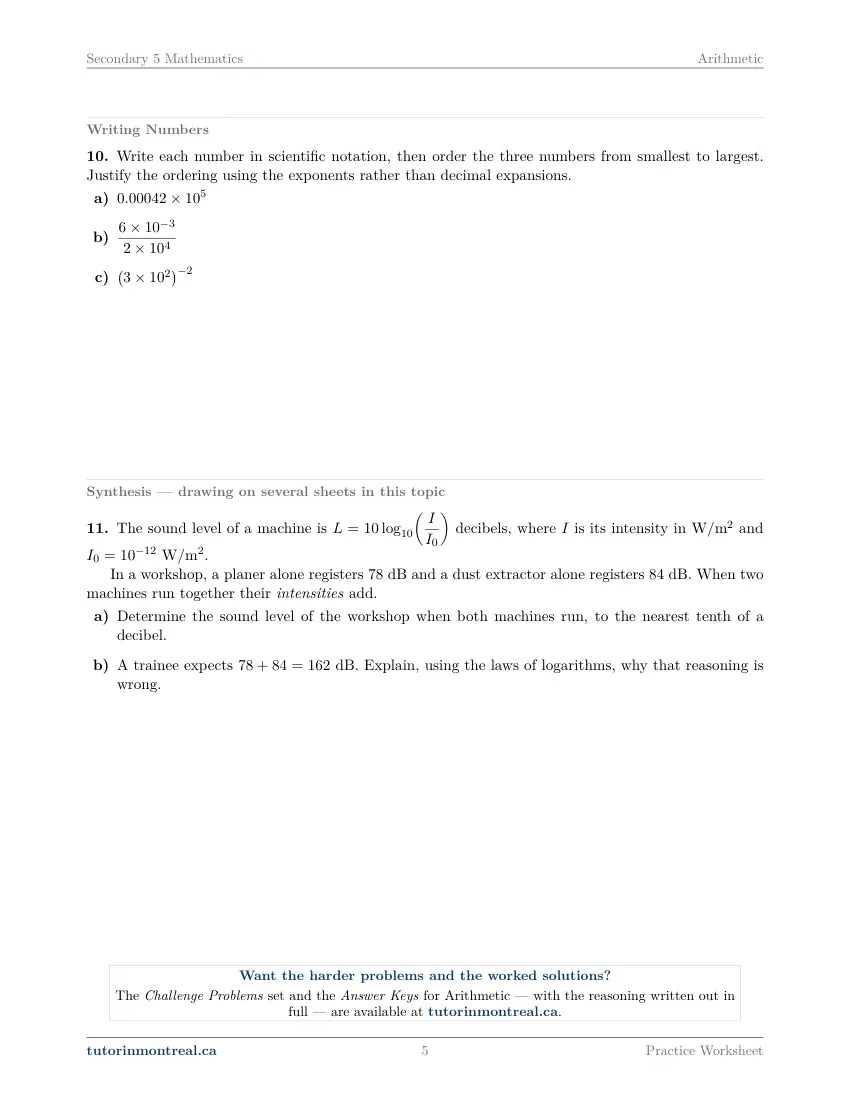
Q10Writing Numbers
Write each number in scientific notation, then order the three numbers from smallest to largest. Justify the ordering using the exponents rather than decimal expansions.
-
Q11Synthesis — drawing on several sheets in this topic
The sound level of a machine is decibels, where is its intensity in and .
In a workshop, a planer alone registers dB and a dust extractor alone registers dB. When two machines run together their intensities add.
- Determine the sound level of the workshop when both machines run, to the nearest tenth of a decibel.
- A trainee expects dB. Explain, using the laws of logarithms, why that reasoning is wrong.
The 8 challenge problems for this topic are a separate, paid sheet and are not reproduced here.
Which stream is this for? This sheet is built for SN. It expects exact answers rather than decimals, logarithms handled from the definition and from their laws, and justifications written in words where the question asks for them — the depth that program expects.
How to do every concept on this sheet
This is the part worksheet sites usually leave out. Below is the actual reasoning behind each group of questions — not a full solution set, the decisions that get you to one. Read it before you start, or after you get stuck.
Absolute value is a distance, and that unlocks Q1
|a − b| is the distance between a and b on the number line. Nothing else about absolute value is worth memorising, because everything else follows. Q1 says a reading must differ from a target by at most a tolerance, which in that language is immediate:
|x − c| ≤ d ⟺ c − d ≤ x ≤ c + d ⟺ x ∈ [c − d, c + d]Write the condition, unfold it into the double inequality, add c across all three parts, and the interval is the answer. Testing a specific reading then means computing the distance and comparing it with the tolerance — one line, with the absolute value bars actually written, because "it looks close enough" is not a justification.
The reversed case. |x − c| ≥ d is not one interval but two: everything at least d away, on either side, so ]−∞, c − d] ∪ [c + d, +∞[. "At most" gives a segment; "at least" gives a union. Sketching the number line with c marked in the middle settles which one you are in far faster than manipulating the inequality does.
Priority of operations, and the sign that is not part of the base
Q4 is an evaluation whose entire difficulty is one pair of brackets. It then asks you to say, in a sentence, why −2⁴ and (−2)⁴ differ.
The exponent binds tighter than the minus sign. In −2⁴ the power applies to 2 alone and the opposite is taken afterwards, so the result is negative. In (−2)⁴ the brackets make −2 itself the base, and an even number of negative factors multiplies out positive.
−2⁴ = −(2 · 2 · 2 · 2) = −16 (−2)⁴ = (−2)(−2)(−2)(−2) = 16The same reasoning explains why an odd exponent makes the two expressions agree — worth a sentence if you want the mark for understanding rather than for arithmetic.
Two other grouping symbols behave like brackets and are read the same way: a radical sign groups everything under it, and absolute value bars group everything between them. Simplify inside first, always. A cube root of a negative number is perfectly real — unlike an even root — which is why ∛(−27) is an ordinary −3 and not an error.
The laws of exponents, and the one habit that fixes most errors
Q7 is two simplifications. The laws themselves are short:
aᵐ · aⁿ = aᵐ⁺ⁿ aᵐ ⁄ aⁿ = aᵐ⁻ⁿ (aᵐ)ⁿ = aᵐⁿ a⁻ⁿ = 1 ⁄ aⁿ a^(m/n) = (ⁿ√a)ᵐThe habit: when a power is applied to a product, it lands on every factor, including the numerical coefficient. In (2a³b⁻²)⁴ the 2 becomes 16, and leaving it as 2 is the most frequent single mistake on questions of this shape.
For a fractional negative exponent on a fraction, do the three jobs in the easiest order: flip, root, power. Invert the fraction to kill the minus sign, take the root indicated by the denominator of the exponent, then raise to the numerator. Taking the root before the power keeps the numbers small — on (27/64)^(−2/3) that means working with 4 and 3 rather than with six-digit cubes.
Finally, "positive exponents only" is an instruction about the form of the answer, not about the algebra: finish the simplification with whatever signs come out, then move the negative-exponent factors across the fraction bar at the end.
Rationalizing: multiply by a well-chosen 1
Q2(a) and Q5 ask for a denominator with no radical in it. The tool depends on how many terms the denominator has.
Clearing a radical from a denominator
Simplify the radical first — it makes every later number smaller.
- 1Simplify the radical
√8 = 2√2. Doing this first often removes half the arithmetic, and sometimes cancels against the numerator before you multiply by anything. - 2One term underneath → multiply top and bottom by that radical
5 ⁄ √2 = 5√2 ⁄ 2. You are multiplying by√2 ⁄ √2, which is 1, so the value is untouched — only its form changes. - 3Two terms underneath → multiply by the conjugate
The conjugate of
a + √bisa − √b. The product is(a)² − (√b)²by the difference of squares, and both radicals vanish at once. This is the only reason the conjugate is the right choice. - 4Watch the sign of the new denominator
(2 + √7)(2 − √7) = 4 − 7 = −3. A negative denominator is normal here; carry the minus into the numerator and simplify rather than leaving it downstairs.
A logarithm is an exponent — say it before every log question
Q3 asks for three logarithms without a calculator, and each one is answered by translating the notation back into a power:
log_b a = c ⟺ b^c = aSo log₂(1/32) is the question "2 to what power gives 1/32?", and the negative exponent is the answer to that question. log₉27 asks the same of a base and a value that are both powers of 3, so the answer is a fraction — writing both numbers as powers of a common base is the move that makes it visible. A base smaller than 1 works identically; it simply forces the exponent negative.
Q8 uses the laws instead. There are three, and they mirror the exponent laws exactly, because a logarithm is an exponent:
log(MN) = log M + log N log(M ⁄ N) = log M − log N log(Mⁿ) = n · log MUsed left to right they break a logarithm apart; used right to left they collect several into one, which is what Q8 wants — condense to a single logarithm first, then evaluate it from the definition. A coefficient in front of a logarithm is a power hiding in plain sight: ½ log 81 is log √81.
There is no law for log(M + N). The product law turns a multiplication inside into an addition outside. It says nothing about an addition inside, and log(M + N) does not simplify at all. Checking with a single number settles it: log(1 + 1) = log 2 ≈ 0.301, while log 1 + log 1 = 0.
This is precisely the error Q11 asks you to diagnose in a decibel context, and it is worth being able to state cleanly, because it appears on exams in half a dozen disguises.
Solving an exponential equation (Q9)
When both sides cannot be written as powers of the same base, take a logarithm of both sides and use the power law to bring the unknown down out of the exponent:
b^(u) = k ⟹ u · log b = log k ⟹ u = log k ⁄ log bThen solve the ordinary equation that remains for x. Two practical points. Any base of logarithm works — base 10 and the natural logarithm give the same answer — because the base cancels in the quotient. And keep the quotient in exact form until the very last step: rounding the intermediate value and then multiplying by 2 doubles the rounding error, which is usually enough to lose the second decimal the question asks for.
Number sets, intervals, and scientific notation
Q6 wants the same set written two ways. Interval notation uses a square bracket at an included end and a reversed bracket at an excluded one, with infinity always reversed; set-builder notation names the set the values live in and the condition they satisfy, as in { m ∈ ℝ | 1.5 ≤ m < 8 }. Choosing the right set matters: a mass is a real number, so the interval is continuous, whereas intersecting an interval with ℤ produces a finite list you write out in extension. On that list, the brackets decide the two endpoints and nothing else does.
Q10 asks for scientific notation and then for an ordering justified by exponents. Scientific notation is a × 10ⁿ with 1 ≤ a < 10, and the normalising step is the one people skip: 0.00042 × 10⁵ is not yet in the form, because 0.00042 is not between 1 and 10. Once every number is normalised, the comparison is easy and is the point of the question — the power of 10 decides the order first, and the leading number only breaks ties between equal powers.
The synthesis question (Q11)
Decibels are defined by a logarithm, and Q11 asks what happens when two machines run at once. The physical fact given to you is that the intensities add, not the levels — so the method is: convert each level back to an intensity using the definition of a logarithm, add the intensities, then convert the total forward again. Part (b) then asks you to explain the trainee's wrong answer, and the explanation is the law that does not exist: adding two logarithms corresponds to multiplying what is inside them, which is not what adding intensities does. Factoring the smaller power of 10 out of the sum before taking the logarithm keeps the arithmetic clean.
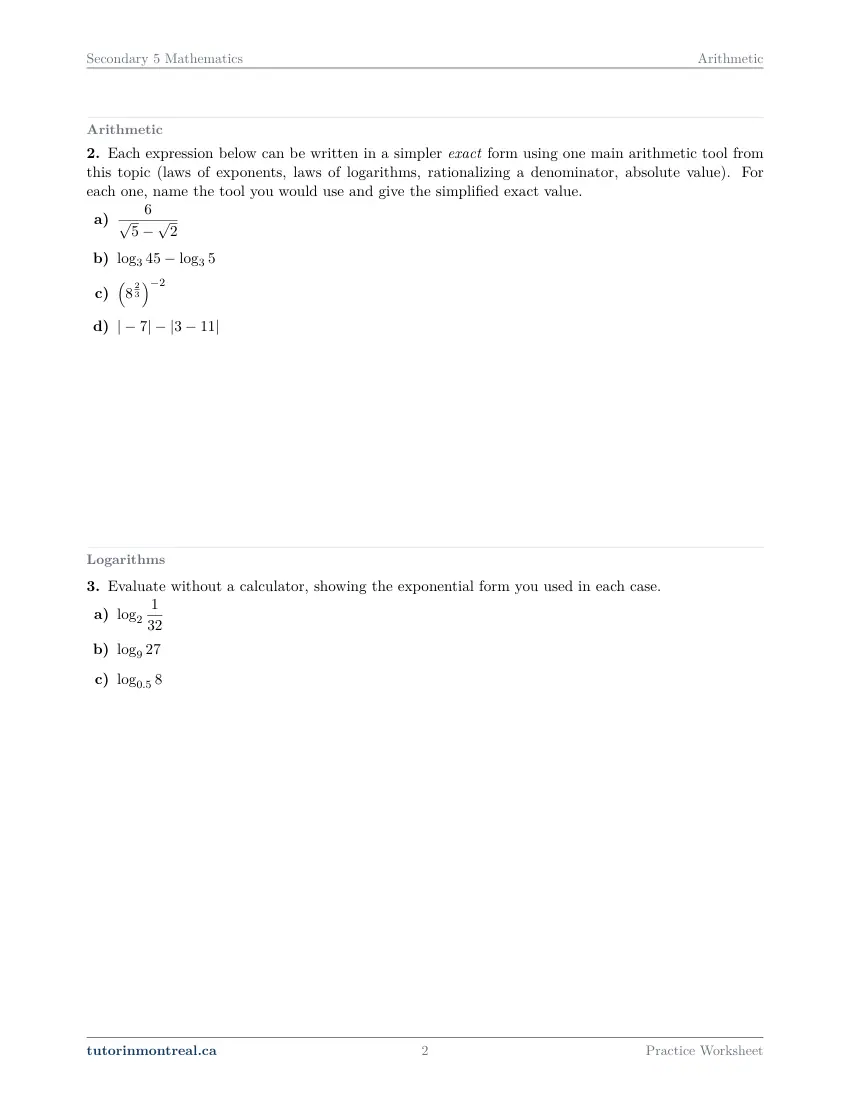
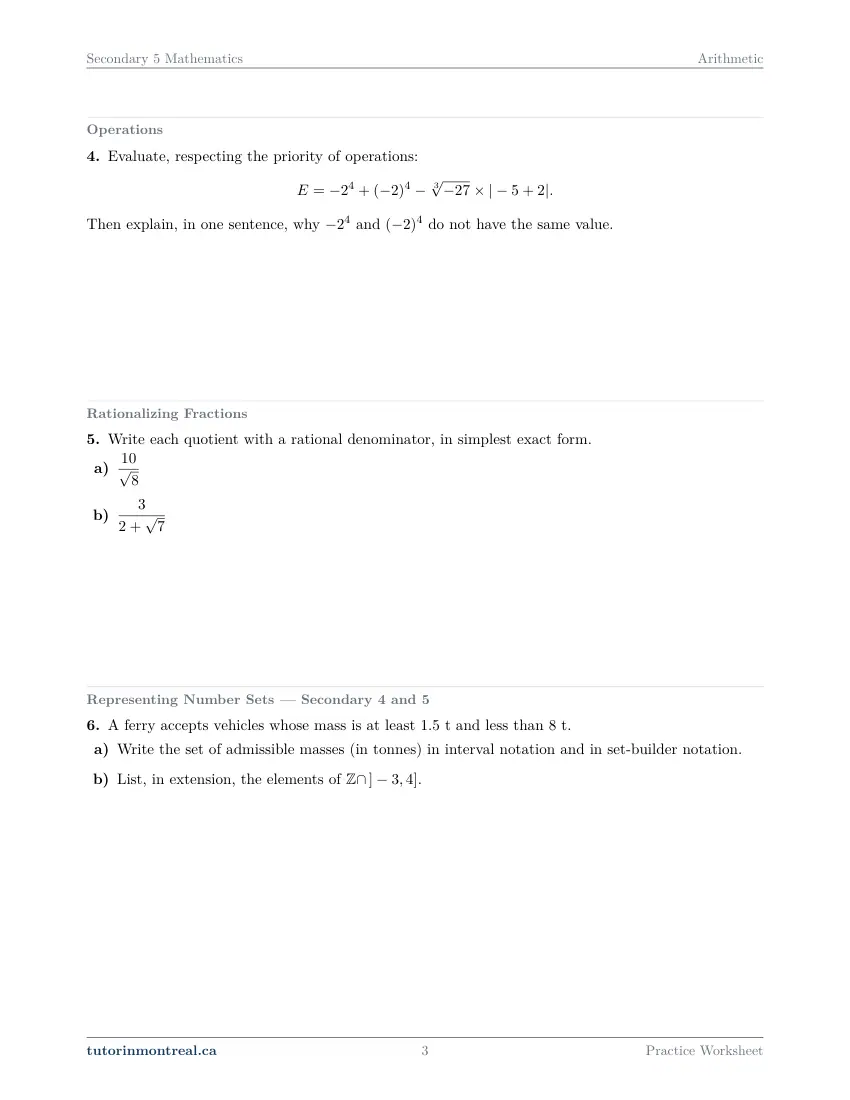
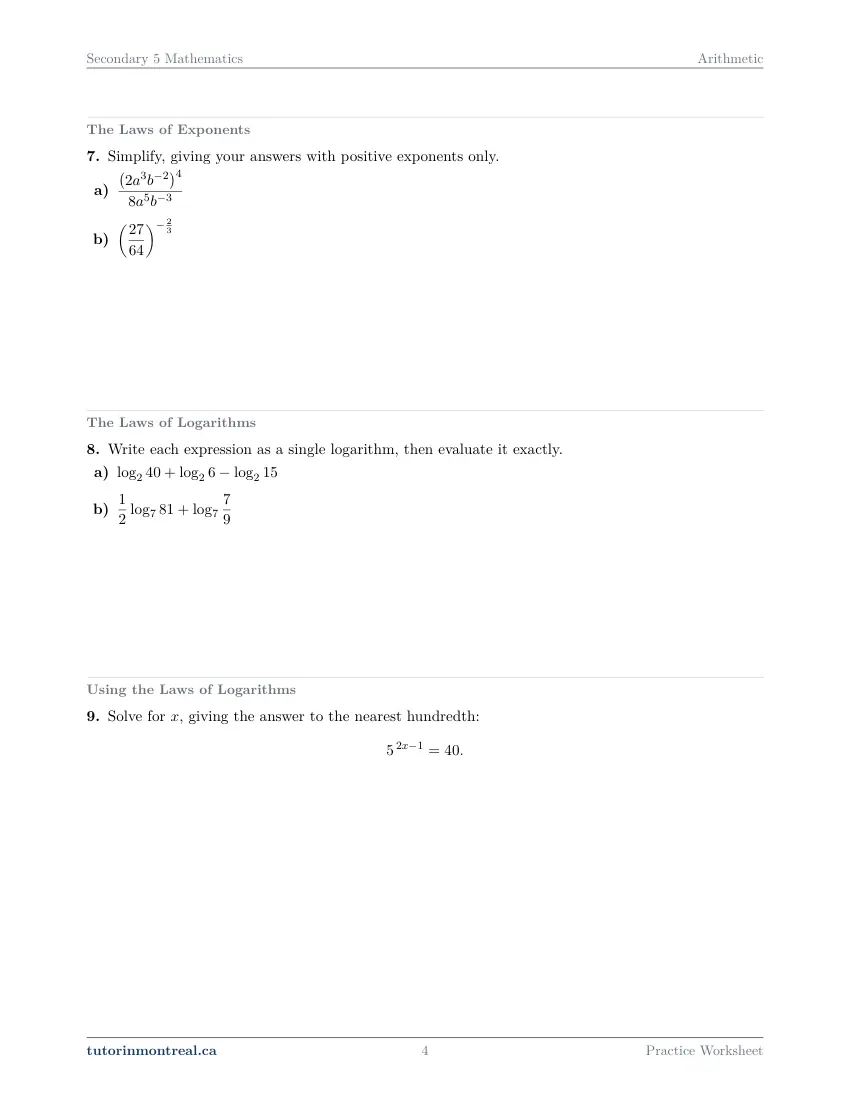
Preview all 5 pages
Click any page to open the full PDF.
Getting the most out of it
Use Q2 as a diagnostic before anything else
It names four tools and asks which one each expression needs. Do it cold, first, and whichever tool you could not name is the section of this sheet to work through — that is more useful than working straight down the page.
No calculator on the logarithm questions
Q3 and Q8 are designed to be done from the definition and the laws. A calculator turns them into typing practice and hides exactly the skill the exam tests. Keep it for Q9, where a decimal answer is actually requested.
Stay in exact form until the final line
Radicals, fractions and logarithms all stay as they are until the question asks for a decimal. Rounding early and then continuing to compute is the most common way to produce an answer that is right in method and wrong in the last digit.
Want the solutions, or something more challenging?
The worksheet, the questions above and every explanation on this page stay free permanently. Three more PDFs exist for this topic — the worked answer key, a harder problem set, and the answer key to that. They come with the Secondary 5 Math Solutions Bundle, which is what keeps the rest of the series free.
What else exists for Arithmetic
Three PDFs · 9 pages · all three are in the bundle below.
- Answer key — 2 pages. All 11 questions worked step by step, including the restrictions and the justifications. Not a list of final answers.
- Challenge problems — 5 pages, 8 problems. A separate sheet at exam-plus difficulty covering the same 10 concepts. Harder than anything on the free sheet.
- Challenge answer key — 2 pages. Every challenge problem worked to the same standard, with the checks shown.
- PDF, letter size, print-ready.
The one thing that's for sale
Every Secondary 5 Math topic — the complete Solutions Bundle
One download, one payment, the whole program. Every answer key and every challenge set for all 21 Secondary 5 Math worksheet sets — including this one.
- Worked solutions, not answer lists — every step written out
- Covers the whole year's program at this level
- Less than the price of one hour of tutoring — for the entire year's solutions
Taking Secondary 1 Math as well? The Secondary 1 Math bundle covers all 15 of its sets — 45 PDFs, 182 pages — on the same terms.
Taking Secondary 2 Math as well? The Secondary 2 Math bundle covers all 14 of its sets — 42 PDFs, 181 pages — on the same terms.
Taking Secondary 3 Math as well? The Secondary 3 Math bundle covers all 11 of its sets — 33 PDFs, 154 pages — on the same terms.
Taking Secondary 4 Math as well? The Secondary 4 Math bundle covers all 17 of its sets — 51 PDFs, 154 pages — on the same terms.
Taking CEGEP Calculus I as well? The CEGEP Calculus I bundle covers all 8 of its sets — 24 PDFs, 82 pages — on the same terms.
Taking CEGEP Calculus II as well? The CEGEP Calculus II bundle covers all 8 of its sets — 24 PDFs, 90 pages — on the same terms.
Taking CEGEP Linear Algebra as well? The CEGEP Linear Algebra bundle covers all 7 of its sets — 21 PDFs, 82 pages — on the same terms.
Taking AP Calculus AB as well? The AP Calculus AB bundle covers all 8 of its sets — 24 PDFs, 126 pages — on the same terms.
Common questions
Is this worksheet really free?
Yes — the questions are on this page to read, and the PDF downloads directly, no email and no account. The one paid item is optional: the complete Secondary 5 Solutions Bundle, which covers every set at this level.
Why is −2⁴ negative but (−2)⁴ positive?
Because the exponent binds tighter than the minus sign. In −2⁴ the power applies to 2 only and the opposite is taken afterwards; in (−2)⁴ the brackets make −2 the base, and four negative factors multiply out positive. With an odd exponent the two expressions agree, which is a good way to check you have understood the reason rather than memorised the case.
How do I evaluate a logarithm without a calculator?
Translate it back into a power: log_b a = c means b to the power c equals a. Then ask what exponent turns the base into the value, writing both as powers of a common base if it helps. Negative and fractional answers are normal — they are what appear when the value is a reciprocal or a root of the base.
Can I split log(a + b) into log a + log b?
No. The product law turns a multiplication inside the logarithm into an addition outside it, and says nothing about an addition inside. log(a + b) has no simplification. One number disproves the claim: log(1 + 1) is about 0.301 while log 1 + log 1 is 0.
What does rationalizing a denominator actually gain?
A form that can be compared and combined. Two answers written over different radicals look different even when they are equal, and adding fractions with radical denominators is awkward. Rationalizing puts every exact answer in a standard shape, which is why marking schemes ask for it.
Which Secondary 5 stream is this for?
It is built for SN. The sheet expects exact values rather than decimals, logarithms handled both from the definition and from their laws, and written justifications where the question asks for them.
Can teachers use this in class?
Yes. Print and photocopy it for your own classes freely — I just ask that the tutorinmontreal.ca footer stays on the page.
I'm stuck on one question. Can you help?
Yes — through one-on-one tutoring, in Montreal or online. Get in touch to arrange a session, or see the current rates.
← All 21 Secondary 5 Math worksheets · Secondary 1 Math series (15 sheets) → · Secondary 2 Math series (14 sheets) → · Secondary 3 Math series (11 sheets) → · Secondary 4 Math series (17 sheets) → · CEGEP Calculus I series (8 sheets) → · CEGEP Calculus II series (8 sheets) → · CEGEP Linear Algebra series (7 sheets) → · AP Calculus AB series (8 sheets) →
The same topic at the other level: Secondary 4 Math · Arithmetic.