Secondary 5 Absolute Value Functions Worksheet
Absolute value equations split into two cases, and almost every difficulty here comes from that split: building the rule from a vertex and one more point, solving both cases and rejecting the impostor, reading the extremum, the range and the intervals of variation off the parameters, sketching the V, rewriting a rule without bars as a piecewise function, and restricting the domain so the inverse relation becomes a function. You can read it here on the page, and printing it costs nothing.
Practice worksheet — free PDF
No email, no account, no watermark. Teachers: photocopy it for your classes freely. Worked solutions and 5 harder problems come with the Secondary 5 Math bundle.
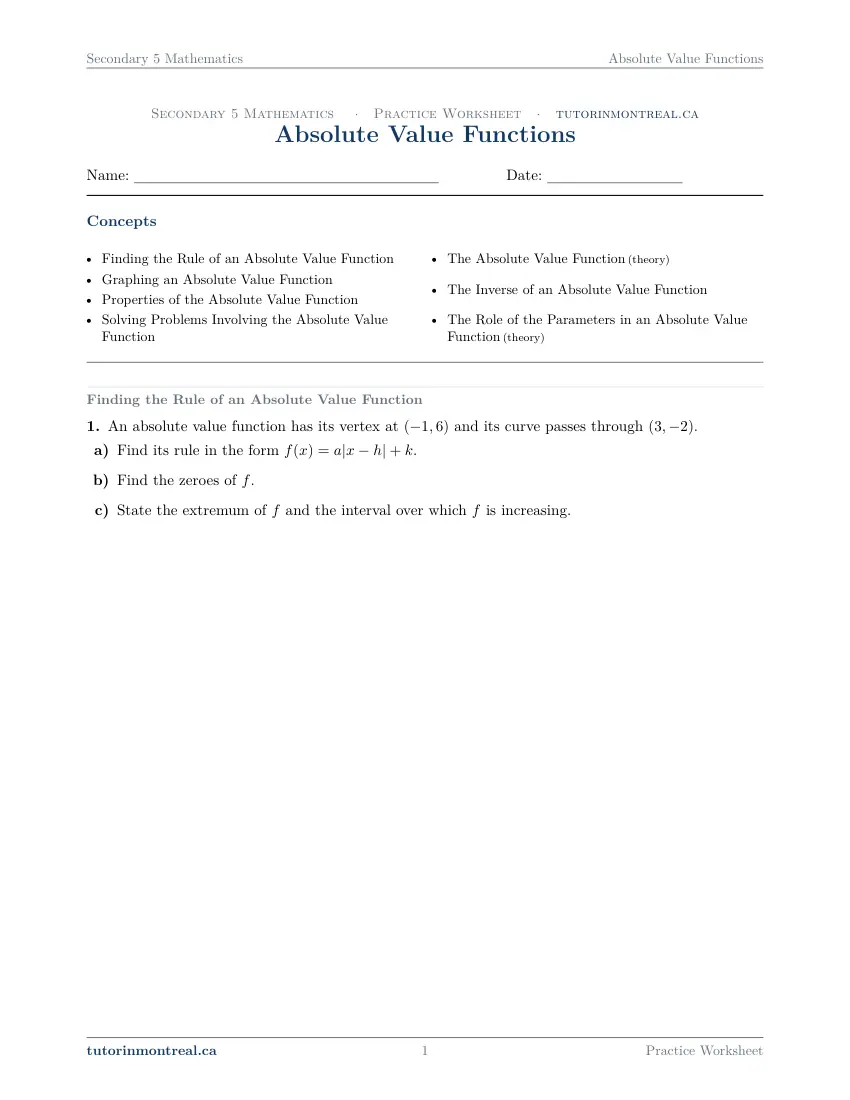
All 7 questions
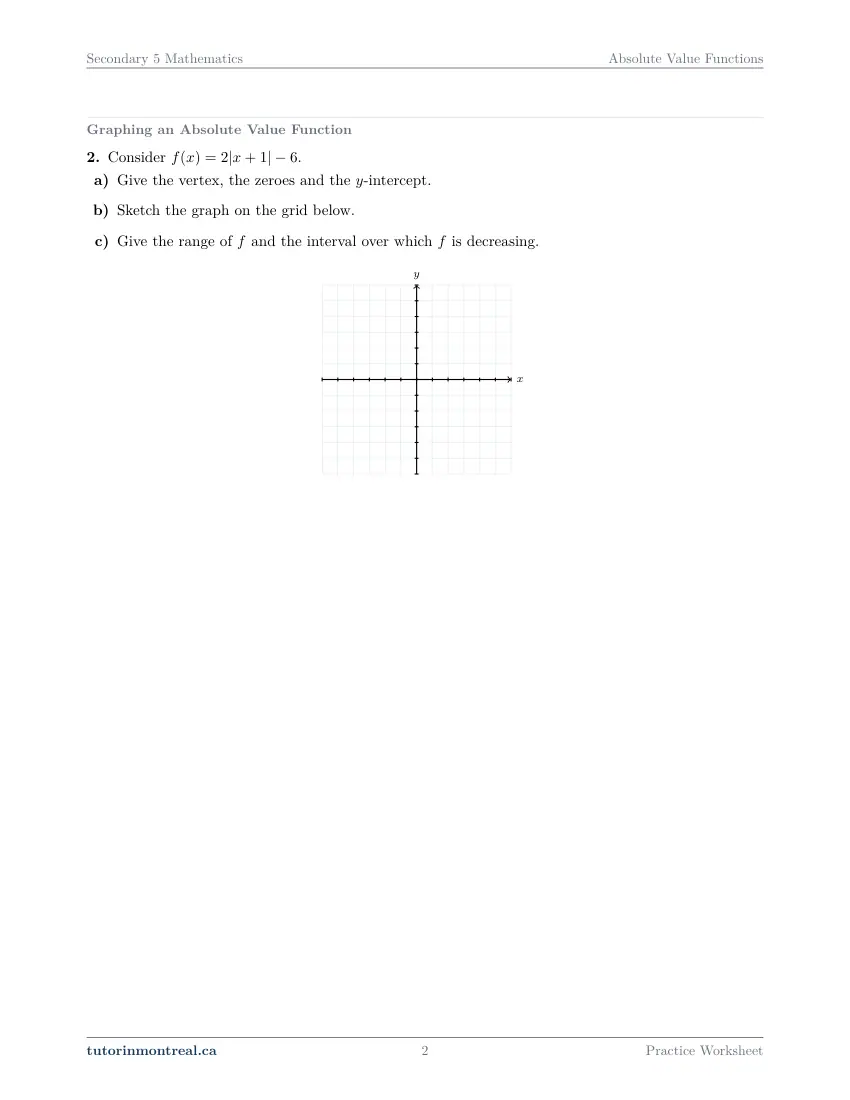
Each question targets one named concept from the sheet. Read them here, or print the PDF — it has working space under each one.
-
Q1Finding the Rule of an Absolute Value Function
An absolute value function has its vertex at and its curve passes through .
- Find its rule in the form .
- Find the zeroes of .
- State the extremum of and the interval over which is increasing.
-
Q2Graphing an Absolute Value Function
Consider .
- Give the vertex, the zeroes and the -intercept.
- Sketch the graph on the grid below.
- Give the range of and the interval over which is decreasing.
A blank Cartesian grid for this question is on the printable PDF.
-
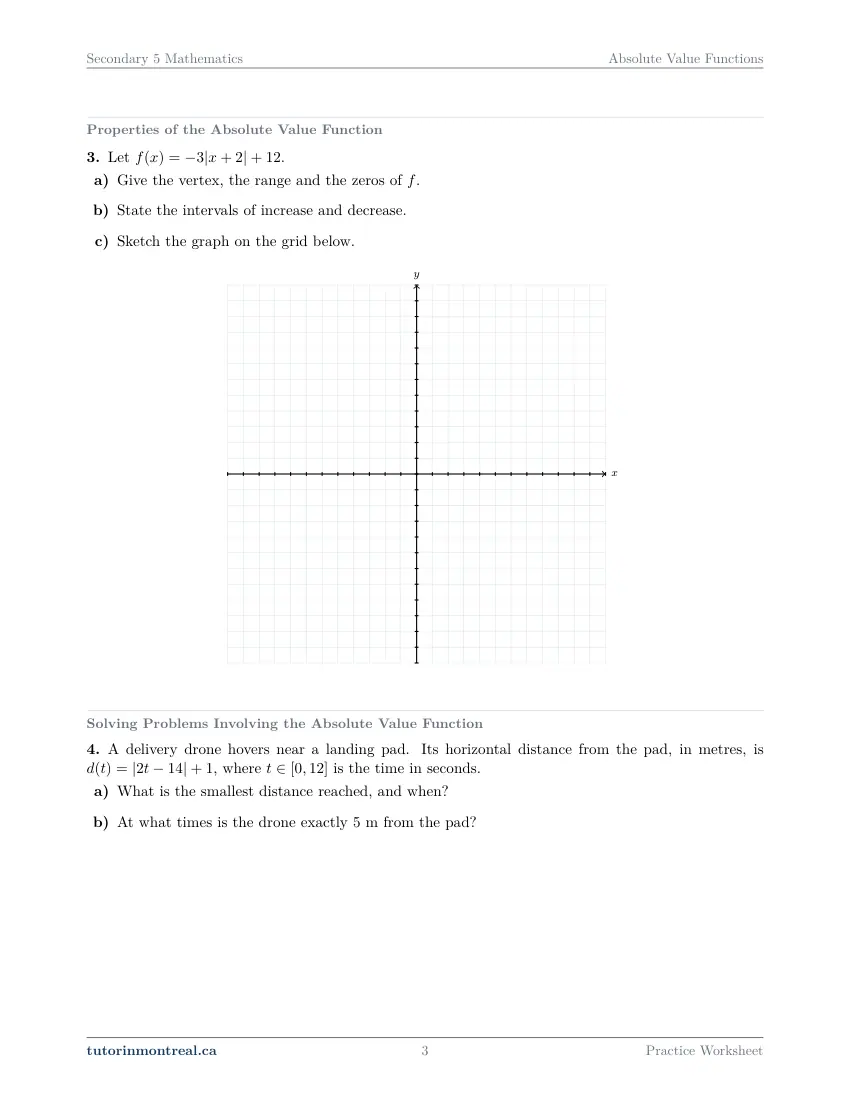
Q3Properties of the Absolute Value Function
Let .
- Give the vertex, the range and the zeros of .
- State the intervals of increase and decrease.
- Sketch the graph on the grid below.
A blank Cartesian grid for this question is on the printable PDF.
-
Q4Solving Problems Involving the Absolute Value Function
A delivery drone hovers near a landing pad. Its horizontal distance from the pad, in metres, is , where is the time in seconds.
- What is the smallest distance reached, and when?
- At what times is the drone exactly m from the pad?
-
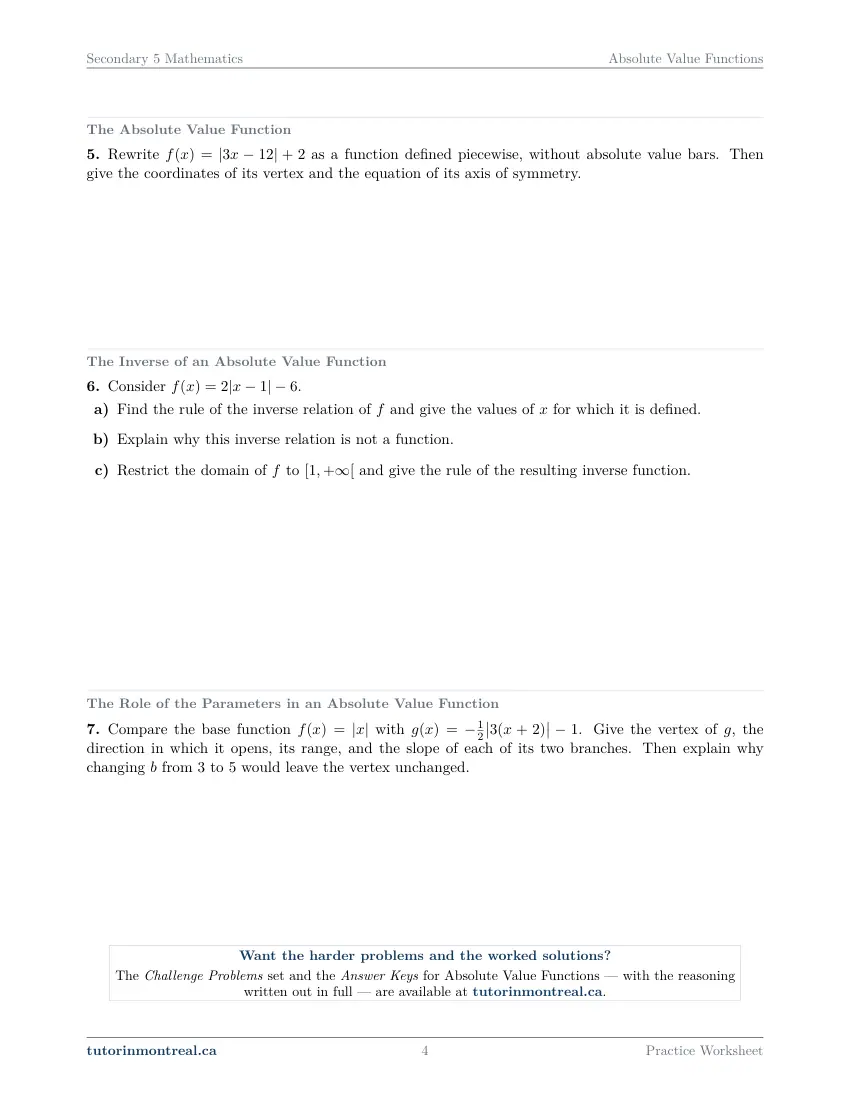
Q5The Absolute Value Function
Rewrite as a function defined piecewise, without absolute value bars. Then give the coordinates of its vertex and the equation of its axis of symmetry.
-
Q6The Inverse of an Absolute Value Function
Consider .
- Find the rule of the inverse relation of and give the values of for which it is defined.
- Explain why this inverse relation is not a function.
- Restrict the domain of to and give the rule of the resulting inverse function.
-
Q7The Role of the Parameters in an Absolute Value Function
Compare the base function with . Give the vertex of , the direction in which it opens, its range, and the slope of each of its two branches. Then explain why changing from to would leave the vertex unchanged.
The 5 challenge problems for this topic are a separate, paid sheet and are not reproduced here.
Which stream is this for? This sheet is built for SN. It assumes you handle the full form a|b(x − h)| + k, write ranges and intervals of variation in interval notation, convert to piecewise form, and construct an inverse on a restricted domain, and it goes to the depth that program expects.
How to do every concept on this sheet
This is the part worksheet sites usually leave out. Below is the actual reasoning behind each group of questions — not a full solution set, the decisions that get you to one. Read it before you start, or after you get stuck.
What the bars actually mean, and why everything else follows
|u| is the distance from u to zero. Two consequences run through every question on this sheet. First, an absolute value is never negative. Second, two different inputs give the same output whenever they sit the same distance from zero — which is exactly why the graph is a V and exactly why the inverse in Q6 misbehaves.
In the standard form
f(x) = a |x − h| + kthe bars are zero precisely when x = h, and nowhere else they can be. So the vertex is (h, k), the axis of symmetry is the vertical line x = h, and every other point of the graph is pushed away from k in the direction the sign of a chooses. Q2, Q3 and Q7 are all that one reading, done carefully.
The form says x − h. Q2's rule is 2|x + 1| − 6, so
h = −1 and the vertex is at (−1, −6); Q3's is −3|x + 2| + 12, so
h = −2. Rewrite the inside as x − (−1) before you read anything if the plus
sign keeps catching you. And note that the domain is always ℝ — an absolute value swallows any
real number. It is the range that gets restricted, and only ever on one side.
The sign of a decides four answers at once
Once you know a's sign, the extremum, the range and both intervals of variation are fixed — you are not deducing them one at a time.
If a > 0 the V opens upward: k is a minimum, the range is [k, +∞[, the function decreases on ]−∞, h] and increases on [h, +∞[.
If a < 0 the branches point downward: k is a maximum, the range is ]−∞, k], the function increases on ]−∞, h] and decreases on [h, +∞[.
This also runs backwards, which is how a question can hand you the range instead of the rule: a range with a lowest value means an upward V and a positive a; a range with a highest value means the opposite.
Two details that cost marks. The bracket at h is closed on both intervals — the vertex belongs to the decreasing piece and to the increasing piece, because a single point cannot be left out of the description of the variation. And the infinite end is always reversed: ]−∞, h], never [−∞, h].
Solving an absolute value equation: two cases, and one check before them
Q1(b), Q2(a), Q3(a) and Q4(b) are all the same move. The bars have to be alone on one side before you split anything.
The procedure, in order
Skipping step 2 is the most common way to produce two confident, wrong answers.
- 1Isolate the absolute value
Undo the
+ k, then divide bya. You want the equation in the shape|expression| = cwith nothing else attached. Dividing by a negative a is where signs go missing — in Q3 you divide by −3 after moving the 12 across. - 2Look at the right-hand side before splitting
If
c < 0there is no solution, full stop, because a distance is never negative. Ifc = 0there is exactly one solution, not two, because the only number at distance 0 from zero is zero itself. Onlyc > 0gives two. - 3Split into the two cases
|u| = cbecomesu = coru = −c. Write both lines down immediately, before solving either — the forgotten second case is the classic half-mark answer. Each case is then an ordinary first-degree equation. - 4Keep only what the context allows
The algebra does not know about the situation. Q4 restricts time to [0, 12] seconds, so any candidate outside that window is discarded, and you should say so explicitly rather than silently dropping it.
The same shape solves inequalities, which is why it is worth doing properly. |u| ≤ c is the single double inequality −c ≤ u ≤ c and gives one bounded interval; |u| ≥ c gives two pieces joined by a union. Sketching the V and the horizontal line y = c tells you which of the two you are looking at faster than any rule.
Building the rule from a vertex and one point (Q1)
The vertex hands you h and k directly, so only a is unknown, and a single extra point determines it. Substitute the point, evaluate the bars to a plain positive number, and solve the one-step equation that is left. With vertex (2, −1) and the curve through (6, 7):
a |6 − 2| − 1 = 7 ⟹ 4a = 8 ⟹ a = 2Then verify by substituting the point back. Note also the symmetry shortcut a question may lean on: the two zeroes of an absolute value function are mirror images across the axis, so their midpoint is h. If a problem gives you the zeroes instead of the vertex, average them and you have h for free.
Sketching the V (Q2 and Q3)
Plot the vertex, then use the slopes. To the right of the vertex the branch rises or falls at a rate of a; to the left it does the mirror image, at a rate of −a. So from (h, k) you can step one unit right and a units up, again and again, and the branch draws itself with no substitution at all.
Then use symmetry to double your points for free. The y-intercept you computed in Q2(a) has a mirror twin on the other branch, the same vertical distance from the axis x = h. Two straight lines, one sharp corner, no curving — an absolute value graph is made of segments, and rounding the vertex like a parabola is a drawing error markers do notice.
Rewriting without bars: the piecewise form (Q5)
Q5 asks for the definition that the bars are shorthand for. The recipe is short: find where the inside changes sign, then write one linear rule for each side.
Set the inside to zero to find the boundary. Where the inside is positive or zero, the bars do nothing and you copy the expression as it is. Where the inside is negative, the bars flip its sign, so you write the whole expression with a minus in front and expand. For |2x − 6| + 1 the boundary is x = 3, giving 2x − 5 when x ≥ 3 and −2x + 7 when x < 3.
Check your two pieces agree at the boundary — they must, because the graph has no break — and that point is the vertex.
One more move worth having: a coefficient inside the bars can be pulled out, because |3x − 12| = 3|x − 4|. Doing that first converts a rule into standard form, which makes the vertex readable without any piecewise work. The same identity is the whole content of Q7.
Why b cannot move the vertex (Q7)
In the full form a|b(x − h)| + k, the parameter b looks like it should shift or reflect something. It cannot, and the reason is one identity:
|b(x − h)| = |b| · |x − h|So a and b collapse into a single effective coefficient a·|b|. Change b from 3 to 5 and the branches get steeper — nothing else. The vertex sits where the inside of the bars is zero, and b(x − h) = 0 happens at x = h for every b ≠ 0, whatever its size or sign.
The sign of b is invisible on the graph. Reflecting a symmetric shape across its own axis of symmetry changes nothing, so a negative b produces exactly the same curve as the positive one. Only the sign of a decides which way the V opens. This is also why a question that gives you graph data can never pin a and b down separately — the data determine the product, and that is all there is to determine.
Distance models (Q4)
Absolute value shows up in context whenever the quantity is a gap: how far something is from a target, how far apart two moving objects are, how far a measurement strays from a nominal value. A gap cannot be negative, so it is the absolute value of a difference, and folding the negative part of a straight line back above the axis is what makes the V.
In Q4 the minimum is not something to search for: the bars contribute their smallest possible value, zero, exactly when the inside is zero, so solve 2t − 14 = 0 and the smallest distance is whatever the constant outside the bars is. Part (b) is then the two-case equation again, with the domain check from step 4 of the procedure above.
The inverse, and why it needs a restriction (Q6)
Swap x and y, isolate the bars, and then undo them — which is where the trouble appears, because undoing an absolute value produces a ±:
|y − h| = c ⟹ y = h ± cThat ± is not sloppiness; it is the honest answer. For every input except one, the inverse relation returns two values, so it fails the definition of a function. The single exception is the image of the vertex, where the ± term is zero and the two branches coincide. Part (b) wants that stated with a concrete pair of preimages, not just asserted.
Restricting the domain fixes it. Keep only half of the V — say [h, +∞[ — and the function becomes one-to-one, so the inverse exists as a function. On that half, x − h ≥ 0, the bars do nothing, and only the + branch of the ± survives; the − branch is what you discard. The domain of the inverse is the range of the original, so it starts at k and runs to infinity, and it is worth writing that down as part of the answer rather than leaving the rule bare.
Preview all 4 pages
Click any page to open the full PDF.
Getting the most out of it
Write both cases before you solve either one
The moment you reach |expression| = c, write the two lines down — one with + c, one with − c — and only then start solving. The lost solution is almost never a calculation error; it is a case that was never written on the page.
Sketch, even when the question does not ask for one
A V takes ten seconds to draw from the vertex and two slopes, and it answers range, extremum, variation and "how many solutions" questions at a glance. On the inequality and inverse questions it turns an abstract argument into something you can point at.
Say what each parameter did, out loud
After Q7, close the sheet and describe from memory what a, b, h and k each control — and which of them the graph cannot see. That one paragraph is what the exam's "justify" marks are actually testing.
Want the solutions, or something more challenging?
The worksheet, the questions above and every explanation on this page stay free permanently. Three more PDFs exist for this topic — the worked answer key, a harder problem set, and the answer key to that. They come with the Secondary 5 Math Solutions Bundle, which is what keeps the rest of the series free.
What else exists for Absolute Value Functions
Three PDFs · 7 pages · all three are in the bundle below.
- Answer key — 2 pages. All 7 questions worked step by step, including the restrictions and the justifications. Not a list of final answers.
- Challenge problems — 3 pages, 5 problems. A separate sheet at exam-plus difficulty covering the same 7 concepts. Harder than anything on the free sheet.
- Challenge answer key — 2 pages. Every challenge problem worked to the same standard, with the checks shown.
- PDF, letter size, print-ready.
The one thing that's for sale
Every Secondary 5 Math topic — the complete Solutions Bundle
One download, one payment, the whole program. Every answer key and every challenge set for all 21 Secondary 5 Math worksheet sets — including this one.
- Worked solutions, not answer lists — every step written out
- Covers the whole year's program at this level
- Less than the price of one hour of tutoring — for the entire year's solutions
Taking Secondary 1 Math as well? The Secondary 1 Math bundle covers all 15 of its sets — 45 PDFs, 182 pages — on the same terms.
Taking Secondary 2 Math as well? The Secondary 2 Math bundle covers all 14 of its sets — 42 PDFs, 181 pages — on the same terms.
Taking Secondary 3 Math as well? The Secondary 3 Math bundle covers all 11 of its sets — 33 PDFs, 154 pages — on the same terms.
Taking Secondary 4 Math as well? The Secondary 4 Math bundle covers all 17 of its sets — 51 PDFs, 154 pages — on the same terms.
Taking CEGEP Calculus I as well? The CEGEP Calculus I bundle covers all 8 of its sets — 24 PDFs, 82 pages — on the same terms.
Taking CEGEP Calculus II as well? The CEGEP Calculus II bundle covers all 8 of its sets — 24 PDFs, 90 pages — on the same terms.
Taking CEGEP Linear Algebra as well? The CEGEP Linear Algebra bundle covers all 7 of its sets — 21 PDFs, 82 pages — on the same terms.
Taking AP Calculus AB as well? The AP Calculus AB bundle covers all 8 of its sets — 24 PDFs, 126 pages — on the same terms.
Common questions
Is this worksheet really free?
Yes — the questions are on this page to read, and the PDF downloads directly, no email and no account. The one paid item is optional: the complete Secondary 5 Solutions Bundle, which covers every set at this level.
Why does an absolute value equation have two solutions?
Because |u| measures distance from zero, and two different numbers sit at the same distance from zero. So |u| = c splits into u = c or u = −c. Check c first, though: if c is negative there is no solution at all, and if c is exactly zero there is only one.
How do I get the vertex from the rule?
The vertex is where the expression inside the bars equals zero, so from a|x − h| + k it is the point (h, k). Watch the sign: |x + 2| is |x − (−2)|, so h is −2. The axis of symmetry is the vertical line through that vertex.
Is the vertex included in the increasing interval or the decreasing one?
Both. The intervals are written with a closed bracket at h on either side, so a function with a minimum decreases on ]−∞, h] and increases on [h, +∞[. The infinite end always takes a reversed bracket.
What does the parameter b change if the vertex stays put?
Only the steepness of the two branches, because |b(x − h)| equals |b| times |x − h|, so a and b act as a single product. The vertex is where b(x − h) is zero, which is x = h for any non-zero b, and the sign of b makes no visible difference at all.
Why is the inverse of an absolute value function not a function?
Because isolating the variable leaves a ±, so almost every input is sent to two different outputs. Restricting the original function to one branch of the V — one side of the vertex — removes the ambiguity, and then the inverse is a genuine function on the range of the original.
Can teachers use this in class?
Yes. Print and photocopy it for your own classes freely — I just ask that the tutorinmontreal.ca footer stays on the page.
I'm stuck on one question. Can you help?
Yes — through one-on-one tutoring, in Montreal or online. Get in touch to arrange a session, or see the current rates.
← All 21 Secondary 5 Math worksheets · Secondary 1 Math series (15 sheets) → · Secondary 2 Math series (14 sheets) → · Secondary 3 Math series (11 sheets) → · Secondary 4 Math series (17 sheets) → · CEGEP Calculus I series (8 sheets) → · CEGEP Calculus II series (8 sheets) → · CEGEP Linear Algebra series (7 sheets) → · AP Calculus AB series (8 sheets) →