Secondary 5 Sample Space and Events Worksheet
The foundations the rest of the probability program is built on: what makes an experiment random, how to write the sample space of a two-stage experiment and count it without double counting, how complements work, how to handle two overlapping groups, and how to tell a theoretical probability from an experimental or a subjective one. These decide whether the later formulas mean anything at all. Print the PDF at no cost, or just read through it here.
Practice worksheet — free PDF
No email, no account, no watermark. Teachers: photocopy it for your classes freely. Worked solutions and 2 harder problems come with the Secondary 5 Math bundle.
All 3 questions
Each question targets one named concept from the sheet. Read them here, or print the PDF — it has working space under each one.
-
Q1Probability –
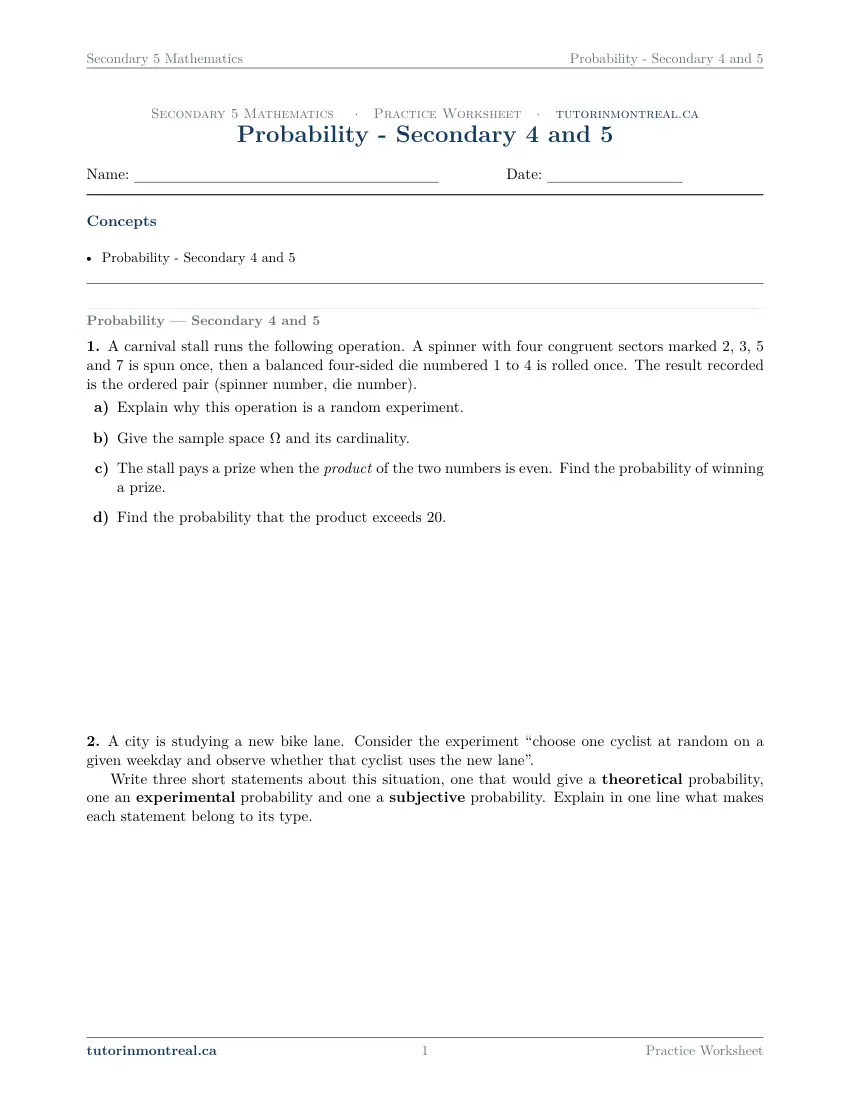
A carnival stall runs the following operation. A spinner with four congruent sectors marked , , and is spun once, then a balanced four-sided die numbered to is rolled once. The result recorded is the ordered pair (spinner number, die number).
- Explain why this operation is a random experiment.
- Give the sample space and its cardinality.
- The stall pays a prize when the product of the two numbers is even. Find the probability of winning a prize.
- Find the probability that the product exceeds .
-
Q2Probability –
A city is studying a new bike lane. Consider the experiment “choose one cyclist at random on a given weekday and observe whether that cyclist uses the new lane”.
Write three short statements about this situation, one that would give a theoretical probability, one an experimental probability and one a subjective probability. Explain in one line what makes each statement belong to its type.
-
Q3Probability –
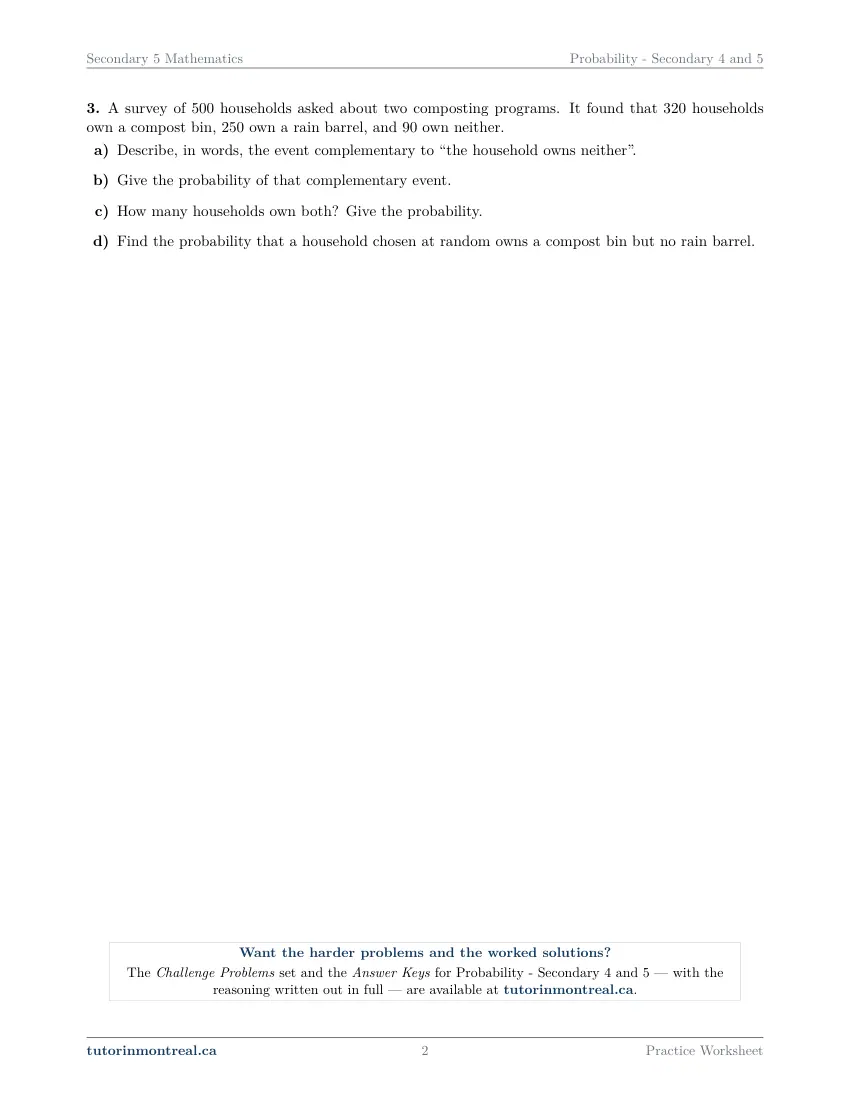
A survey of 500 households asked about two composting programs. It found that 320 households own a compost bin, 250 own a rain barrel, and 90 own neither.
- Describe, in words, the event complementary to “the household owns neither”.
- Give the probability of that complementary event.
- How many households own both? Give the probability.
- Find the probability that a household chosen at random owns a compost bin but no rain barrel.
The 2 challenge problems for this topic are a separate, paid sheet and are not reproduced here.
Which stream is this for? This sheet is built for SN. It expects you to justify equiprobability before counting, to write a sample space properly and to argue about types of probability in full sentences, and it goes to the depth that program expects.
How to do every concept on this sheet
This is the part worksheet sites usually leave out. Below is the actual reasoning behind each group of questions — not a full solution set, the decisions that get you to one. Read it before you start, or after you get stuck.
What makes an experiment random — three conditions, three sentences (Q1a)
"Explain why this operation is a random experiment" is not a warm-up; it is a definition question, and it is marked as three separate claims. An operation is a random experiment when all three hold:
1. It can be repeated as often as you like under the same conditions. 2. All its possible results are known before it is carried out. 3. The result of any one trial cannot be predicted with certainty.
The second and third conditions sound contradictory until you separate them: you know the list of what could happen, you just cannot say which entry of that list will happen. A complete answer applies each of the three to the actual situation in the question rather than reciting the definition — spinning the same spinner again is the same conditions, the sixteen possible pairs are known in advance, and no single spin is predictable.
Writing the sample space of a two-stage experiment (Q1b)
When an experiment has two stages and the result recorded is an ordered pair, the sample space is every possible first result matched with every possible second result. Write it in set-builder form and then show enough of the list for it to be unambiguous:
Ω = {(s, d) | s ∈ {2, 3, 5, 7}, d ∈ {1, 2, 3, 4}}Its cardinality comes from the multiplication principle — four choices at the first stage, each followed by four at the second, gives sixteen outcomes. The word ordered matters: the pair (2, 3) is a different outcome from (3, 2), and the two stages here are different objects anyway.
The sentence that unlocks every later part. Say explicitly that the sixteen outcomes are equiprobable, and why — the sectors are congruent and the die is balanced. That is not a formality. The formula
P(E) = n(E) ⁄ n(Ω)is only valid when the outcomes of Ω are equally likely. Every counting answer on this sheet rests on that one line, and it is a line the marking scheme looks for.
Counting an event without counting anything twice (Q1c, Q1d)
"The product is even" is the classic place to lose a mark, because the natural first thought — add the outcomes where the first number is even to the outcomes where the second number is even — counts twice every outcome where both are even.
Counting a favourable event
Work down the list and stop at the first approach that fits.
- 1Check that Ω is equiprobable
If it is not, counting outcomes is the wrong tool entirely and you need probabilities on the branches instead.
- 2Can you just list them?
With sixteen outcomes, writing out the sixteen products in a 4 × 4 grid takes a minute and makes both parts (c) and (d) a matter of reading. For "the product exceeds 20" that is by far the safest route.
- 3Otherwise split into cases that cannot overlap
For "the product is even": either the first number is even — every second number then works — or the first number is odd, in which case the second must be even. Those two cases share no outcome, so their counts may be added.
- 4Or count the complement
A product is odd exactly when both factors are odd, which is a much smaller thing to count. Then subtract from 1. "At least one" is nearly always cheaper through its complement, "none".
Two events are not two equiprobable outcomes. "The product is even or it is odd — that is two possibilities, so each has probability one half" is a piece of reasoning that feels solid and is not. The formula counting favourable over possible applies to equiprobable outcomes, and an event that groups ten outcomes is not interchangeable with one that groups six. The same argument would give a probability of one half to winning any lottery. Whenever you divide by a total, be able to say what the equally likely outcomes are.
Theoretical, experimental, subjective — and writing them yourself (Q2)
Q2 turns the usual question inside out: instead of classifying three given statements, you have to compose one of each about the same situation, and justify each in a line. That is harder, and it is the version that shows whether the distinction is understood.
Theoretical — the value comes from a model of equiprobable cases, counted before any observation. Your statement must therefore contain a model: some collection of cases and a reason they are interchangeable. Experimental — the value is a relative frequency read off repeated real trials, so your statement must contain a count and a number of trials. Subjective — the value is somebody's judgment, so your statement must name whose judgment it is, and it can be neither counted nor measured.
The one-line justifications are where the marks sit, and the shortest honest summary is worth memorising: a theoretical probability comes from a model, an experimental one from data, and a subjective one from an opinion. A useful test on your own three sentences — ask what more data would do to each. Only the experimental value would move.
Two overlapping groups: one identity does all four parts (Q3)
Q3 gives you how many households own each of two things and how many own neither, and asks for the overlap and for one group without the other. Everything comes from:
n(A ∪ B) = n(A) + n(B) − n(A ∩ B)The subtraction is there for exactly the reason it was needed above — the households owning both were counted once in each of the first two totals, so one copy has to come back out. Rearranged, it hands you the overlap directly.
The route through the question: "owns neither" is the complement of "owns at least one", so subtracting it from the total gives n(A ∪ B). The identity then gives n(A ∩ B). And "owns a compost bin but no rain barrel" is the households owning a bin, minus those owning both — a subtraction, not a new count.
The complement of "neither" is "at least one", not "both". Part (a) asks for the complementary event in words, and this is where it goes wrong. The complement of an event is everything the event excludes — all of it. "Owns neither" excludes owning only the first, owning only the second, and owning both, and the phrase covering those three at once is "owns at least one of the two".
Finish with the four-region check: both, first only, second only, neither. Those four groups are disjoint and cover everybody, so their counts must add to the total surveyed. If they do not, one of your subtractions went the wrong way.
Preview all 2 pages
Click any page to open the full PDF.
Getting the most out of it
Draw the grid, or the two-way table
A two-stage experiment with a manageable number of outcomes belongs in a rectangle: first result down the side, second across the top, the recorded value in each cell. Two overlapping groups belong in a two-by-two table with a totals row and column. Both turn a reasoning question into a reading question, and both make double counting visible instead of invisible.
Say the event in words before you write the fraction
"At least one is even", "neither owns one", "the complement of that" — write the sentence, then decide whether to count it directly, split it into non-overlapping cases, or count its complement. Most errors on this sheet are committed in the translation step, not in the arithmetic.
Justify equiprobability once, out loud
One line at the start — congruent sectors, balanced die, so the outcomes are equally likely — licenses every count that follows and is itself worth marks. On a question where the outcomes are not equally likely, noticing that is the entire question.
Want the solutions, or something more challenging?
The worksheet, the questions above and every explanation on this page stay free permanently. Three more PDFs exist for this topic — the worked answer key, a harder problem set, and the answer key to that. They come with the Secondary 5 Math Solutions Bundle, which is what keeps the rest of the series free.
What else exists for Probability - Secondary 4 and 5
Three PDFs · 4 pages · all three are in the bundle below.
- Answer key — 1 page. All 3 questions worked step by step, including the restrictions and the justifications. Not a list of final answers.
- Challenge problems — 2 pages, 2 problems. A separate sheet at exam-plus difficulty covering the same 1 concept. Harder than anything on the free sheet.
- Challenge answer key — 1 page. Every challenge problem worked to the same standard, with the checks shown.
- PDF, letter size, print-ready.
The one thing that's for sale
Every Secondary 5 Math topic — the complete Solutions Bundle
One download, one payment, the whole program. Every answer key and every challenge set for all 21 Secondary 5 Math worksheet sets — including this one.
- Worked solutions, not answer lists — every step written out
- Covers the whole year's program at this level
- Less than the price of one hour of tutoring — for the entire year's solutions
Taking Secondary 1 Math as well? The Secondary 1 Math bundle covers all 15 of its sets — 45 PDFs, 182 pages — on the same terms.
Taking Secondary 2 Math as well? The Secondary 2 Math bundle covers all 14 of its sets — 42 PDFs, 181 pages — on the same terms.
Taking Secondary 3 Math as well? The Secondary 3 Math bundle covers all 11 of its sets — 33 PDFs, 154 pages — on the same terms.
Taking Secondary 4 Math as well? The Secondary 4 Math bundle covers all 17 of its sets — 51 PDFs, 154 pages — on the same terms.
Taking CEGEP Calculus I as well? The CEGEP Calculus I bundle covers all 8 of its sets — 24 PDFs, 82 pages — on the same terms.
Taking CEGEP Calculus II as well? The CEGEP Calculus II bundle covers all 8 of its sets — 24 PDFs, 90 pages — on the same terms.
Taking CEGEP Linear Algebra as well? The CEGEP Linear Algebra bundle covers all 7 of its sets — 21 PDFs, 82 pages — on the same terms.
Taking AP Calculus AB as well? The AP Calculus AB bundle covers all 8 of its sets — 24 PDFs, 126 pages — on the same terms.
Common questions
Is this worksheet really free?
Yes — the questions are on this page to read, and the PDF downloads directly, no email and no account. The one paid item is optional: the complete Secondary 5 Solutions Bundle, which covers every set at this level.
What is the difference between an outcome and an event?
An outcome is a single element of the sample space — one possible result of the experiment. An event is a set of outcomes, so it may contain one, several, or none of them. This is why two complementary events are almost never equally likely: they group different numbers of outcomes.
When can I use favourable over possible?
Only when the outcomes of the sample space are equiprobable, and you should say why they are before using it. If the outcomes are not equally likely — different sector sizes, a loaded die, unequal group sizes — the count is meaningless and you have to work with the probabilities of the branches instead.
What is the complement of 'owns neither'?
"Owns at least one of the two." A complement contains everything the original event leaves out, which here means owning only the first, owning only the second, and owning both. The answer "owns both" is the most common wrong one, because it keeps only the third of those three cases.
How do I count 'at least one' without counting anything twice?
Two safe routes. Either split into cases that cannot overlap — the first has the property, or the first does not and the second does — and add. Or count the complement, "none of them has the property", and subtract from 1. Adding the two separate counts directly double counts every outcome where both hold.
How are theoretical, experimental and subjective probability different?
A theoretical probability comes from a model of equiprobable cases and is fixed by that model. An experimental probability is a relative frequency read from real trials, so it shifts with each new sample and settles towards the theoretical value as the number of trials grows. A subjective probability is a personal judgment about a one-off event, and it changes only if the person changes their mind.
Can teachers use this in class?
Yes. Print and photocopy it for your own classes freely — I just ask that the tutorinmontreal.ca footer stays on the page.
I'm stuck on one question. Can you help?
Yes — through one-on-one tutoring, in Montreal or online. Get in touch to arrange a session, or see the current rates.
← All 21 Secondary 5 Math worksheets · Secondary 1 Math series (15 sheets) → · Secondary 2 Math series (14 sheets) → · Secondary 3 Math series (11 sheets) → · Secondary 4 Math series (17 sheets) → · CEGEP Calculus I series (8 sheets) → · CEGEP Calculus II series (8 sheets) → · CEGEP Linear Algebra series (7 sheets) → · AP Calculus AB series (8 sheets) →
The same topic at the other level: Secondary 4 Math · Probability - Secondary 4 and 5.