Secondary 5 Function Properties and Inverses Worksheet
The properties that cut across the whole function catalogue instead of belonging to one family: naming a function from its rule, reading its domain, inverting it, evaluating it piece by piece or cycle by cycle, and predicting what a, b, h and k do to any graph written in standard form. Learn them once and every later chapter gets shorter. The PDF prints at no charge, with the reasoning spelled out below it.
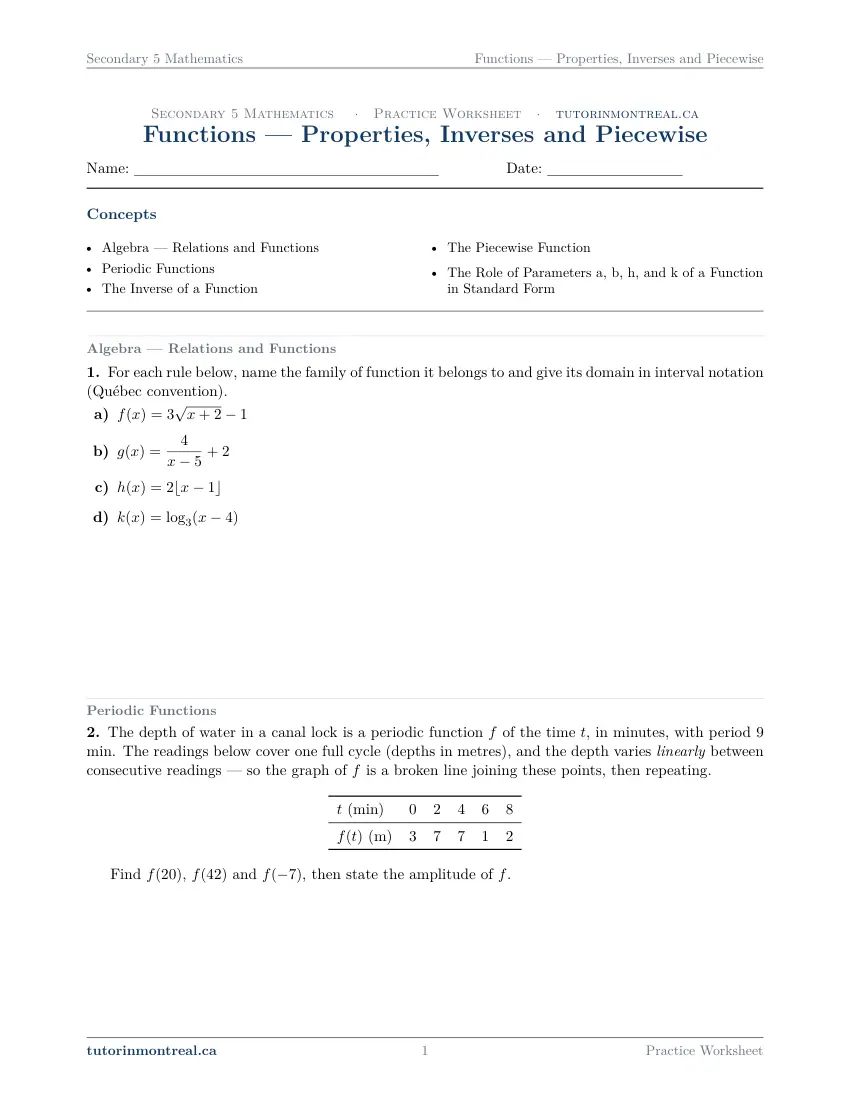
Practice worksheet — free PDF
No email, no account, no watermark. Teachers: photocopy it for your classes freely. Worked solutions and 5 harder problems come with the Secondary 5 Math bundle.
4 of the 5 questions
Each question targets one named concept from the sheet. Read them here, or print the PDF — it has working space under each one. 4 of the 5 questions are printed below. The other 1 is built on a diagram or a table of values that does not translate to the page, so it is in the free PDF — marked below where it would have come.
-
Q1Algebra — Relations and Functions
For each rule below, name the family of function it belongs to and give its domain in interval notation (Québec convention).
-
Q2Periodic Functions
This question is built around a diagram or a table of values. Open it in the PDF.
-
Q3The Inverse of a Function
Let . Find the rule of , then verify your answer by computing .
-
Q4The Piecewise Function
A function is defined by Evaluate , , and , give the maximum value of , and state whether the graph has a break at (justify).
-
Q5The Role of Parameters a, b, h and k of a Function in Standard Form
The point belongs to the base function . The transformed function is Find the coordinates of the image of on the graph of , and name the transformation produced by each of the four parameters.
The 5 challenge problems for this topic are a separate, paid sheet and are not reproduced here.
Which stream is this for? This sheet is built for SN. It assumes the full catalogue — radical, rational, logarithmic, step, periodic and piecewise rules — and it expects domains in Québec interval notation and justified answers, which is the depth that program expects.
How to do every concept on this sheet
This is the part worksheet sites usually leave out. Below is the actual reasoning behind each group of questions — not a full solution set, the decisions that get you to one. Read it before you start, or after you get stuck.
Naming the family, and reading the domain straight off the rule
Q1 gives four rules and asks for the family and the domain of each. It looks like vocabulary and it is really a single technique: the family tells you which part of the rule is fragile, and the fragile part gives you the domain.
What restricts a domain, by family
Find the fragile part, write its condition, solve it. That is the whole answer.
- 1Even radical → the radicand must be ≥ 0
A square root of a negative number does not exist in ℝ. Solve the inequality on what sits under the sign and you have the domain; the answer is a half-line with a square bracket at the end, because the radicand is allowed to be exactly zero.
- 2Rational → the denominator must be ≠ 0
Solve the equation "denominator = 0" and throw those values out. One excluded value in the middle of ℝ means the domain is a union of two intervals, both with reversed brackets at the excluded end.
- 3Logarithm → the argument must be > 0
Strictly positive: zero is excluded too, because no power of a positive base is ever 0. The bracket is reversed, and this is the family where the strict inequality is most often written as ≥ by accident.
- 4Polynomial, step, absolute value → all of ℝ
Nothing is fragile: the greatest integer of any real number exists, and so does any polynomial. Write
ℝ, or]−∞, +∞[. A restriction here would have to come from the context of a problem, not from the rule.
Notice that the constants outside the fragile part never restrict anything. In a rule such as 3√(x + 2) − 1 the 3 and the −1 change the shape of the graph and change the range; they have no effect whatever on which x are allowed. Students routinely try to fold them into the condition. Only the radicand matters.
Periodic functions: fold the argument back into one cycle
Q2 gives one full cycle of a periodic function and then asks for values far outside it, including a negative time. (Its table of readings is on the printable sheet.) The definition does all the work:
f(t + p) = f(t) for every t, where p is the periodSo add or subtract whole periods until the argument lands inside one recorded cycle, then read the value there. For a period of 9 and an argument of 20, subtract two periods to reach 2. For a negative argument, add periods until you are back in range — the rule works in both directions, and a negative time is not a special case.
Amplitude is not the maximum. The amplitude is half the total swing:
amplitude = (maximum − minimum) ⁄ 2A function oscillating between 1 and 7 has amplitude 3, not 7. Two related traps: the maximum and minimum must be taken over a whole cycle, not over the listed points only, and when the graph is a broken line joining given points the last segment runs from the final listed value back up to the first one — that closing segment is part of the cycle and is easy to forget.
The inverse: exchange the variables, then isolate
Q3 is four lines of algebra, and it is worth doing them in a fixed order every time.
Finding f⁻¹
Exchange first, isolate second. Doing it the other way round is where signs get lost.
- 1Write y = f(x)
Nothing clever yet — just name the output.
- 2Exchange x and y
This single move is the inversion: it swaps the roles of input and output, which is the same as swapping the coordinates of every point of the graph. Geometrically it reflects the curve in the line y = x.
- 3Isolate y
Ordinary equation solving. Undo the operations in reverse order of how they were applied — the last thing done to x is the first thing you undo.
- 4Verify by composing
Q3 asks for exactly this, and it is not busywork: f(f⁻¹(a)) = a is the definition of an inverse. If the composition does not return the number you started with, the algebra is wrong and you have caught it in ten seconds.
f⁻¹ is not 1 ⁄ f. The −1 is not an exponent here; it is notation for "the function that undoes f". For f(x) = 3x, the inverse is x ⁄ 3, while 1 ⁄ f(x) is 1 ⁄ (3x) — two entirely different functions.
The second thing to know is when an inverse is a function at all. It is exactly when f is injective: distinct inputs must have distinct outputs, so no horizontal line may cut the graph more than once. That is why a quadratic, an absolute value or a step function has to have its domain restricted before it can be inverted, while a strictly increasing rule can always be inverted as it stands.
Piecewise: the condition chooses the rule, not the other way round
Q4 asks for four evaluations, a maximum and a judgement about a break. To evaluate, look at the input, find the one condition it satisfies, and use that line — the other lines are irrelevant at that number, however tempting their formulas look. Pay attention to whether each boundary carries ≤ or <, because at a boundary exactly one piece owns the point.
For the maximum, a piece with a strict inequality at its end approaches a value without reaching it, and a value that is never attained cannot be the maximum. Compute what each piece approaches at each end, mark which ends are attained, and take the greatest attained value.
A break at a boundary means the value the neighbouring piece is heading towards is not the value actually assigned there. Justifying it is a two-part sentence: what the left piece approaches, and what the function is really equal to. "The graph jumps" on its own is not a justification.
The parameters a, b, h and k
Q5 gives a point of a base function and a transformed rule, and asks where the point goes and what each parameter did. Written in standard form g(x) = a · f(b(x − h)) + k, each letter has exactly one job:
(x, y) ⟼ ( h + x ⁄ b , k + a · y )b scales horizontally by the factor 1 ⁄ |b| — so b = ⅓ stretches by 3, which feels backwards and is the most common slip. a scales vertically by |a| and, when a < 0, reflects across the horizontal axis. h translates right, k translates up. Apply them in that order — scalings first, translations last — and a known point of the base function lands where it should.
A safer route than memorising the mapping: ask what value of x makes the argument b(x − h) equal to the argument of the point you know. Solve that little equation, then feed the answer through the outside of the rule. It takes one extra line and it never depends on remembering which way b goes.
Factor b out of the argument first. A rule written f(2x − 6) is not a translation of 6; rewriting the argument as 2(x − 3) shows the translation is 3. In general f(bx + d) = f(b(x + d ⁄ b)), so h = −d ⁄ b. The parameter h can only be read directly once b is outside the bracket, and reading it off an unfactored argument is a mistake that produces a plausible, entirely wrong graph.
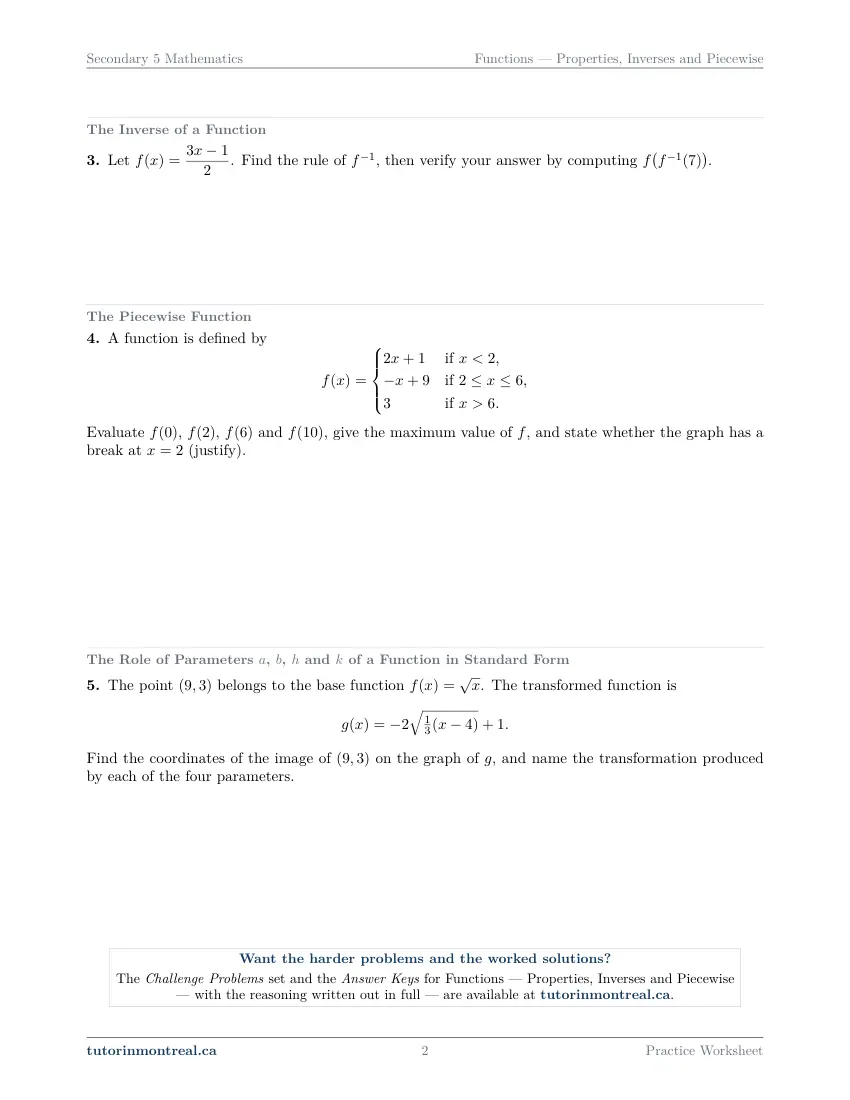
Preview all 2 pages
Click any page to open the full PDF.
Getting the most out of it
Sketch the base function before you touch the parameters
Draw the plain square root, the plain step, the plain reciprocal — small, in the margin, unlabelled. Every parameter question becomes a question about moving one curve you can already see, instead of about a formula you are trying to recall.
Check every inverse by composing, every time
Substituting one number back through both functions catches essentially every algebra slip in Q3, and it takes ten seconds. Build the habit here and it transfers to every equation you solve for the rest of the year.
Use Q1 as a weekly two-minute drill
Cover the answers, name the four families, write the four domains. Do it again a week later. Domain conditions are recall, not reasoning, and recall responds to spacing far better than to a single long session.
Want the solutions, or something more challenging?
The worksheet, the questions above and every explanation on this page stay free permanently. Three more PDFs exist for this topic — the worked answer key, a harder problem set, and the answer key to that. They come with the Secondary 5 Math Solutions Bundle, which is what keeps the rest of the series free.
What else exists for Functions - Properties, Inverses and Piecewise
Three PDFs · 6 pages · all three are in the bundle below.
- Answer key — 1 page. All 5 questions worked step by step, including the restrictions and the justifications. Not a list of final answers.
- Challenge problems — 3 pages, 5 problems. A separate sheet at exam-plus difficulty covering the same 5 concepts. Harder than anything on the free sheet.
- Challenge answer key — 2 pages. Every challenge problem worked to the same standard, with the checks shown.
- PDF, letter size, print-ready.
The one thing that's for sale
Every Secondary 5 Math topic — the complete Solutions Bundle
One download, one payment, the whole program. Every answer key and every challenge set for all 21 Secondary 5 Math worksheet sets — including this one.
- Worked solutions, not answer lists — every step written out
- Covers the whole year's program at this level
- Less than the price of one hour of tutoring — for the entire year's solutions
Taking Secondary 1 Math as well? The Secondary 1 Math bundle covers all 15 of its sets — 45 PDFs, 182 pages — on the same terms.
Taking Secondary 2 Math as well? The Secondary 2 Math bundle covers all 14 of its sets — 42 PDFs, 181 pages — on the same terms.
Taking Secondary 3 Math as well? The Secondary 3 Math bundle covers all 11 of its sets — 33 PDFs, 154 pages — on the same terms.
Taking Secondary 4 Math as well? The Secondary 4 Math bundle covers all 17 of its sets — 51 PDFs, 154 pages — on the same terms.
Taking CEGEP Calculus I as well? The CEGEP Calculus I bundle covers all 8 of its sets — 24 PDFs, 82 pages — on the same terms.
Taking CEGEP Calculus II as well? The CEGEP Calculus II bundle covers all 8 of its sets — 24 PDFs, 90 pages — on the same terms.
Taking CEGEP Linear Algebra as well? The CEGEP Linear Algebra bundle covers all 7 of its sets — 21 PDFs, 82 pages — on the same terms.
Taking AP Calculus AB as well? The AP Calculus AB bundle covers all 8 of its sets — 24 PDFs, 126 pages — on the same terms.
Common questions
Is this worksheet really free?
Yes — the questions are on this page to read, and the PDF downloads directly, no email and no account. The one paid item is optional: the complete Secondary 5 Solutions Bundle, which covers every set at this level.
Is f⁻¹ the same thing as 1/f?
No. The −1 in f⁻¹ is notation for the function that undoes f, not an exponent. For f(x) = 3x the inverse is x/3, while 1/f(x) is 1/(3x). Mixing the two is the single most common error on inverse questions.
Which functions actually have an inverse function?
Only injective ones — functions where distinct inputs always give distinct outputs, so that no horizontal line meets the graph twice. A strictly increasing or strictly decreasing rule qualifies. A quadratic, an absolute value or a step function does not, unless you first restrict its domain to a piece on which it is monotonic.
How do I evaluate a periodic function at a time outside the cycle I was given?
Add or subtract whole periods until the argument lands inside one recorded cycle, then read the value there. It works in both directions, so a negative argument is handled by adding periods rather than subtracting them.
Is the amplitude the same as the maximum value?
No. The amplitude is half the difference between the maximum and the minimum over a full cycle. A function swinging between 1 and 7 has amplitude 3. The maximum only equals the amplitude in the special case where the minimum is the opposite of the maximum.
Why does a piecewise function have a break at a boundary?
Because the value one piece is heading towards at that boundary is not the value the function is actually assigned there. Justify it by naming both numbers: what the neighbouring piece approaches, and what the function equals. The size of the jump is the difference between them.
Can teachers use this in class?
Yes. Print and photocopy it for your own classes freely — I just ask that the tutorinmontreal.ca footer stays on the page.
I'm stuck on one question. Can you help?
Yes — through one-on-one tutoring, in Montreal or online. Get in touch to arrange a session, or see the current rates.
← All 21 Secondary 5 Math worksheets · Secondary 1 Math series (15 sheets) → · Secondary 2 Math series (14 sheets) → · Secondary 3 Math series (11 sheets) → · Secondary 4 Math series (17 sheets) → · CEGEP Calculus I series (8 sheets) → · CEGEP Calculus II series (8 sheets) → · CEGEP Linear Algebra series (7 sheets) → · AP Calculus AB series (8 sheets) →
The same topic at the other level: Secondary 4 Math · Functions - Properties, Inverses and Piecewise.