Secondary 4 Function Properties and Inverses Worksheet
The vocabulary sheet the rest of the Secondary 4 functions year leans on: naming a function's family from where the variable sits, giving the complete property list of a graph, evaluating a periodic function far outside its first cycle, choosing branches in a piecewise rule and testing continuity at the joins, writing an inverse relation and deciding whether it is still a function, and saying exactly what each of a, b, h and k controls. Skim it here before you commit paper to it. The PDF is free and there is no sign-up.
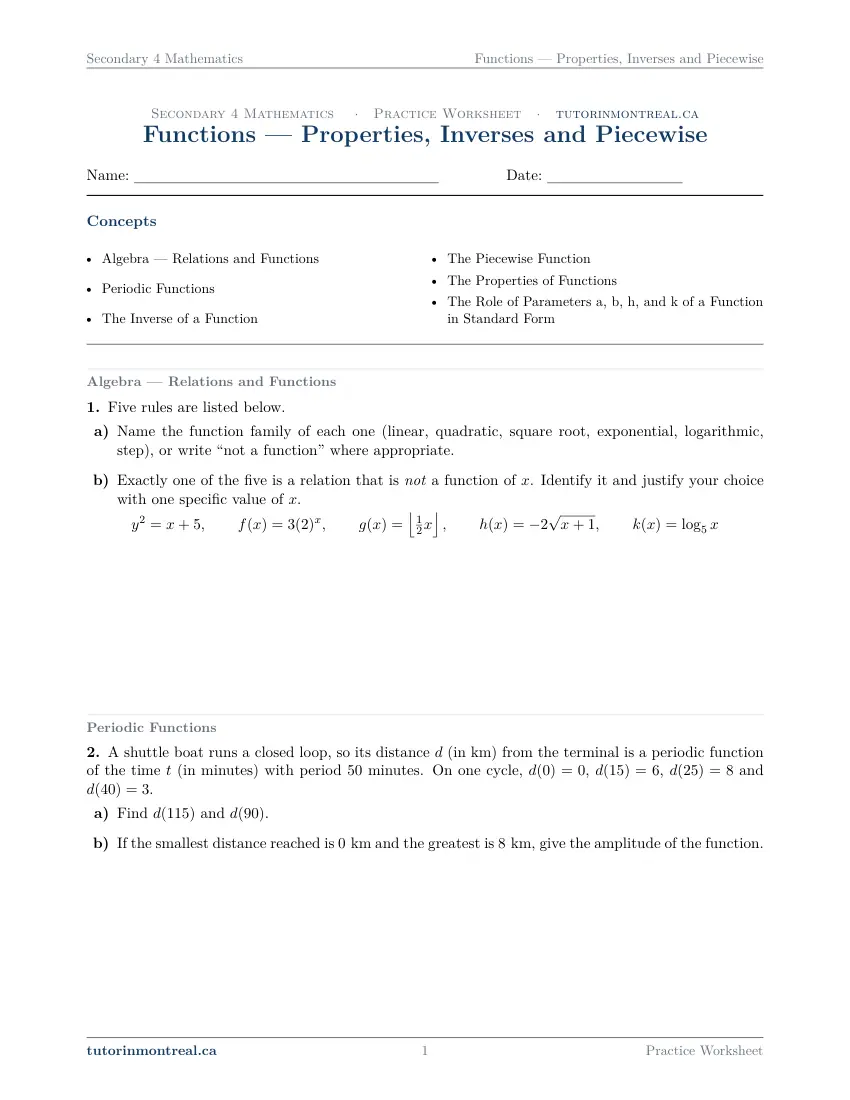
Practice worksheet — free PDF
No email, no account, no watermark. Teachers: photocopy it for your classes freely. Worked solutions and 6 harder problems come with the Secondary 4 Math bundle.
All 6 questions
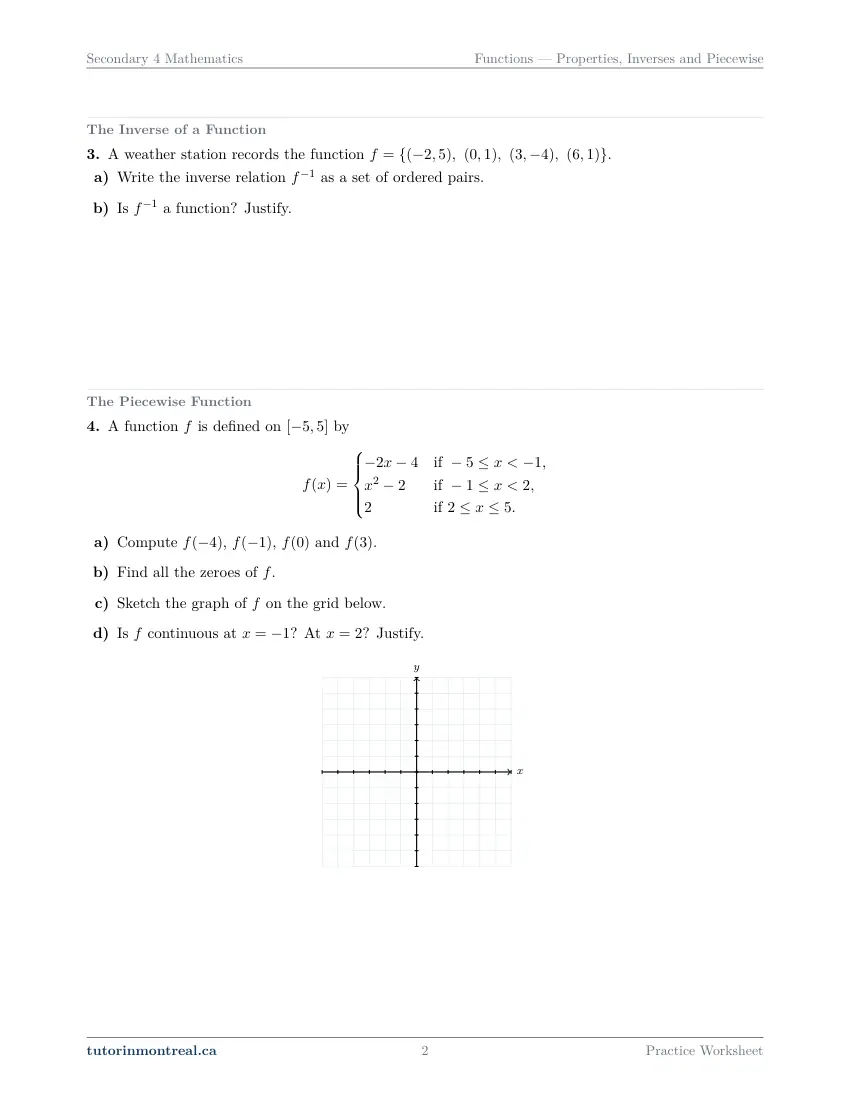
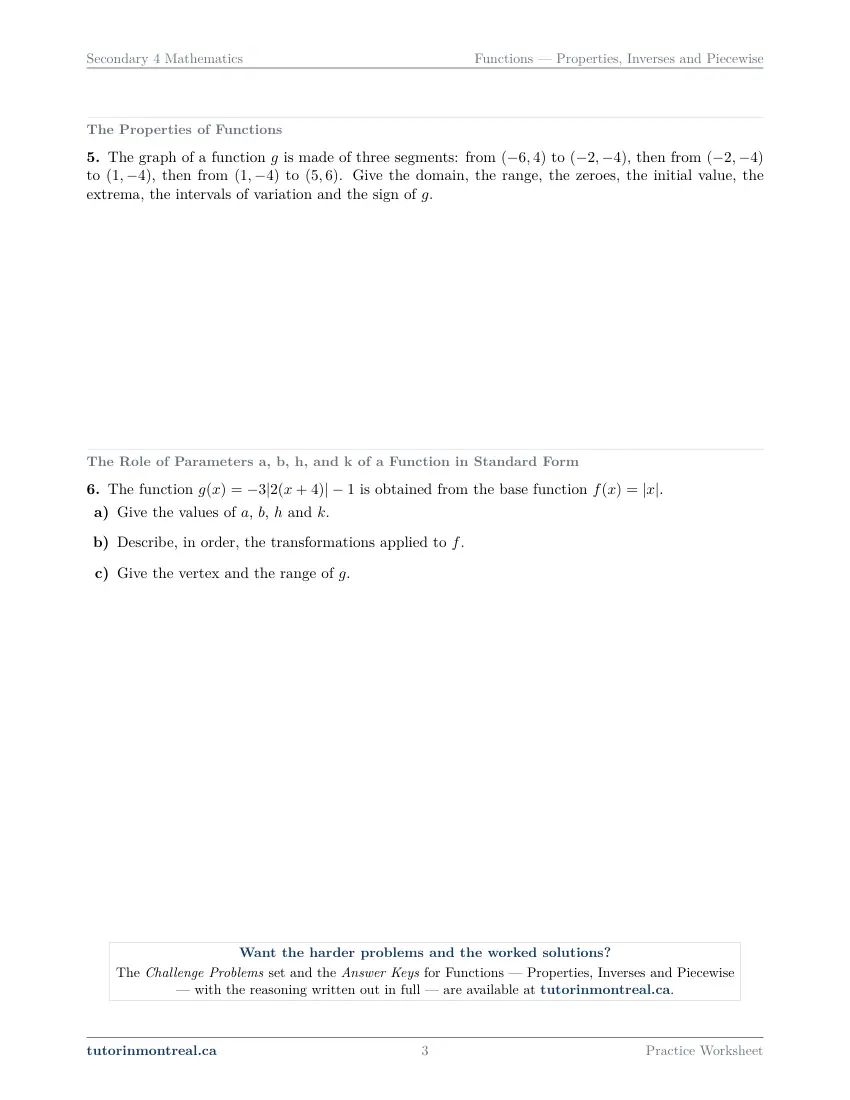
Each question targets one named concept from the sheet. Read them here, or print the PDF — it has working space under each one.
-
Q1Algebra — Relations and Functions
Five rules are listed below.
- Name the function family of each one (linear, quadratic, square root, exponential, logarithmic, step), or write “not a function” where appropriate.
- Exactly one of the five is a relation that is not a function of . Identify it and justify your choice with one specific value of .
-
Q2Periodic Functions
A shuttle boat runs a closed loop, so its distance (in km) from the terminal is a periodic function of the time (in minutes) with period minutes. On one cycle, , , and .
- Find and .
- If the smallest distance reached is and the greatest is , give the amplitude of the function.
-
Q3The Inverse of a Function
A weather station records the function .
- Write the inverse relation as a set of ordered pairs.
- Is a function? Justify.
-
Q4The Piecewise Function
A function is defined on by
- Compute , , and .
- Find all the zeroes of .
- Sketch the graph of on the grid below.
- Is continuous at ? At ? Justify.
A blank Cartesian grid for this question is on the printable PDF.
-
Q5The Properties of Functions
The graph of a function is made of three segments: from to , then from to , then from to . Give the domain, the range, the zeroes, the initial value, the extrema, the intervals of variation and the sign of .
-
Q6The Role of Parameters a, b, h, and k of a Function in Standard Form
The function is obtained from the base function .
- Give the values of , , and .
- Describe, in order, the transformations applied to .
- Give the vertex and the range of .
The 6 challenge problems for this topic are a separate, paid sheet and are not reproduced here.
Which stream is this for? This sheet is built for SN. It assumes you are working across the whole family of functions the program introduces, testing continuity at the joins of a piecewise rule, and reasoning about injectivity when you invert, and it goes to the depth that program expects.
How to do every concept on this sheet
This is the part worksheet sites usually leave out. Below is the actual reasoning behind each group of questions — not a full solution set, the decisions that get you to one. Read it before you start, or after you get stuck.
Naming the family: look at where the variable sits
Q1 lists several rules and asks for the family of each. The whole classification is decided by one question — where does the variable appear? — and it takes about three seconds per rule once you ask it deliberately.
Where is the variable?
One look at the position of x names the family.
- 1In the exponent → exponential
The base is a fixed positive number and x rides on top. Compare with a power function, where the variable is the base — the two look alike and behave nothing alike.
- 2Inside a logarithm → logarithmic
The argument of the log is where the restriction lives, and it is the source of the vertical asymptote.
- 3Under a radical → square root function
Half a parabola on its side. Its domain is restricted, which is often the first thing a question asks about.
- 4Inside greatest-integer brackets → step function
A staircase of half-open horizontal segments.
- 5Squared → quadratic; to the first power only → first degree
Simplify before deciding. An x² that cancels means the rule was never quadratic.
- 6Inside absolute value bars → absolute value function
A V. Its vertex behaves like a parabola's, which is why Q6 uses it to teach the parameters.
Q1 also asks a second, separate question: which of the rules is a relation and not a function. A rule written with y squared solves to y = ± something, so one x is paired with two y-values — that is the definition being broken, and the justification the question wants is one specific value of x with its two partners written out.
Two different tests, two different lines. The vertical line test asks whether f is a function: no vertical line may cut the graph twice. The horizontal line test asks whether the inverse is a function: no horizontal line may cut the graph twice. Mixing them up is the most common error on this whole sheet, because both questions appear on it.
The property list, in a fixed order
Q5 hands you a graph made of segments and asks for everything. Answering in a fixed order every time is what stops you from omitting one — and an omission here is a straight loss, because each property is marked separately.
The seven readings
Same order, every graph, every time.
- 1Domain
The x-values the graph occupies, read left to right. Include the endpoints when the ends of the graph are filled points.
- 2Range
The y-values, read bottom to top. A different axis and a different interval — writing the domain twice is the classic slip.
- 3Zeroes
Where the graph meets the x-axis. If a crossing falls between grid lines you must compute it, not estimate it — see the next section.
- 4Initial value
f(0), the y-intercept. On a piece-by-piece graph, first decide which piece contains x = 0.
- 5Extrema
The largest and smallest y-values actually reached. A minimum held along a whole flat stretch is still one minimum value — report the value, and say where it is reached if asked.
- 6Variation
Where the graph rises, falls, or stays constant. Written as intervals of x, and a constant stretch is its own interval, not part of either neighbour.
- 7Sign
Where the graph is above the axis and where it is below. Also intervals of x, and the boundaries are the zeroes, not the turning points.
Sign and variation are not the same question. A graph climbing from far below the axis up through a zero is increasing along its whole length but negative only up to the zero. Variation is about direction; sign is about which side of the x-axis. Their intervals have different boundaries — turning points for one, zeroes for the other — and Q5 asks for both in order to see whether you know that.
Getting exact values off a segment graph
When a zero falls between two grid lines, "about 2.5" is not an answer. Find the rate of change of that segment from its two endpoints, write the segment as y = y₁ + a(x − x₁), set it equal to zero and solve. That is three lines and gives an exact number. Q5 is built with at least one zero that cannot be read off the picture, so the method is not optional.
Periodic functions
A function is periodic with period p when f(t + p) = f(t) for every t. To evaluate it far outside the cycle you were given data for, subtract whole periods until you land back inside it — practically, divide by the period and keep the remainder, then look the remainder up in your data. Q2 asks for two such values.
Amplitude is half the swing.
amplitude = (maximum − minimum) ⁄ 2It measures the distance from the middle of the oscillation to either extreme, not from the bottom to the top. Q2 asks for it in one line, and the divided-by-two is the only thing being tested.
Piecewise functions: the interval is the instruction
Q4 gives a rule in three branches. Every part of the question is answered by first deciding which branch an x belongs to, and the inequality signs written next to each branch are what decide it — including whether a boundary value belongs to the branch on its left or the one on its right.
- Evaluating. Locate x in the list of intervals, then use only that branch. At a boundary, read the inequality signs carefully: one branch claims it and the other does not.
- Zeroes. Solve each branch's formula separately, then keep only the roots that actually lie inside that branch's interval. A root of a formula that falls outside the stretch where the formula applies is not a zero of the function. Discarding it, with a reason, is the point of the question.
- Continuity at a join. Compare the value the branch on the left is heading towards with the value the function actually takes there. Equal → the pieces meet and the function is continuous. Different → there is a jump, and you say so and name the two values.
- Graphing. Filled dot where a branch includes its endpoint, open dot where it does not — but if the neighbouring branch supplies that value, the point is filled and there is no hole. Both situations occur in Q4, which is why the sketch is worth more than it looks.
Inverses: swap the pairs, then ask about injectivity
Q3 gives a function as a set of ordered pairs, which strips the idea down to its mechanics. The inverse relation is obtained by swapping the two coordinates of every pair — and that is all the inverse ever is, whether the function arrives as a set, a graph or a rule. With a rule you swap x and y and then re-isolate; with a graph you reflect in the line y = x.
Whether the result is a function is decided entirely by f, not by f−1:
f−1 is a function ⟺ f is injective (no two inputs share an output)So the diagnosis runs backwards from where students look. Find two different inputs of f with the same image and you have proved the inverse is not a function, in one line, by naming them. Q3 is constructed so that such a pair exists and is easy to spot if you look for it.
Two consequences worth writing down every time: the domain of the inverse is the range of f, and the range of the inverse is the domain of f. Those two sentences answer a surprising number of exam questions on their own.
The parameters a, b, h and k
Q6 takes a base function and dresses it in all four parameters at once. Each one does exactly one thing:
g(x) = a · f( b(x − h) ) + k- a — vertical scaling by |a|, plus a reflection in the x-axis if a is negative. It also flips a minimum into a maximum, which is what decides the range.
- b — horizontal scaling by 1⁄|b|, plus a reflection in the y-axis if b is negative. Note the inversion: because b multiplies the input, a b bigger than 1 shrinks the graph horizontally. This is the parameter that is described backwards most often.
- h — horizontal translation, h units right when h is positive.
- k — vertical translation, k units up when k is positive.
When the question asks you to describe the transformations in order, put the scalings and reflections first and the translations last. Applied in the other order the numbers no longer match.
The h sign trap. The form reads (x − h), so a bracket containing (x + 4) means h = −4 and a translation four units to the left. Writing h = 4 gets the direction, the vertex and the description all wrong at once, from a single missed minus sign. Rewrite the bracket as a subtraction before reading anything out of it.
Then the vertex is (h, k) and the range depends on the sign of a: with a negative the vertex is a maximum and the range runs down from k.
Preview all 3 pages
Click any page to open the full PDF.
Getting the most out of it
Answer the property list in the same order every time
Domain, range, zeroes, initial value, extrema, variation, sign. Write the seven headings down the page before you look at the graph, then fill them in. The habit is what stops the two losses that happen on this question — omitting one, and giving the same interval for sign and for variation.
Test every join point twice
On a piecewise rule, evaluate both neighbouring branches at each boundary value. If the two numbers agree the graph is continuous there; if they disagree you have found the jump and you also know which branch owns the point. It answers the evaluation, the sketch and the continuity parts at once.
Write one function three ways
Take any rule on this sheet and produce a table of values, a graph and the rule itself, then read the same property off all three. Moving between representations is the skill this unit is really assessing, and it is not built by staying in one of them.
Want the solutions, or something more challenging?
The worksheet, the questions above and every explanation on this page stay free permanently. Three more PDFs exist for this topic — the worked answer key, a harder problem set, and the answer key to that. They come with the Secondary 4 Math Solutions Bundle, which is what keeps the rest of the series free.
What else exists for Functions - Properties, Inverses and Piecewise
Three PDFs · 8 pages · all three are in the bundle below.
- Answer key — 2 pages. All 6 questions worked step by step, including the restrictions and the justifications. Not a list of final answers.
- Challenge problems — 4 pages, 6 problems. A separate sheet at exam-plus difficulty covering the same 6 concepts. Harder than anything on the free sheet.
- Challenge answer key — 2 pages. Every challenge problem worked to the same standard, with the checks shown.
- PDF, letter size, print-ready.
The one thing that's for sale
Every Secondary 4 Math topic — the complete Solutions Bundle
One download, one payment, the whole program. Every answer key and every challenge set for all 17 Secondary 4 Math worksheet sets — including this one.
- Worked solutions, not answer lists — every step written out
- Covers the whole year's program at this level
- Less than the price of one hour of tutoring — for the entire year's solutions
Taking Secondary 1 Math as well? The Secondary 1 Math bundle covers all 15 of its sets — 45 PDFs, 182 pages — on the same terms.
Taking Secondary 2 Math as well? The Secondary 2 Math bundle covers all 14 of its sets — 42 PDFs, 181 pages — on the same terms.
Taking Secondary 3 Math as well? The Secondary 3 Math bundle covers all 11 of its sets — 33 PDFs, 154 pages — on the same terms.
Taking Secondary 5 Math as well? The Secondary 5 Math bundle covers all 21 of its sets — 63 PDFs, 228 pages — on the same terms.
Taking CEGEP Calculus I as well? The CEGEP Calculus I bundle covers all 8 of its sets — 24 PDFs, 82 pages — on the same terms.
Taking CEGEP Calculus II as well? The CEGEP Calculus II bundle covers all 8 of its sets — 24 PDFs, 90 pages — on the same terms.
Taking CEGEP Linear Algebra as well? The CEGEP Linear Algebra bundle covers all 7 of its sets — 21 PDFs, 82 pages — on the same terms.
Taking AP Calculus AB as well? The AP Calculus AB bundle covers all 8 of its sets — 24 PDFs, 126 pages — on the same terms.
Common questions
Is this worksheet really free?
Yes — the questions are on this page to read, and the PDF downloads directly, no email and no account. The one paid item is optional: the complete Secondary 4 Solutions Bundle, which covers every set at this level.
What is the difference between the sign and the variation of a function?
Variation says where the graph goes up, down or stays flat; sign says where it sits above or below the x-axis. They are answered as intervals of x, but with different boundaries — turning points for variation, zeroes for sign. A function can be increasing and negative at the same time, which is why both are asked.
How do I tell whether a rule is a function or just a relation?
Ask whether any single x could be paired with two different y-values. A rule with y squared in it solves to plus-or-minus something, so it fails; graphically, a vertical line cuts it twice. To justify it, name one specific x and write out its two partners.
When is the inverse of a function also a function?
Exactly when the original function is injective — no two inputs share an output. Test it with a horizontal line on the graph: if any horizontal line meets the curve twice, those two inputs collapse to one value and the inverse would have to pair that value with both, which a function may not do.
Does a bigger value of b stretch the graph horizontally?
No, it shrinks it. Because b multiplies the input, the horizontal scaling factor is 1 over |b|, so b = 2 halves the width and b = 1/2 doubles it. A negative b also reflects the graph in the y-axis. This inversion is the single most commonly reversed statement about the parameters.
Which Secondary 4 stream is this for?
It is built for SN. The sheet assumes you are working across the whole family of functions the program introduces, testing continuity at the joins of a piecewise rule, and reasoning about injectivity when you invert, and it goes to the depth that program expects.
Can teachers use this in class?
Yes. Print and photocopy it for your own classes freely — I just ask that the tutorinmontreal.ca footer stays on the page.
I'm stuck on one question. Can you help?
Yes — through one-on-one tutoring, in Montreal or online. Get in touch to arrange a session, or see the current rates.
← All 17 Secondary 4 Math worksheets · Secondary 1 Math series (15 sheets) → · Secondary 2 Math series (14 sheets) → · Secondary 3 Math series (11 sheets) → · Secondary 5 Math series (21 sheets) → · CEGEP Calculus I series (8 sheets) → · CEGEP Calculus II series (8 sheets) → · CEGEP Linear Algebra series (7 sheets) → · AP Calculus AB series (8 sheets) →
The same topic at the other level: Secondary 5 Math · Functions - Properties, Inverses and Piecewise.