Secondary 4 Exponential Functions Worksheet
Two points fix an exponential rule, and most of this sheet is the consequence: finding the multiplier, saying which condition a rejected rule fails, reading the asymptote and the range off the parameter k, separating growth from decay, building a half-life model and running it backwards, then inverting the whole thing into a logarithm. The reasoning is worked out in prose beneath the questions, and the printable copy is free.
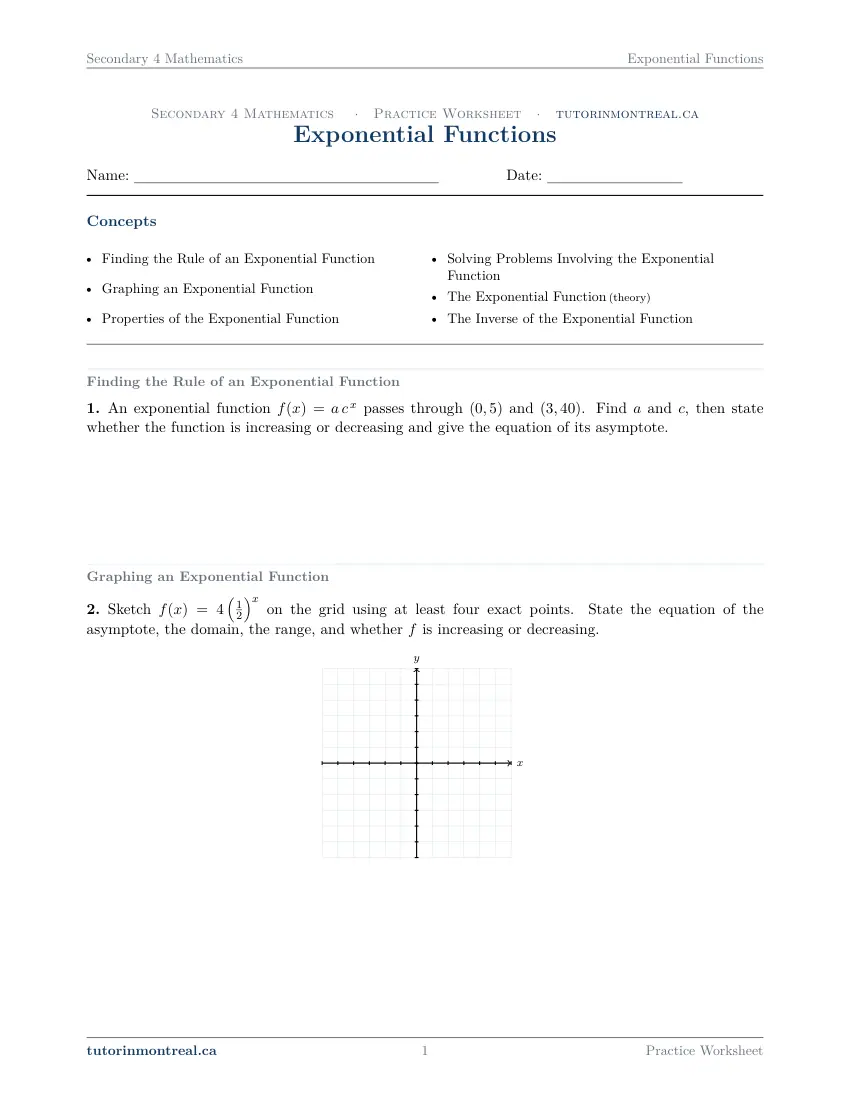
Practice worksheet — free PDF
No email, no account, no watermark. Teachers: photocopy it for your classes freely. Worked solutions and 5 harder problems come with the Secondary 4 Math bundle.
All 6 questions
Each question targets one named concept from the sheet. Read them here, or print the PDF — it has working space under each one.
-
Q1Finding the Rule of an Exponential Function
An exponential function passes through and . Find and , then state whether the function is increasing or decreasing and give the equation of its asymptote.
-
Q2Graphing an Exponential Function
Sketch on the grid using at least four exact points. State the equation of the asymptote, the domain, the range, and whether is increasing or decreasing.
A blank Cartesian grid for this question is on the printable PDF.
-
Q3Properties of the Exponential Function
The charge remaining in a laboratory capacitor, in microcoulombs, after minutes is , where the model is extended to all of for study purposes. Give the domain, the range, the equation of the asymptote, the variation, the initial value and the zero of , then state the sign of .
-
Q4Solving Problems Involving the Exponential Function
A radioactive tracer used in a hospital has an activity of units when it is prepared, and its activity is halved every hours.
- Write the rule giving the activity after hours.
- What is the activity after hours?
- After how long does the activity fall to units?
-
Q5The Exponential Function
Among the six rules below, identify those that define an exponential function of the form or , and for each rule that is rejected, say precisely which condition of the definition fails.
-
Q6The Inverse of the Exponential Function
Let . Find the rule of , its domain and its range, and give the equation of its asymptote.
The 5 challenge problems for this topic are a separate, paid sheet and are not reproduced here.
Which stream is this for? This sheet is built for SN. It assumes you are handling the form a·cˣ + k with a non-zero asymptote, reasoning about the number of zeroes from the signs of a and k, and writing the inverse as a logarithm, and it goes to the depth that program expects.
How to do every concept on this sheet
This is the part worksheet sites usually leave out. Below is the actual reasoning behind each group of questions — not a full solution set, the decisions that get you to one. Read it before you start, or after you get stuck.
What makes a rule exponential — and what disqualifies one
Q5 lists several rules and asks you to say, for each rejection, which condition fails. The verdict alone earns nothing; the named condition is the answer. There are three of them.
- The variable must be in the exponent. If it is in the base — a rule like x³ — it is a power function, not an exponential one. This is the distinction the whole definition rests on, and the two families behave nothing alike.
- The base must be strictly positive. A negative base collapses as soon as the exponent is a fraction: (−2)1/2 is a square root of a negative number, so the rule has no value at half the points of ℝ and cannot define a function on ℝ.
- The base cannot be 1. 1ˣ is 1 for every x, so the rule is a horizontal line: no variation, no asymptotic behaviour, none of the properties that make an exponential function what it is. It is excluded by definition, not by accident.
The coefficient is not part of the base. 5(2)ˣ is not 10ˣ. The power is computed first and then multiplied by 5. Test at x = 2: one gives 5 × 4 = 20, the other gives 100. This error is invisible at x = 1, where both happen to give 10, which is precisely why it survives.
Finding a and c from two points
Q1 hands you two points and asks for both parameters. There is a shortcut and a general method, and the general method is the one worth owning.
Two points → the rule
Divide before you substitute. The division is what removes a.
- 1If one point sits at x = 0, read a straight off it
Because
c⁰ = 1, the value at x = 0 is a (or a + k if there is a k). Q1 is generous in exactly this way — spot it before doing any work. - 2Otherwise, divide one equation by the other
(a·c^x₂) ⁄ (a·c^x₁) = y₂ ⁄ y₁and a cancels, leavingc^(x₂ − x₁) = y₂ ⁄ y₁. One equation, one unknown. - 3Take the root
Ask the question in words: what number, multiplied by itself that many times, gives that ratio? Through (1, 6) and (4, 48) the ratio is 8 over 3 steps, so c = 2.
- 4Back-substitute for a
Put c into either original equation. In the example, 6 = a·2 gives a = 3, so the rule is 3(2)ˣ.
- 5Check with the point you did not use last
One substitution. It catches a mis-taken root, which is the likely error and is otherwise silent.
Read c as a multiplier per unit step, not as a percentage. A c of 2 means "doubles each unit"; a c of 1⁄2 means "halves each unit". That reading is what makes the word problems tractable.
The asymptote is k, and the range follows from it
cˣ is strictly positive for every real x — never zero, never negative, no matter how large the exponent gets in either direction. Everything else about the graph falls out of that one fact.
f(x) = a·cˣ + k · asymptote y = k · range ]k, +∞[ if a > 0, ]−∞, k[ if a < 0The term a·cˣ keeps the sign of a and shrinks towards zero on one side, so the curve creeps towards the height k and never arrives. Q2 has k = 0 and the asymptote is the x-axis; Q3 and Q6 both have a non-zero k, and that is where the marks are.
With a non-zero k, the initial value is a + k, not a. Substituting x = 0 gives a·c⁰ + k = a + k. Q3 asks for the initial value and the y-intercept of a rule with a shifted asymptote precisely to see whether you substituted or guessed.
The same shift changes the sign question. The zero of the function is where the curve crosses y = 0, which is nowhere near the asymptote at y = k. Q3 asks for the asymptote, the zero and the sign in the same breath, and they are three different pieces of information.
Increasing or decreasing takes both a and c
"The base is less than 1, so it is decreasing" is right half the time. Both parameters vote:
- a > 0 and c > 1 → increasing (growth).
- a > 0 and 0 < c < 1 → decreasing (decay). Q2 and Q3.
- a < 0 and c > 1 → decreasing — the curve falls away below the asymptote.
- a < 0 and 0 < c < 1 → increasing, climbing towards the asymptote from below.
Rather than memorise four lines, reason in two steps: cˣ grows when c > 1 and shrinks when c is between 0 and 1; then multiplying by a negative a reverses whatever that was. Answering a variation question without looking at a is the single most common slip on this topic.
How many zeroes an exponential function can have
At most one, and the reason is worth stating because it is a one-line answer to a question that looks like it needs work. Setting a·cˣ + k = 0 gives:
cˣ = −k ⁄ acˣ is strictly monotonic, so it takes each value at most once — hence never two zeroes. And it takes only strictly positive values, and takes every strictly positive value, so there is exactly one zero when −k⁄a > 0, that is when a and k have opposite signs, and none when they share a sign or k = 0. Q3 sits in the first case, which is why it has a zero to find at all.
Solving without a calculator: same base, then equal exponents
Q4 and the zero in Q3 are both solved the same way. Isolate the power, rewrite the number on the other side as a power of the same base, and then equate the exponents — legitimate because an exponential function never takes the same value twice.
The practical skill is recognising powers on sight: the powers of 2 up to 1024, the powers of 3 up to 243, the powers of 5 up to 625, and the reciprocals — 1⁄16 is (1⁄2)4, 1⁄27 is (1⁄3)³. The questions here are built so that these work out exactly; when they do not, the answer is a logarithm.
Half-life and doubling models
Q4 gives a quantity that halves every fixed number of hours. The rule is:
A(t) = A₀ · (1⁄2)^(t ⁄ H)where H is the half-life. The exponent t⁄H is a count of halvings, not a time — that is why the division is inside the exponent and nowhere else. Doubling models are the same shape with a base of 2, and "triples every H units" is the same shape with a base of 3.
Check the model before you use it. Substitute t = H: the exponent must become 1 and the result must be exactly half of A₀. Wrong versions such as A₀(1⁄2)ᵗ⁄H or A₀(1⁄(2H))ᵗ fail that test instantly. Two seconds of checking protects every part of the question that follows, because a mis-built model makes the rest of your work correct and worthless.
Graphing
Q2 asks for exact points, and the way to get them is to choose integer values of x where the power is a whole number or a simple fraction. Draw the asymptote as a dashed horizontal line first: it is the skeleton the curve hangs on, and the curve approaches it without ever touching or crossing it. Then state the domain — always ℝ — and the range, which is the half-line on one side of the asymptote, never all of ℝ.
The inverse is a logarithm
Q6 asks for the inverse of a rule with a shifted asymptote. Swap x and y, then undo the operations in reverse order: undo k, undo a, and finally undo the power itself — and the operation that undoes "c raised to something" is the base-c logarithm, because a logarithm is by definition the exponent you needed.
Then read the consequences off the swap rather than recomputing them. The domain of the inverse is the range of f, so it is a half-line, not all of ℝ; the range of the inverse is the domain of f, so it is all of ℝ; and the horizontal asymptote y = k becomes the vertical asymptote x = k. Verify with a point: if (p, q) is on f, then (q, p) must be on the inverse, and one substitution catches any rearrangement slip.
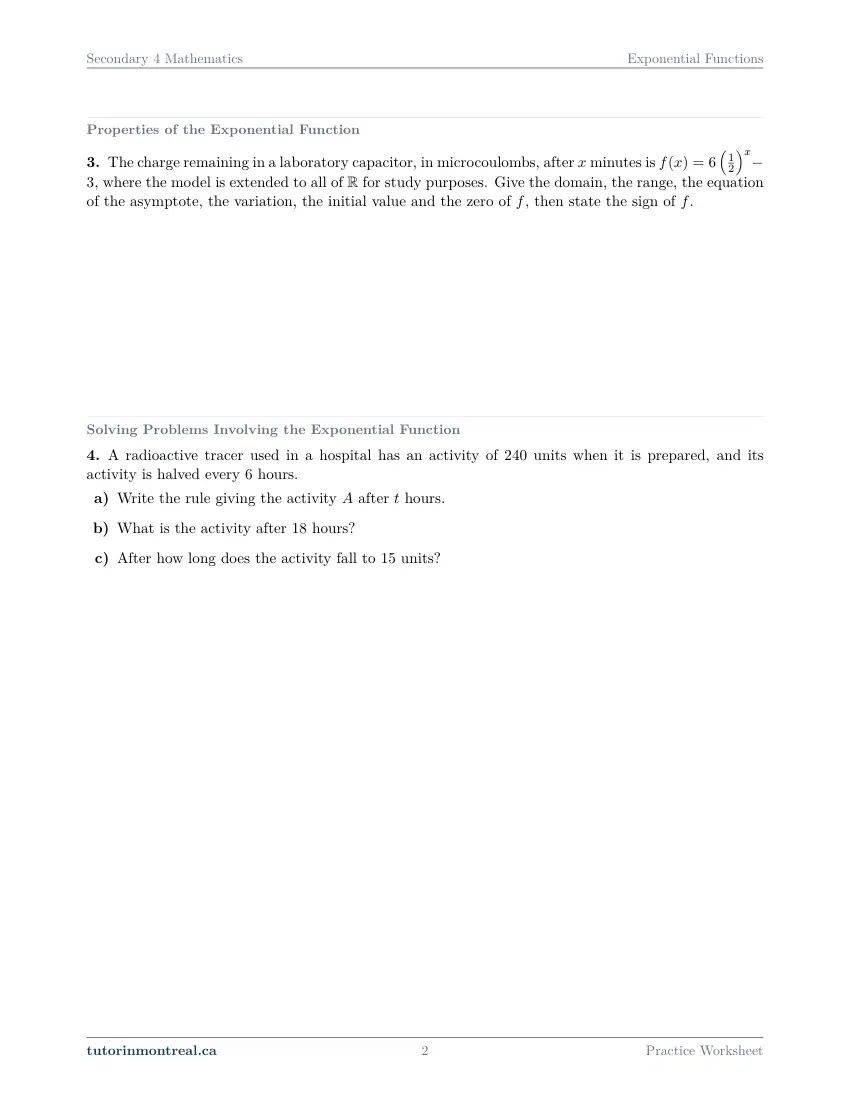
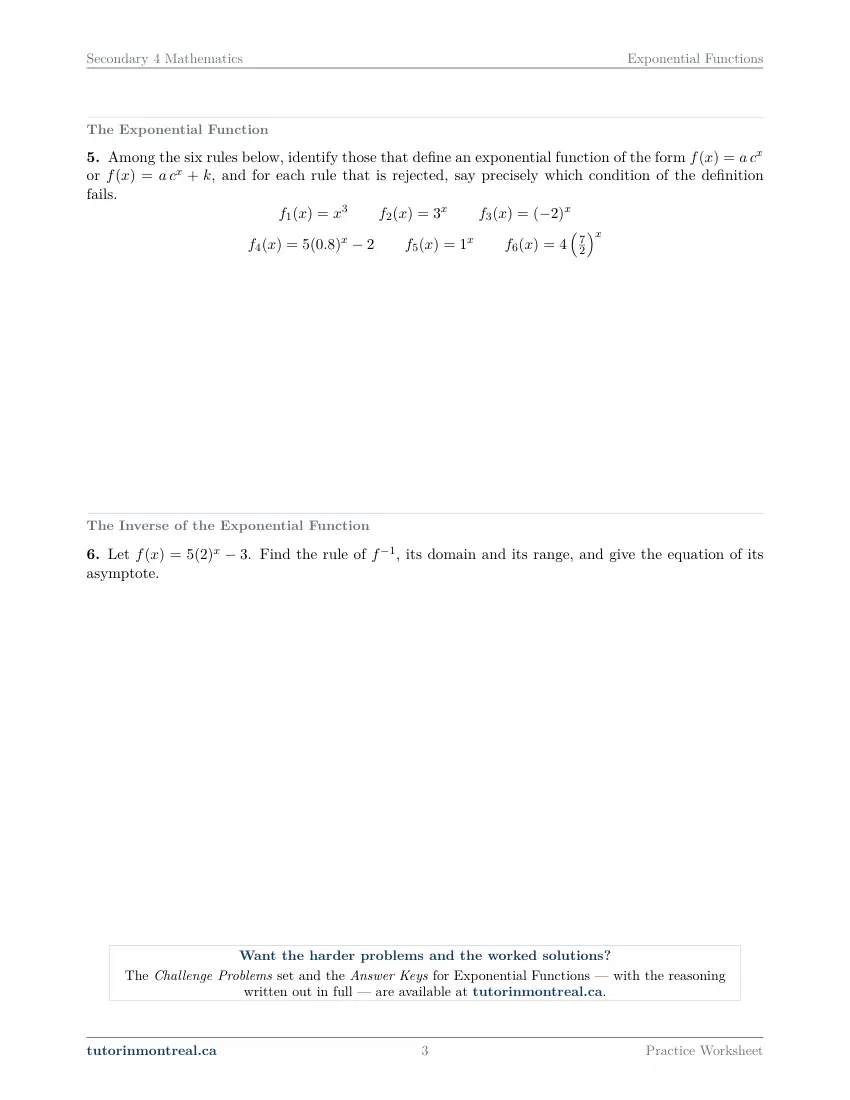
Preview all 3 pages
Click any page to open the full PDF.
Getting the most out of it
Substitute one known point into every model you build
Whenever a word problem makes you write a rule, immediately test it on a fact from the question — a half-life, a starting amount, a second reading. It takes one line and it is the difference between a small slip and a whole question lost.
Say the sign of a and the size of c out loud
Before answering any variation, range or sign question, state the two facts: "a is positive" and "c is between 0 and 1". Every answer on this sheet follows from that pair, and naming them stops you from answering out of habit.
Learn the powers, not the button
Powers of 2 to 1024, powers of 3 to 243, powers of 5 to 625, and their reciprocals. The exponential equations here are designed to come out exactly, and recognising 1⁄16 as a fourth power of a half turns a stuck question into a one-liner.
Want the solutions, or something more challenging?
The worksheet, the questions above and every explanation on this page stay free permanently. Three more PDFs exist for this topic — the worked answer key, a harder problem set, and the answer key to that. They come with the Secondary 4 Math Solutions Bundle, which is what keeps the rest of the series free.
What else exists for Exponential Functions
Three PDFs · 6 pages · all three are in the bundle below.
- Answer key — 1 page. All 6 questions worked step by step, including the restrictions and the justifications. Not a list of final answers.
- Challenge problems — 3 pages, 5 problems. A separate sheet at exam-plus difficulty covering the same 6 concepts. Harder than anything on the free sheet.
- Challenge answer key — 2 pages. Every challenge problem worked to the same standard, with the checks shown.
- PDF, letter size, print-ready.
The one thing that's for sale
Every Secondary 4 Math topic — the complete Solutions Bundle
One download, one payment, the whole program. Every answer key and every challenge set for all 17 Secondary 4 Math worksheet sets — including this one.
- Worked solutions, not answer lists — every step written out
- Covers the whole year's program at this level
- Less than the price of one hour of tutoring — for the entire year's solutions
Taking Secondary 1 Math as well? The Secondary 1 Math bundle covers all 15 of its sets — 45 PDFs, 182 pages — on the same terms.
Taking Secondary 2 Math as well? The Secondary 2 Math bundle covers all 14 of its sets — 42 PDFs, 181 pages — on the same terms.
Taking Secondary 3 Math as well? The Secondary 3 Math bundle covers all 11 of its sets — 33 PDFs, 154 pages — on the same terms.
Taking Secondary 5 Math as well? The Secondary 5 Math bundle covers all 21 of its sets — 63 PDFs, 228 pages — on the same terms.
Taking CEGEP Calculus I as well? The CEGEP Calculus I bundle covers all 8 of its sets — 24 PDFs, 82 pages — on the same terms.
Taking CEGEP Calculus II as well? The CEGEP Calculus II bundle covers all 8 of its sets — 24 PDFs, 90 pages — on the same terms.
Taking CEGEP Linear Algebra as well? The CEGEP Linear Algebra bundle covers all 7 of its sets — 21 PDFs, 82 pages — on the same terms.
Taking AP Calculus AB as well? The AP Calculus AB bundle covers all 8 of its sets — 24 PDFs, 126 pages — on the same terms.
Common questions
Is this worksheet really free?
Yes — the questions are on this page to read, and the PDF downloads directly, no email and no account. The one paid item is optional: the complete Secondary 4 Solutions Bundle, which covers every set at this level.
How do I find the base c when neither point is at x = 0?
Divide one equation by the other. The coefficient a cancels and you are left with c raised to the difference of the two x-values, equal to the ratio of the two y-values. Then take that root — in words, ask what number multiplied by itself that many times gives the ratio — and substitute back to get a.
Is 5(2)ˣ the same as 10ˣ?
No. The power is evaluated first and then multiplied by 5, so the coefficient is never part of the base. At x = 2 one gives 20 and the other gives 100. They agree at x = 1, which is exactly why the mistake goes unnoticed.
Why isn't the range of an exponential function all the real numbers?
Because cˣ is strictly positive for every real x — it approaches zero but never reaches it. So a·cˣ keeps the sign of a and the whole rule stays on one side of the horizontal asymptote y = k. The range is ]k, +∞[ when a is positive and ]−∞, k[ when a is negative.
How can I tell whether the function is increasing or decreasing?
Look at both parameters. A base greater than 1 makes cˣ grow and a base between 0 and 1 makes it shrink; then a negative a reverses that. So a negative coefficient with a base above 1 gives a decreasing function, and a negative coefficient with a base below 1 gives an increasing one.
Which Secondary 4 stream is this for?
It is built for SN. The sheet assumes you are handling rules with a non-zero asymptote, reasoning about zeroes from the signs of a and k, and writing the inverse as a logarithm, and it goes to the depth that program expects.
Can teachers use this in class?
Yes. Print and photocopy it for your own classes freely — I just ask that the tutorinmontreal.ca footer stays on the page.
I'm stuck on one question. Can you help?
Yes — through one-on-one tutoring, in Montreal or online. Get in touch to arrange a session, or see the current rates.
← All 17 Secondary 4 Math worksheets · Secondary 1 Math series (15 sheets) → · Secondary 2 Math series (14 sheets) → · Secondary 3 Math series (11 sheets) → · Secondary 5 Math series (21 sheets) → · CEGEP Calculus I series (8 sheets) → · CEGEP Calculus II series (8 sheets) → · CEGEP Linear Algebra series (7 sheets) → · AP Calculus AB series (8 sheets) →
The same topic at the other level: Secondary 5 Math · Exponential Functions.