Secondary 4 Logarithmic Functions Worksheet
A logarithm is an exponent that has been asked for by name, and this sheet keeps returning to that definition: converting between the two forms, using the product, quotient and power laws to evaluate exactly, stating the conditions the base must satisfy, locating the vertical asymptote and the domain the argument forces, finding a rule from a single point, and inverting back into an exponential. No account, no cost — and each law is explained in words below.
Practice worksheet — free PDF
No email, no account, no watermark. Teachers: photocopy it for your classes freely. Worked solutions and 5 harder problems come with the Secondary 4 Math bundle.
All 6 questions
Each question targets one named concept from the sheet. Read them here, or print the PDF — it has working space under each one.
-
Q1Finding the Rule of a Logarithmic Function
The function passes through the point .
- Find the value of .
- Using this rule, compute and state the equation of the vertical asymptote.
-
Q2Graphing the Logarithmic Function
Sketch on the grid, using at least three exact points. Give the equation of the vertical asymptote, the domain, the range and the zero.
A blank Cartesian grid for this question is on the printable PDF.
-
Q3Properties of Logarithmic Functions
Evaluate each expression without a calculator, naming the logarithm property used.
-
Q4The Inverse of the Logarithmic Function
Let . Find the rule of , its domain and its range.
-
Q5The Logarithmic Function
The logarithm is defined by .
- State the conditions the base must satisfy for to be a logarithmic function, and say why each excluded value fails.
- Use the definition to explain why does not exist for any admissible base, and deduce the domain and the asymptote of .
-
Q6The Role of the Parameters in a Logarithmic Function
Consider .
- State the domain and the equation of the vertical asymptote.
- Evaluate .
- Find the zero of .
The 5 challenge problems for this topic are a separate, paid sheet and are not reproduced here.
Which stream is this for? This sheet is built for SN. It assumes you are evaluating logarithms exactly with the laws, justifying the conditions on the base, reading domains and asymptotes off the parameters, and inverting a logarithmic rule, and it goes to the depth that program expects.
How to do every concept on this sheet
This is the part worksheet sites usually leave out. Below is the actual reasoning behind each group of questions — not a full solution set, the decisions that get you to one. Read it before you start, or after you get stuck.
One definition does most of the work
Everything on this sheet is this single line, applied in one direction or the other:
logc(x) = y ⟺ cy = xRead it in words: a logarithm is an exponent. "Log base c of x" asks the question "what power do I put on c to get x?" Q5 asks for the definition itself and for its consequences, so this line is not background — it is the answer.
Three facts drop straight out of it and are worth knowing by reflex, because they turn up in every evaluation question: logc 1 = 0 (any base to the power 0 is 1), logc c = 1, and logc(cn) = n.
Why the base must be positive and not 1
Q5(a) asks you to state the conditions and say why each excluded value fails. Each exclusion has its own reason and a generic "it doesn't work" earns nothing.
- A negative base makes cy undefined for many exponents — a power of one half is a square root, and there is no real square root of a negative number. The rule would have gaps rather than a domain.
- Base 1 gives 1y = 1 for every y. So the equation 1y = x has no solution at all when x ≠ 1, and infinitely many when x = 1. Either way there is no function to define.
- Base 0 gives 0 for every positive exponent and is undefined for the rest, so it can never produce a strictly positive x.
You cannot take the logarithm of a negative number, or of zero. Since c > 0, the value cy is strictly positive for every real y — so it never equals a negative number, and never equals zero. That is not a convention adopted for convenience; it is a consequence of the definition, and Q5(b) asks you to derive it rather than assert it.
Everything else about the graph follows from it. Whatever sits inside the logarithm must be strictly positive, which is where the domain comes from and where the vertical asymptote comes from.
The domain and the asymptote live in the bracket
Q1, Q2 and Q6 all ask for a domain or an asymptote, and all three are answered the same way: set the argument greater than zero and solve.
f(x) = a·logc(x − h) + k · domain ]h, +∞[ · vertical asymptote x = hThe asymptote sits where the bracket is zero — not at the number that appears inside it. For an argument written as (x + 3) the bracket vanishes at x = −3, so h = −3 and the asymptote is x = −3. Rewrite the argument as a subtraction before reading anything out of it.
What does not restrict anything: a and k sit outside the logarithm. They stretch, reflect and shift the curve vertically, but they cannot change which inputs are allowed. And the range of a logarithmic function is always ℝ — the curve keeps climbing (or falling) without bound, just very slowly. Domain restricted, range unrestricted: the exact mirror image of an exponential function.
Finding a rule from a point
Q1 gives one point and asks for the coefficient. The technique is to exploit the point whose argument is an exact power of the base, because then the logarithm evaluates to a whole number and the unknown falls out in one line.
A worked example of the same shape: for f(x) = a·log5(x + 1) through (24, −6), the argument is 25, which is 5², so the logarithm is 2 and the equation is 2a = −6, giving a = −3.
When more parameters are unknown, take them in this order: the asymptote gives h immediately; a point where the argument equals 1 gives k immediately, because logc 1 = 0 wipes out the a term; and any remaining point then gives a. Choosing that order turns a three-unknown problem into three one-line problems.
The laws — and the law that does not exist
Q3 asks you to evaluate several expressions exactly and to name the property used. The name is part of the mark, so learn them as named rules:
logc(MN) = logcM + logcN (product law) logc(M ⁄ N) = logcM − logcN (quotient law) logc(Mn) = n · logcM (power law)The working method is always the same: use the laws to collapse the expression into a single logarithm whose argument is an exact power of the base, then read the exponent. For instance 3·log₂2 + log₂4 becomes log₂8 + log₂4 by the power law, then log₂32 by the product law, and 32 is 2⁵, so the value is 5. Note the two named steps — that is the shape of a full answer.
There is no law for the logarithm of a sum. logc(M + N) is not logcM + logcN. The product law converts a product into a sum of logarithms, and the resemblance is what makes the false version so tempting.
One counterexample settles it. In base 2 with M = N = 1: the left side is log₂2 = 1 and the right side is 0 + 0 = 0. An identity has to hold for every admissible value, so a single disagreement destroys it — while a single lucky agreement proves nothing at all.
Solving a logarithmic equation
Q6 finishes with a zero to find, and the order of operations is where these go wrong.
Four steps, and the fourth is not optional
Isolate before you convert. Convert before you solve. Then check the domain.
- 1Isolate the logarithm
Undo k, then undo a, until the equation reads
log_c(something) = a number. Applying the base while a constant is still hanging off the outside is the standard error, and it produces an answer that looks reasonable. - 2Convert with the definition
log_c(u) = mbecomesu = c^m. This is the whole point of the definition line at the top of this page. - 3Solve for x
Now it is ordinary algebra. If two logarithms were combined into one along the way, expect a quadratic.
- 4Reject anything outside the domain
Substitute each candidate back into the original arguments. Any value that makes the inside of a logarithm zero or negative is rejected, and you say so explicitly.
Step 4 is not a formality. Combining two logarithms into one enlarges the set of values the equation makes sense for, so the combined equation can have genuine solutions that the original equation cannot accept. They are not arithmetic mistakes — they are correct solutions to a different equation, and the only way to catch them is to test them against the original arguments.
Graphing: choose x so the argument is a power of the base
Q2 asks for exact points, and the way to get them is to work backwards from the values you want. If the argument equals 1 the logarithm is 0 — that is the zero of the function. If it equals the base, the logarithm is 1; the base squared gives 2; the reciprocal of the base gives −1. Solve each of those for x and you have four exact points with no decimals anywhere.
Draw the vertical asymptote as a dashed line before the curve. The curve hugs it, plunging without bound on that side, and never crosses it. On the other side it keeps rising forever — slowly, but with no ceiling, which is what "range ℝ" looks like. The function increases when a > 0 and the base is greater than 1; a negative a reflects it and makes it decreasing.
The inverse: back to an exponential
Q4 asks for the inverse of a logarithmic rule. Swap x and y, then undo in reverse order: the constant first, then the coefficient, and only then the logarithm itself — which is undone by raising the base to both sides.
Undo the whole side, not part of it. When a constant is still attached, it must come off before the base is applied, and when a coefficient is divided out, the entire other side goes through the division — not just the term with x in it. That single omission is the most productive source of wrong inverses on this topic.
Verify with a point every time: if (p, q) is on f, then (q, p) must be on the inverse. One substitution catches any rearrangement slip, and there is no other way to notice one.
Then read the properties off the swap instead of recomputing them. The domain of the inverse is the range of f, which is all of ℝ; the range of the inverse is the domain of f, which is the half-line the logarithm allowed; and the vertical asymptote x = h becomes the horizontal asymptote y = h of the exponential inverse.
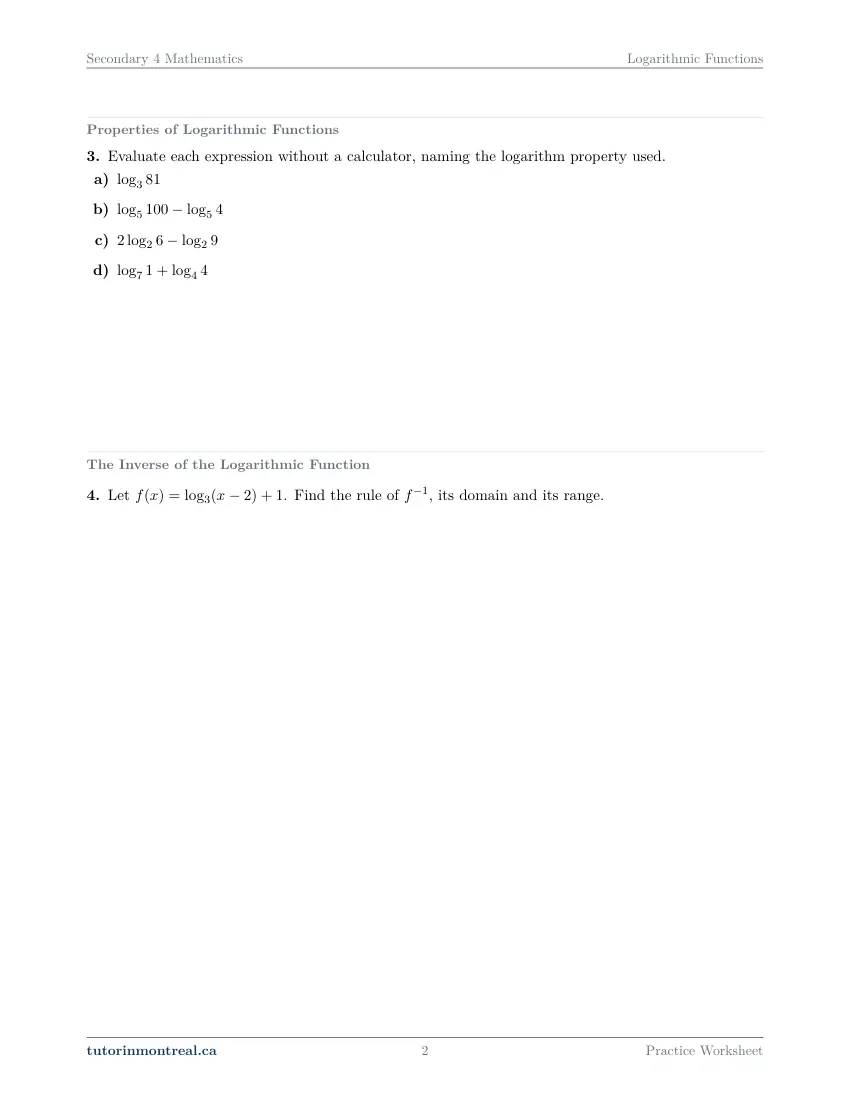
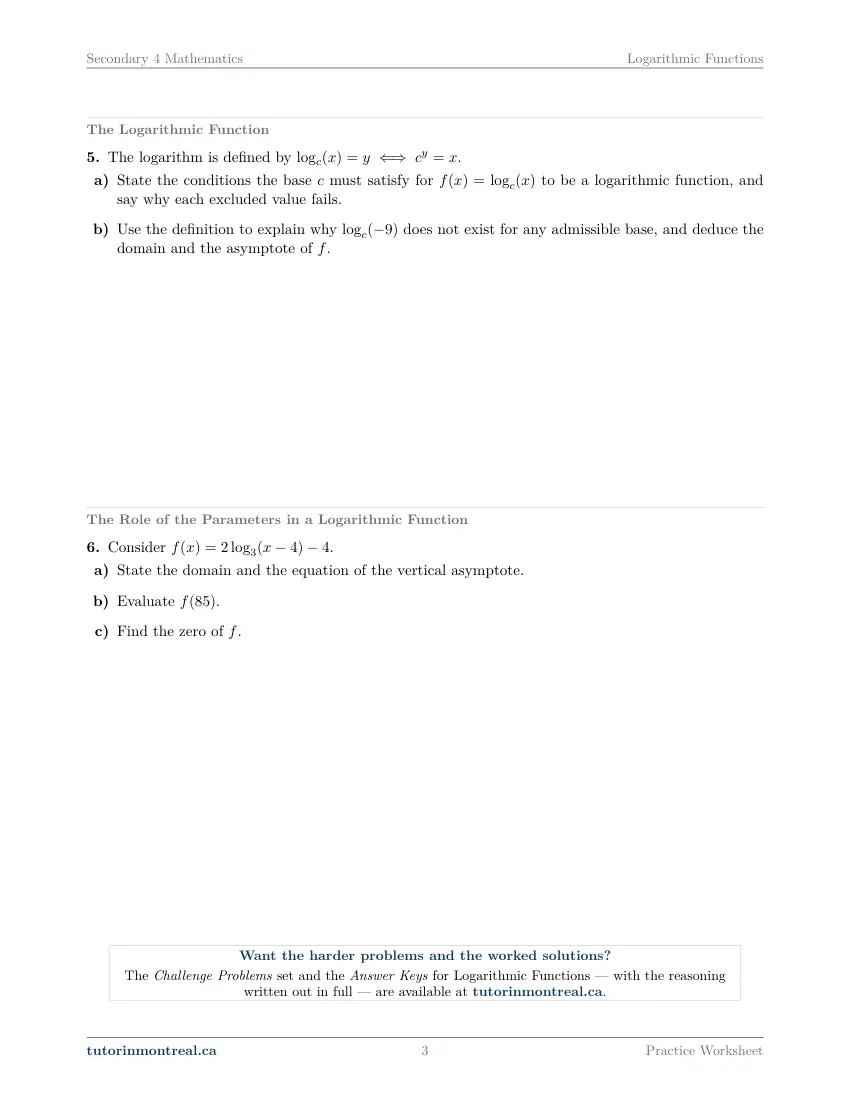
Preview all 3 pages
Click any page to open the full PDF.
Getting the most out of it
Read every logarithm out loud as a question
"Log base 3 of 81" is not a symbol to manipulate, it is the question "3 to what power gives 81?". Saying it that way converts most evaluation questions into mental arithmetic and makes the definition impossible to forget under exam pressure.
Learn the powers of 2, 3 and 5
Up to about a thousand, plus their reciprocals. Every exact-evaluation question on this sheet is built so the argument is a power of the base, so recognising it instantly is the difference between a one-line answer and a stuck question.
Write the domain before the first line of algebra
On any equation containing a logarithm, note "argument > 0" at the top of your work and solve it. Doing it first turns the rejection at the end from an afterthought into a confirmation, and it is where the marks on these questions actually sit.
Want the solutions, or something more challenging?
The worksheet, the questions above and every explanation on this page stay free permanently. Three more PDFs exist for this topic — the worked answer key, a harder problem set, and the answer key to that. They come with the Secondary 4 Math Solutions Bundle, which is what keeps the rest of the series free.
What else exists for Logarithmic Functions
Three PDFs · 5 pages · all three are in the bundle below.
- Answer key — 1 page. All 6 questions worked step by step, including the restrictions and the justifications. Not a list of final answers.
- Challenge problems — 3 pages, 5 problems. A separate sheet at exam-plus difficulty covering the same 6 concepts. Harder than anything on the free sheet.
- Challenge answer key — 1 page. Every challenge problem worked to the same standard, with the checks shown.
- PDF, letter size, print-ready.
The one thing that's for sale
Every Secondary 4 Math topic — the complete Solutions Bundle
One download, one payment, the whole program. Every answer key and every challenge set for all 17 Secondary 4 Math worksheet sets — including this one.
- Worked solutions, not answer lists — every step written out
- Covers the whole year's program at this level
- Less than the price of one hour of tutoring — for the entire year's solutions
Taking Secondary 1 Math as well? The Secondary 1 Math bundle covers all 15 of its sets — 45 PDFs, 182 pages — on the same terms.
Taking Secondary 2 Math as well? The Secondary 2 Math bundle covers all 14 of its sets — 42 PDFs, 181 pages — on the same terms.
Taking Secondary 3 Math as well? The Secondary 3 Math bundle covers all 11 of its sets — 33 PDFs, 154 pages — on the same terms.
Taking Secondary 5 Math as well? The Secondary 5 Math bundle covers all 21 of its sets — 63 PDFs, 228 pages — on the same terms.
Taking CEGEP Calculus I as well? The CEGEP Calculus I bundle covers all 8 of its sets — 24 PDFs, 82 pages — on the same terms.
Taking CEGEP Calculus II as well? The CEGEP Calculus II bundle covers all 8 of its sets — 24 PDFs, 90 pages — on the same terms.
Taking CEGEP Linear Algebra as well? The CEGEP Linear Algebra bundle covers all 7 of its sets — 21 PDFs, 82 pages — on the same terms.
Taking AP Calculus AB as well? The AP Calculus AB bundle covers all 8 of its sets — 24 PDFs, 126 pages — on the same terms.
Common questions
Is this worksheet really free?
Yes — the questions are on this page to read, and the PDF downloads directly, no email and no account. The one paid item is optional: the complete Secondary 4 Solutions Bundle, which covers every set at this level.
What does a logarithm actually mean?
It is an exponent. Log base c of x is the power you have to put on c to get x, which is exactly what the definition says: log base c of x equals y precisely when c to the power y equals x. Reading it as a question — "c to what power gives x?" — answers most evaluation problems without any manipulation.
Is the logarithm of a sum the sum of the logarithms?
No. The product law turns a product into a sum of logarithms, and that resemblance is what makes the false version tempting. In base 2 with both numbers equal to 1, the left side is 1 and the right side is 0 — one counterexample is enough to destroy an identity, and one lucky agreement never establishes one.
Where is the vertical asymptote, and what is the domain?
Set whatever is inside the logarithm greater than zero and solve; that is the domain. The asymptote is the boundary of it — the value where the argument becomes zero. For an argument written with a plus sign inside, that boundary is negative, so rewrite the bracket as a subtraction before reading it off. The coefficient and the constant outside the log change neither.
Why do I have to reject some of the solutions I find?
Because combining logarithms enlarges the set of values the equation makes sense for. A candidate can genuinely solve the combined equation while making the argument of an original logarithm zero or negative, and such a value was never admissible. Substituting each answer back into the original arguments is the only way to tell them apart.
Which Secondary 4 stream is this for?
It is built for SN. The sheet assumes you are evaluating logarithms exactly with the laws, justifying the conditions on the base, reading domains and asymptotes off the parameters and inverting a logarithmic rule, and it goes to the depth that program expects.
Can teachers use this in class?
Yes. Print and photocopy it for your own classes freely — I just ask that the tutorinmontreal.ca footer stays on the page.
I'm stuck on one question. Can you help?
Yes — through one-on-one tutoring, in Montreal or online. Get in touch to arrange a session, or see the current rates.
← All 17 Secondary 4 Math worksheets · Secondary 1 Math series (15 sheets) → · Secondary 2 Math series (14 sheets) → · Secondary 3 Math series (11 sheets) → · Secondary 5 Math series (21 sheets) → · CEGEP Calculus I series (8 sheets) → · CEGEP Calculus II series (8 sheets) → · CEGEP Linear Algebra series (7 sheets) → · AP Calculus AB series (8 sheets) →
The same topic at the other level: Secondary 5 Math · Logarithmic Functions.