Secondary 4 Geometry Worksheet
Secondary 4 geometry is mostly the question "which relation licenses this step?", and the sheet keeps asking it: angles of elevation and depression, Thales' theorem and its converse, the angles of a circle, the minimum conditions for congruent and for similar triangles, equivalent figures and equivalent solids, a missing dimension recovered from a second-degree equation or from a system, decomposing an awkward figure, and volume handled algebraically. A written justification for every relation sits further down, and the PDF is free to print.
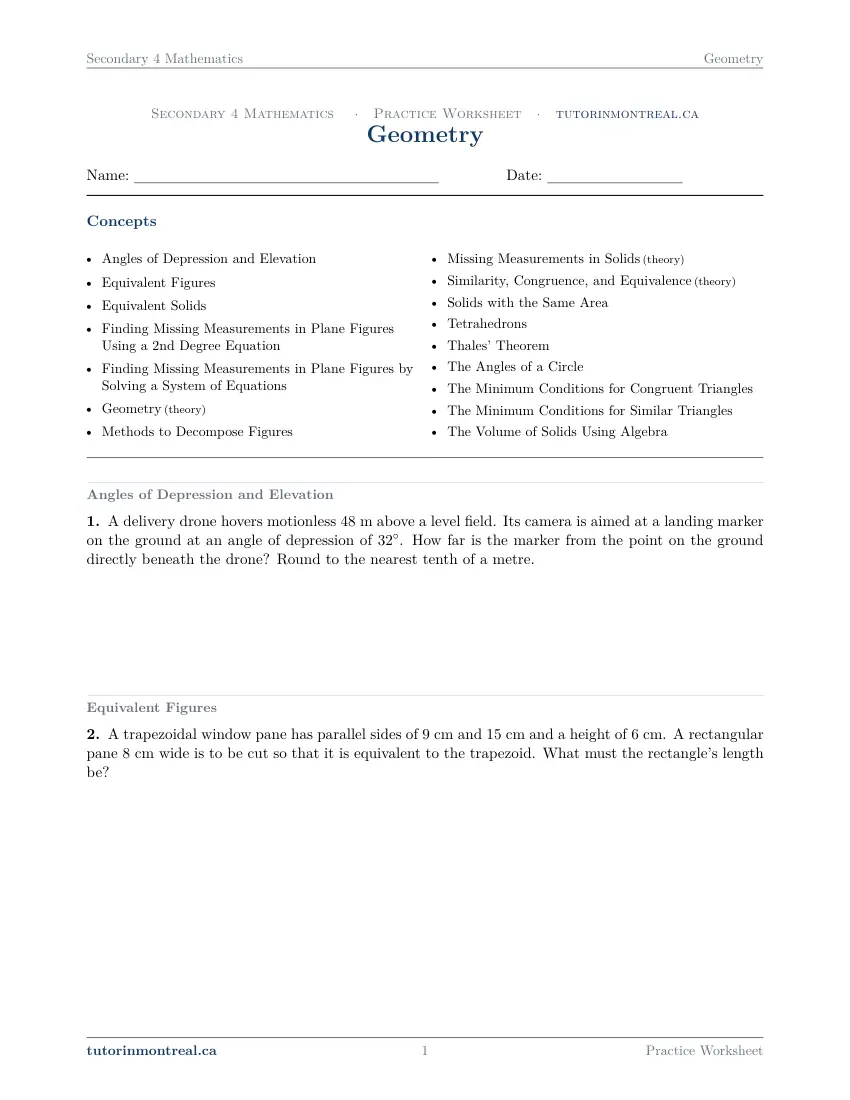
Practice worksheet — free PDF
No email, no account, no watermark. Teachers: photocopy it for your classes freely. Worked solutions and 14 harder problems come with the Secondary 4 Math bundle.
16 of the 17 questions
Each question targets one named concept from the sheet. Read them here, or print the PDF — it has working space under each one. 16 of the 17 questions are printed below. The other 1 is built on a diagram or a table of values that does not translate to the page, so it is in the free PDF — marked below where it would have come.
-
Q1Angles of Depression and Elevation
A delivery drone hovers motionless m above a level field. Its camera is aimed at a landing marker on the ground at an angle of depression of . How far is the marker from the point on the ground directly beneath the drone? Round to the nearest tenth of a metre.
-
Q2Equivalent Figures
A trapezoidal window pane has parallel sides of cm and cm and a height of cm. A rectangular pane cm wide is to be cut so that it is equivalent to the trapezoid. What must the rectangle's length be?
-
Q3Equivalent Solids
A right circular cylinder has a radius of cm and a height of cm. A cone with the same radius is to be equivalent to this cylinder. Find the cone's height.
-
Q4Finding Missing Measurements in Plane Figures Using a 2nd Degree Equation
A rectangular herb bed is m longer than it is wide and covers . Find its dimensions.
-
Q5Finding Missing Measurements in Plane Figures by Solving a System of Equations
A rectangular banner has a perimeter of dm, and its length is dm more than twice its width. Find its dimensions.
-
Q6Geometry
Most geometry problems are solved by first recognizing which relation applies. For each situation below, name the property or theorem you would use, and state the one condition that must be verified before you are allowed to use it.
- Two transversals cut three lines, and three of the four consecutive segment lengths they determine are known.
- An angle whose vertex is on a circle intercepts an arc whose measure is known.
- A cable runs from the top of a mast to an anchor on level ground, and the angle it makes with the ground is known.
- A container of one shape is to be replaced by a container of a different shape holding exactly the same amount.
-
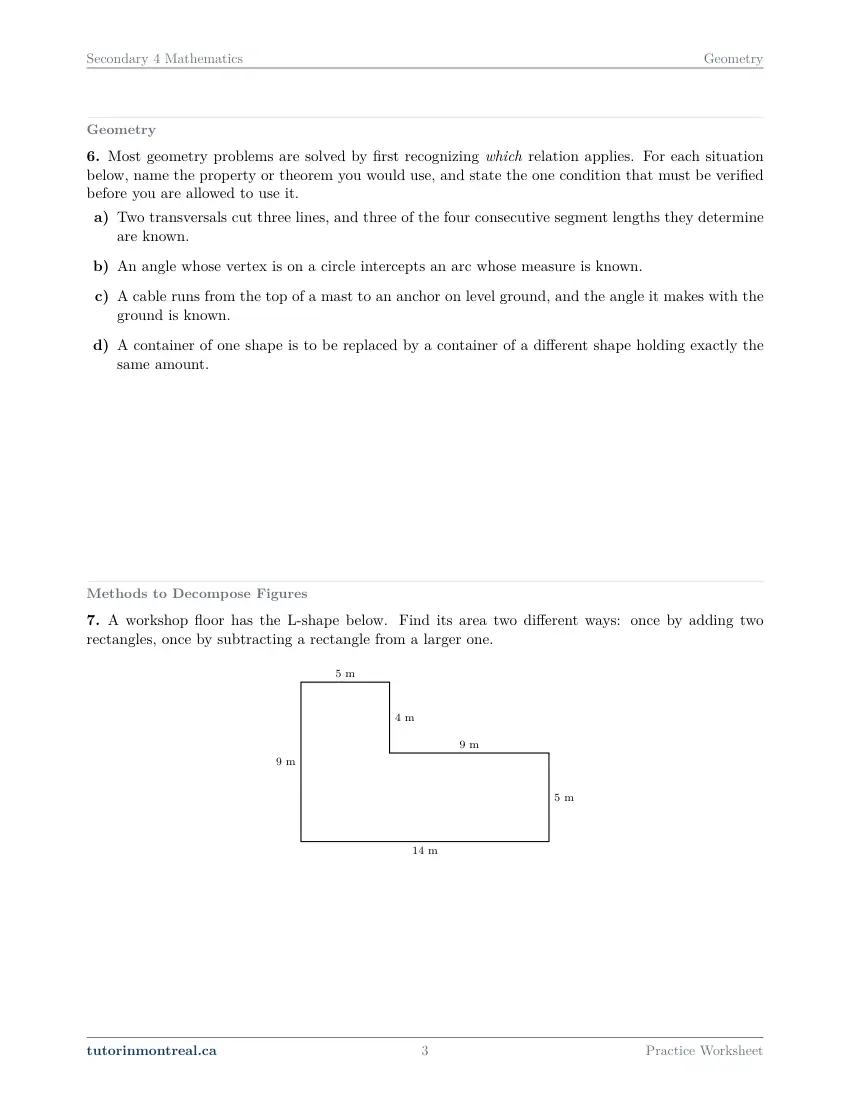
Q7Methods to Decompose Figures
This question is built around a diagram or a table of values. Open it in the PDF.
-
Q8Missing Measurements in Solids
A right circular cone involves three lengths: the radius of the base, the height , and the apothem (slant height) .
- State the relation linking , and , and justify it.
- A technician knows only the volume and the radius of such a cone and must find its total area. Describe the order of the steps, naming which quantity must be found first and why the total area cannot be obtained directly.
-
Q9Similarity, Congruence, and Equivalence
Decide whether each statement is always, sometimes or never true. Justify each answer with an argument or an explicit counterexample.
- Two congruent figures are equivalent.
- Two equivalent figures are congruent.
- Two similar figures whose ratio of similarity is are congruent.
- Two equivalent triangles have the same perimeter.
-
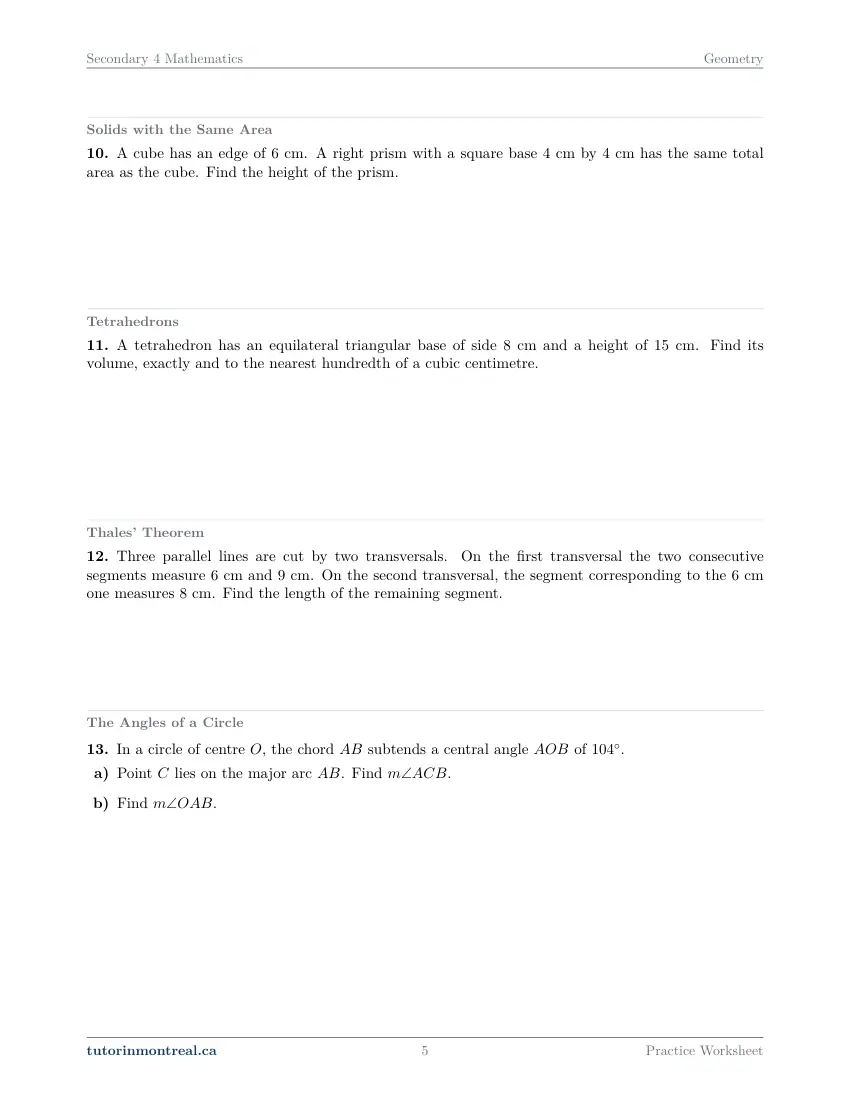
Q10Solids with the Same Area
A cube has an edge of cm. A right prism with a square base cm by cm has the same total area as the cube. Find the height of the prism.
-
Q11Tetrahedrons
A tetrahedron has an equilateral triangular base of side cm and a height of cm. Find its volume, exactly and to the nearest hundredth of a cubic centimetre.
-
Q12Thales' Theorem
Three parallel lines are cut by two transversals. On the first transversal the two consecutive segments measure cm and cm. On the second transversal, the segment corresponding to the cm one measures cm. Find the length of the remaining segment.
-
Q13The Angles of a Circle
In a circle of centre , the chord subtends a central angle of .
- Point lies on the major arc . Find .
- Find .
-
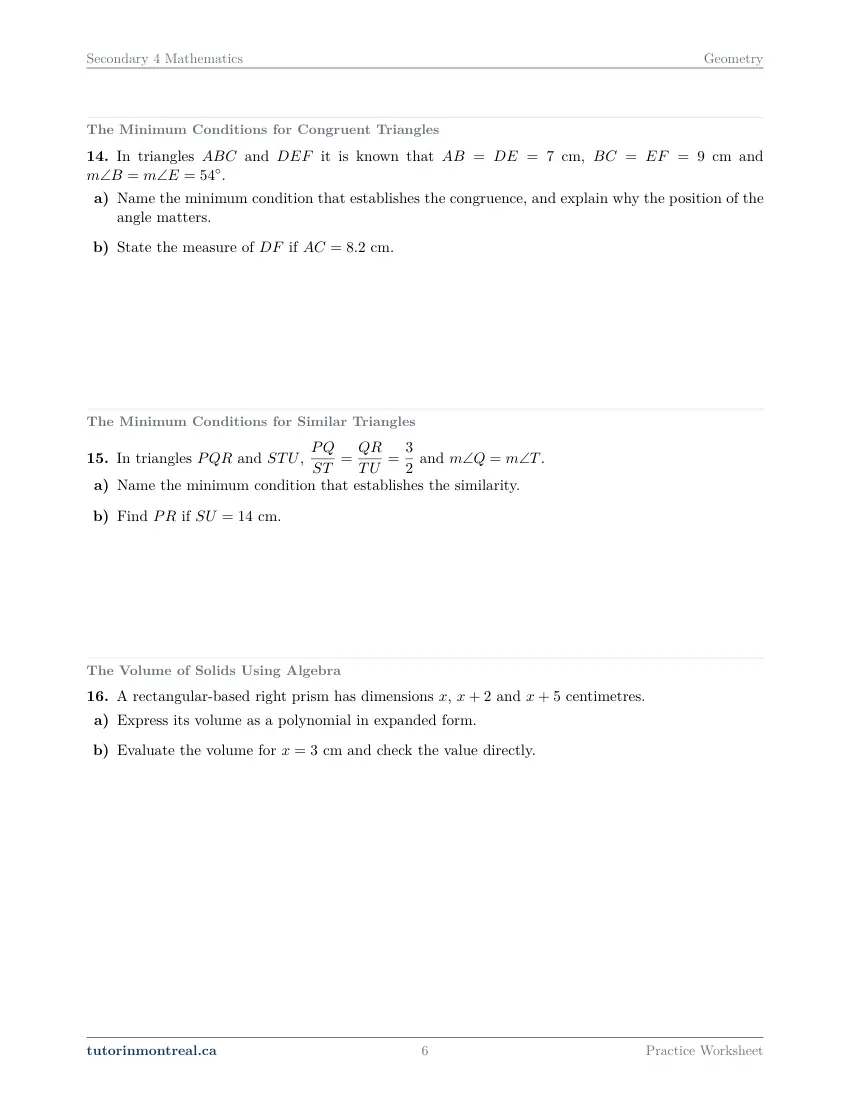
Q14The Minimum Conditions for Congruent Triangles
In triangles and it is known that cm, cm and .
- Name the minimum condition that establishes the congruence, and explain why the position of the angle matters.
- State the measure of if cm.
-
Q15The Minimum Conditions for Similar Triangles
In triangles and , and .
- Name the minimum condition that establishes the similarity.
- Find if cm.
-
Q16The Volume of Solids Using Algebra
A rectangular-based right prism has dimensions , and centimetres.
- Express its volume as a polynomial in expanded form.
- Evaluate the volume for cm and check the value directly.
-
Q17Synthesis — drawing on several sheets in this topic
Road salt is dumped into a conical pile on level ground; the base of the pile is a circle of diameter m. From a point on the ground m from the edge of the pile, in the same vertical plane as the apex, the angle of elevation of the apex is .
The municipality wants to move all of the salt into a rectangular-based bin measuring m by m, filled level to the top. How deep must the bin be? Round to the nearest hundredth of a metre.
The 14 challenge problems for this topic are a separate, paid sheet and are not reproduced here.
Which stream is this for? This sheet is built for SN. It expects algebraic set-ups — second-degree equations and systems for missing measurements, volumes written as polynomials, exact radical answers — and it goes to the depth that program expects.
How to do every concept on this sheet
This is the part worksheet sites usually leave out. Below is the actual reasoning behind each group of questions — not a full solution set, the decisions that get you to one. Read it before you start, or after you get stuck.
Naming the relation is most of the work
A geometry question rarely tells you which theorem it wants. Q6 asks for exactly that, and adds a second demand that is where the marks quietly sit: the one condition that must be verified before you are allowed to use the relation. Every theorem in this unit has such a condition, and applying a theorem whose hypothesis fails is the most expensive kind of wrong answer, because the arithmetic afterwards is flawless and worth nothing.
What is in the figure, and what it unlocks
Check the condition in the second sentence before you write a single number.
- 1Parallel lines cut by transversals → Thales
Proportional segments. The condition is that the cut lines really are parallel — otherwise the proportion is simply false. Q12 uses it forwards; the converse turns the same proportion into a way of proving two lines parallel.
- 2An angle in a circle → the inscribed angle property
An inscribed angle is half its intercepted arc. The condition is that the vertex lies on the circle and its sides are chords. A vertex at the centre, inside, or outside obeys a different rule each time. Q13.
- 3A right angle in a triangle → a trigonometric ratio
Sine, cosine or tangent. The condition is a genuine right angle — a mast perpendicular to level ground, not merely a tall thing. Q1 and Q17.
- 4"Holds the same amount" → equivalence
Equal volumes, or equal areas for plane figures. The condition is that both quantities be expressed in the same unit before you set them equal. Q2, Q3, Q10 and Q17.
- 5Equal angles or proportional sides → congruence or similarity
SSS, SAS, ASA for congruence; AA, SSS and SAS for similarity. The condition is that the parts you match are corresponding, and for SAS that the angle is the included one. Q14 and Q15.
Congruent, similar, equivalent — three different words (Q2, Q9, Q10)
They get used interchangeably in conversation and they mean three different things, which is why Q9 asks you to sort always, sometimes and never statements about them. Congruent means same shape and same size — every corresponding side and angle equal. Similar means same shape, sizes in a fixed ratio k. Equivalent means same area (or same volume for solids) and says nothing at all about shape.
The implications run one way only. Congruent figures are always similar and always equivalent. Similar figures with k = 1 are congruent. But equivalent figures need not be congruent, need not be similar, and need not even have the same number of sides — which is why Q2 can ask for a rectangle equivalent to a trapezoid at all.
Two claims that feel true and are not. Equal area does not force equal perimeter: a 2 cm by 18 cm rectangle and a 6 cm by 6 cm square both cover 36 cm², with perimeters of 40 cm and 24 cm. And equal total surface area does not force equal volume — Q10 builds a cube and a prism with matching areas precisely so that the question after it can compare what they hold.
To disprove a statement of this kind you need one explicit counterexample with numbers, computed both ways. "It does not always work" earns nothing.
One ratio worth carrying into every similarity question: if lengths are in the ratio k, then areas are in the ratio k² and volumes in the ratio k³. Doubling every edge of a solid multiplies its surface by 4 and its capacity by 8 — the reason this appears on exams as a "surprising" result is that most people expect all three to double.
Equivalent solids: change one dimension, not all of them (Q3)
Q3 sets a cone equal in volume to a cylinder of the same radius. Because a cone is exactly one third of the cylinder on the same base and height, matching their volumes with the radius held fixed forces the cone's height to be three times the cylinder's — a result you can predict before writing anything, and then confirm algebraically.
That prediction is the habit to build. Write the two volume formulas, cancel everything the two solids share (here π and r²), and see what is left. When only one dimension is free, the relation between it and the volume is linear and you solve directly. When the shape is fixed and all dimensions scale together — a sphere recast as a cone whose height is tied to its radius, for instance — the unknown ends up cubed, and a cube root appears in the answer. Knowing which of the two situations you are in tells you what the answer should look like before you get there.
Angles of elevation and depression (Q1, Q17)
Both angles are measured from the horizontal, never from the vertical: the angle of elevation looks up from the observer, the angle of depression looks down. The fact that makes the drone question work is that these two are equal — the horizontal at the drone and the ground are parallel, so the angle of depression at the top and the angle of elevation at the bottom are alternate interior angles. Draw that horizontal dashed line into your sketch and the right triangle appears on its own.
When the unknown is downstairs. With a known height and an unknown ground distance, the tangent relation puts the unknown in the denominator:
tan 32° = 48⁄d → d = 48⁄tan 32°That is not the same as 48 · tan 32°, and swapping the two is the single most common error in this unit — it is also easy to catch, because a small angle must give a long ground distance for a fixed height. Check the calculator is in degrees before you trust any of it.
Thales, and the proportion that has to be built correctly (Q12)
Parallel lines cut proportional segments on any two transversals. The theorem is easy; setting up the proportion is where it goes wrong, because a proportion is only true if the two sides describe the same pair of positions. Write it as
first segment ⁄ second segment = first segment ⁄ second segmentwith the left-hand fraction taken entirely from one transversal and the right-hand fraction entirely from the other, in the same order. Mixing a length from one transversal into the same fraction as a length from the other produces a plausible-looking equation with no theorem behind it. And read the question for what each length measures: a segment from the vertex is not the same as the whole side, and the two ratios AD⁄DB and AD⁄AB are different numbers.
The angles of a circle (Q13)
Three facts cover Q13 and most of what follows it. A central angle has the same measure as its intercepted arc. An inscribed angle, with its vertex on the circle, measures half its intercepted arc — so two inscribed angles standing on the same arc are equal, however far apart their vertices are. And any triangle formed by two radii is isosceles, because those two sides are both radii; that is what turns Q13(b) into a base-angle computation rather than a circle question at all.
Minimum conditions: what "minimum" is protecting you from (Q14, Q15)
A minimum condition is the smallest amount of information that pins a triangle down completely. For congruence: SSS, SAS, ASA. For similarity: AA, three proportional sides, or two proportional sides with the angle between them.
The word included in SAS is doing real work, and Q14 asks you to explain why. Two sides and the angle between them can be assembled in exactly one way — draw the angle, mark the two lengths along its arms, join the ends, and the triangle is determined. Move the given angle so that it is not between them and that guarantee vanishes: the third vertex can often be placed in two different positions, so two non-congruent triangles fit the same data. Once congruence is established, every corresponding side and angle is equal, which is all Q14(b) needs; once similarity is established, every pair of corresponding sides shares the same ratio k, which is all Q15(b) needs.
Building an equation for a missing measurement (Q4, Q5)
Both questions are algebra dressed as geometry, and both are won or lost in the first two lines. Name the unknown explicitly — "let w be the width in metres" — express every other length in terms of it, then write the one sentence in the problem that becomes an equation. Q4 turns into a second-degree equation because an area is a product of two lengths; Q5 gives two independent facts about two unknowns, so it becomes a system, most easily solved by substituting the second equation into the first.
Reject the impossible root, and say why. A second-degree equation from a geometry problem almost always has one negative root. It is not an error and it is not ignorable: write "rejected: a length cannot be negative". Other context conditions bite the same way — a border width has to be less than half the shorter side, or the inner rectangle disappears. Finish by checking the surviving answer against the original wording, not against your own equation, which may be where the mistake was.
Decomposing a figure, two ways on purpose (Q7)
The L-shaped floor is asked for twice — once by adding two rectangles, once by subtracting a rectangle from the enclosing one — and the reason is that the two methods check each other. If they disagree, one of your missing side lengths is wrong, and on an L-shape the missing sides are always found by subtracting: the short side of the notch is the difference of the two full sides it sits between. (This question depends on its diagram, so it lives on the printed sheet rather than on this page.)
The same discipline applies to any composite region. Decide whether the shape is a sum or a difference, mark the pieces on the drawing before computing anything, and treat a negative area as an immediate signal that you subtracted a piece larger than the whole.
Solids: find the bridge quantity first (Q8, Q11, Q16)
Q8 is the general principle stated in the open. In a right circular cone the radius, the height and the apothem are tied by s² = r² + h², because the axis, a radius and the corresponding slant line form a right triangle with the right angle at the centre of the base. Volume formulas contain h; area formulas contain s. So a question that gives you the volume and asks for the area has a compulsory middle step: get h from the volume, get s from Pythagoras, then compute the area. Naming that missing bridge quantity before you start is a strategy that generalises to every solid on this sheet.
Q11 needs the area of an equilateral triangle, (√3⁄4)a², before the pyramid volume ⅓ A_b h can be used — and the question asks for the exact value as well as the rounded one, so keep √3 intact through the whole computation and round only at the very end. Rounding early and then multiplying is how an answer drifts in the second decimal place. Q16 goes the other way, expressing a volume as a polynomial: multiply two brackets first, then distribute the third factor, and keep the units as cubic centimetres in the final line.
Q17: the synthesis problem
A conical salt pile measured by an angle of elevation, then moved into a rectangular bin. Three steps chained together — trigonometry for the height, the cone formula for the volume, equivalence for the depth of the bin — with one trap built into the wording. The angle is taken from a point measured from the edge of the pile, while the apex stands above its centre, so the horizontal distance in the right triangle is that measurement plus the radius. Sketch the vertical cross-section and the extra length is impossible to miss; skip the sketch and it is nearly impossible to catch.
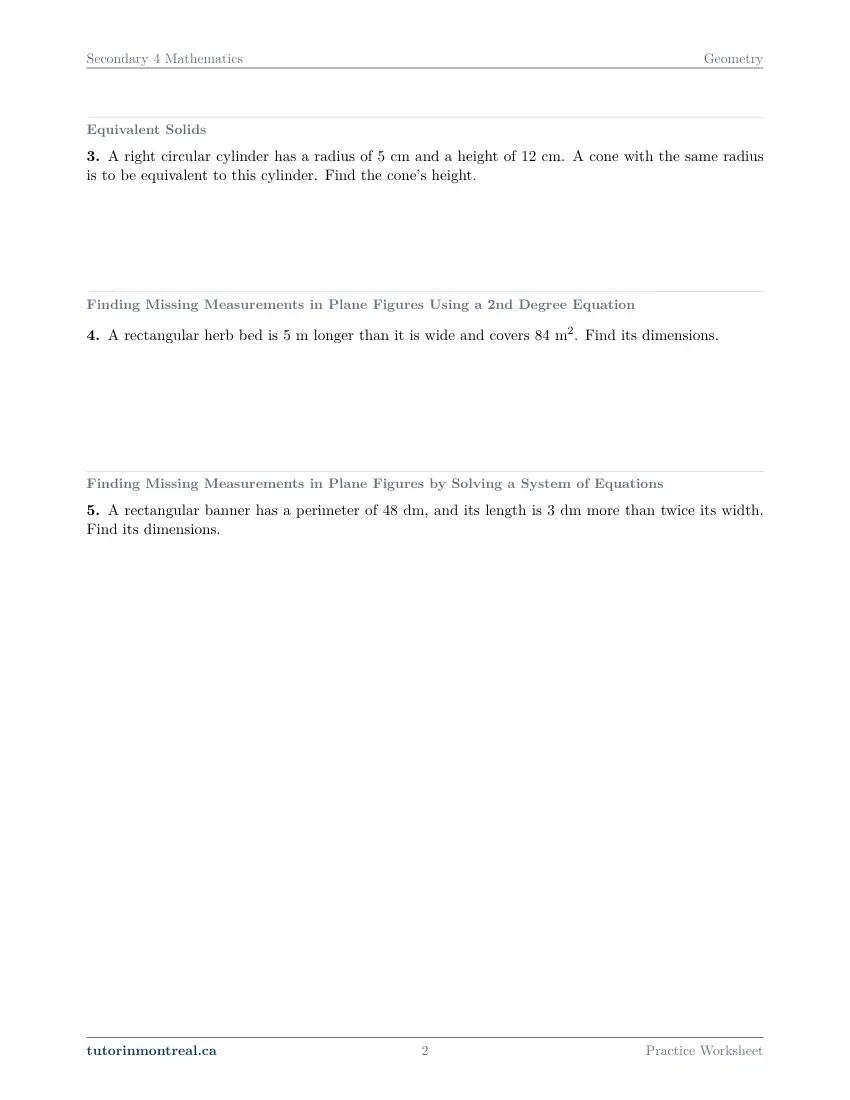
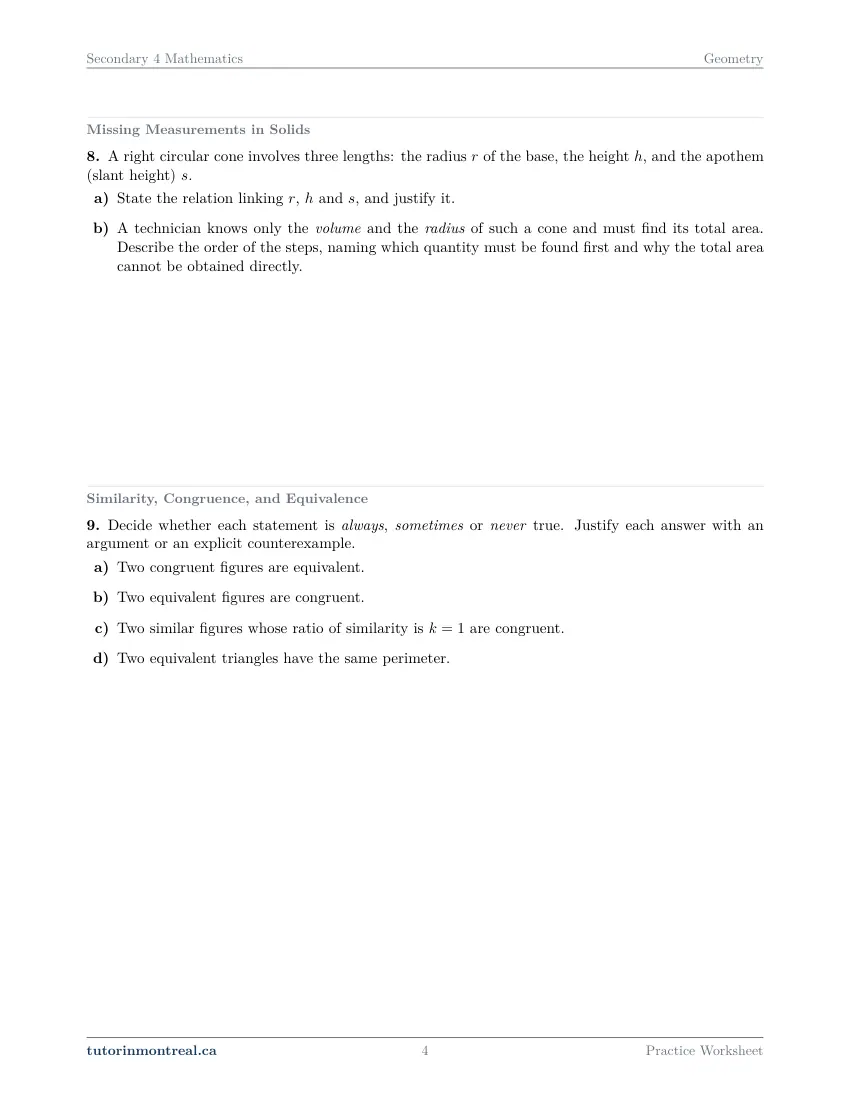
Preview all 7 pages
Click any page to open the full PDF.
Getting the most out of it
Draw it, label it, then reach for a formula
Every question here that people get wrong, they get wrong at the diagram. Redraw the figure large, mark every given length and angle on it, and mark the unknown with a letter. The right relation usually becomes obvious once the picture is honest.
Answer the theorem-naming question in writing
The question that asks you to name a relation and state its condition, and the always/sometimes/never one, are the two most tempting to answer in your head. Write the sentences out. An exam wants the justification, not the verdict, and these are the questions that show whether you can produce one.
Keep exact values until the last line
Radicals and π survive the whole computation; rounding belongs to the final answer only. Several questions here ask for the exact form and the rounded form, which is a deliberate habit-building exercise for the exam.
Want the solutions, or something more challenging?
The worksheet, the questions above and every explanation on this page stay free permanently. Three more PDFs exist for this topic — the worked answer key, a harder problem set, and the answer key to that. They come with the Secondary 4 Math Solutions Bundle, which is what keeps the rest of the series free.
What else exists for Geometry
Three PDFs · 14 pages · all three are in the bundle below.
- Answer key — 3 pages. All 17 questions worked step by step, including the restrictions and the justifications. Not a list of final answers.
- Challenge problems — 7 pages, 14 problems. A separate sheet at exam-plus difficulty covering the same 16 concepts. Harder than anything on the free sheet.
- Challenge answer key — 4 pages. Every challenge problem worked to the same standard, with the checks shown.
- PDF, letter size, print-ready.
The one thing that's for sale
Every Secondary 4 Math topic — the complete Solutions Bundle
One download, one payment, the whole program. Every answer key and every challenge set for all 17 Secondary 4 Math worksheet sets — including this one.
- Worked solutions, not answer lists — every step written out
- Covers the whole year's program at this level
- Less than the price of one hour of tutoring — for the entire year's solutions
Taking Secondary 1 Math as well? The Secondary 1 Math bundle covers all 15 of its sets — 45 PDFs, 182 pages — on the same terms.
Taking Secondary 2 Math as well? The Secondary 2 Math bundle covers all 14 of its sets — 42 PDFs, 181 pages — on the same terms.
Taking Secondary 3 Math as well? The Secondary 3 Math bundle covers all 11 of its sets — 33 PDFs, 154 pages — on the same terms.
Taking Secondary 5 Math as well? The Secondary 5 Math bundle covers all 21 of its sets — 63 PDFs, 228 pages — on the same terms.
Taking CEGEP Calculus I as well? The CEGEP Calculus I bundle covers all 8 of its sets — 24 PDFs, 82 pages — on the same terms.
Taking CEGEP Calculus II as well? The CEGEP Calculus II bundle covers all 8 of its sets — 24 PDFs, 90 pages — on the same terms.
Taking CEGEP Linear Algebra as well? The CEGEP Linear Algebra bundle covers all 7 of its sets — 21 PDFs, 82 pages — on the same terms.
Taking AP Calculus AB as well? The AP Calculus AB bundle covers all 8 of its sets — 24 PDFs, 126 pages — on the same terms.
Common questions
Is this worksheet really free?
Yes — the questions are on this page to read, and the PDF downloads directly, no email and no account. The one paid item is optional: the complete Secondary 4 Solutions Bundle, which covers every set at this level.
What is the difference between congruent, similar and equivalent figures?
Congruent means same shape and same size. Similar means same shape with all lengths in a fixed ratio. Equivalent means same area, or same volume for solids, with no condition on shape at all — which is why a rectangle can be equivalent to a trapezoid. Equal area also does not force equal perimeter: a 2 cm by 18 cm rectangle and a 6 cm by 6 cm square both cover 36 cm² with very different perimeters, and for solids, equal surface area does not force equal volume.
How do I set up a proportion for Thales' theorem?
Take both lengths of the left-hand fraction from one transversal and both lengths of the right-hand fraction from the other, in the same order. Mixing a length from one transversal with a length from the other inside a single fraction produces an equation no theorem supports.
Why does the angle have to be between the two sides in SAS?
Because two sides with the angle between them can be assembled in exactly one way. Move the angle so that it is not included and the third vertex can often be placed in two different spots, giving two triangles that fit the same measurements without being congruent.
When do I use the height of a cone and when do I use the apothem?
The height appears in the volume, the apothem in the lateral and total area, and they are linked by s² = r² + h². If a question gives you one and asks for something that needs the other, that relation is the compulsory middle step.
Which Secondary 4 stream is this for?
It is built for SN. The sheet expects algebraic set-ups — second-degree equations and systems for missing measurements, volumes written as polynomials and answers left in exact radical form — which is the depth that program expects.
Can teachers use this in class?
Yes. Print and photocopy it for your own classes freely — I just ask that the tutorinmontreal.ca footer stays on the page.
I'm stuck on one question. Can you help?
Yes — through one-on-one tutoring, in Montreal or online. Get in touch to arrange a session, or see the current rates.
← All 17 Secondary 4 Math worksheets · Secondary 1 Math series (15 sheets) → · Secondary 2 Math series (14 sheets) → · Secondary 3 Math series (11 sheets) → · Secondary 5 Math series (21 sheets) → · CEGEP Calculus I series (8 sheets) → · CEGEP Calculus II series (8 sheets) → · CEGEP Linear Algebra series (7 sheets) → · AP Calculus AB series (8 sheets) →
The same topic at the other level: Secondary 5 Math · Geometry.