Secondary 5 Rational Functions Worksheet
Two asymptotes, two branches, and one rule that can be written two ways. The sheet covers reading the asymptotes off the standard form, building a rule from a description, sketching both branches, locating zeros and sign intervals, converting between the standard and the general form, inverting the function, and telling a genuine asymptote from a hole. Read what you like here and print the PDF for nothing.
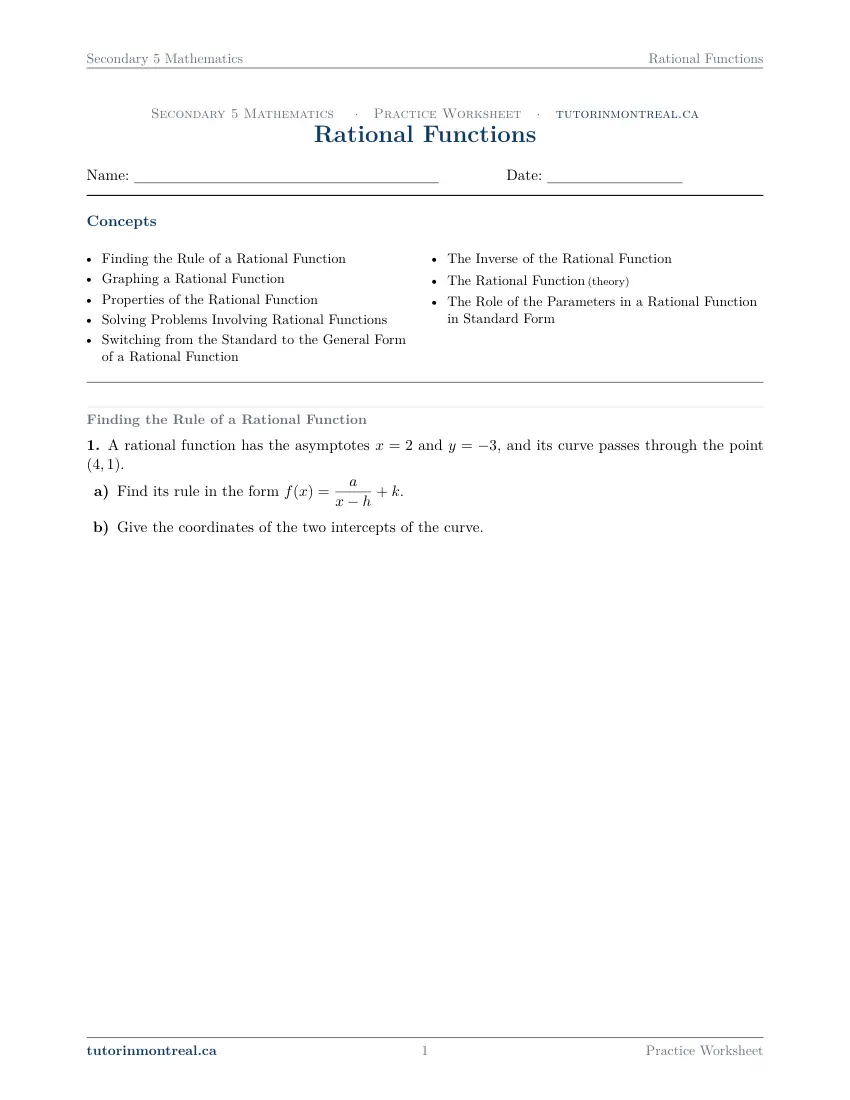
Practice worksheet — free PDF
No email, no account, no watermark. Teachers: photocopy it for your classes freely. Worked solutions and 7 harder problems come with the Secondary 5 Math bundle.
All 8 questions
Each question targets one named concept from the sheet. Read them here, or print the PDF — it has working space under each one.
-
Q1Finding the Rule of a Rational Function
A rational function has the asymptotes and , and its curve passes through the point .
- Find its rule in the form .
- Give the coordinates of the two intercepts of the curve.
-
Q2Graphing a Rational Function
Consider .
- Give the equations of the two asymptotes and the coordinates of the two intercepts.
- Sketch both branches on the grid below, using at least two extra plotted points per branch.
- Give the domain and the range of .
A blank Cartesian grid for this question is on the printable PDF.
-
Q3Properties of the Rational Function
Let .
- Give the two asymptotes, the domain and the range.
- Find the zero and the -intercept.
- Give the intervals where is positive and where it is negative.
-
Q4Solving Problems Involving Rational Functions
A robotics club buys a 3D printer for $; each printed part then costs $ in filament. After parts, the average cost per part is
- What is the average cost per part after parts?
- How many parts must the club print for the average cost to drop below $?
- What is the horizontal asymptote of , and what does it mean here?
-
Q5Switching from the Standard to the General Form of a Rational Function
- Write in the general form .
- Write in standard form and give its asymptotes.
-
Q6The Inverse of the Rational Function
Let . Find the rule of and give the equations of the asymptotes of and of .
-
Q7The Rational Function
Here “rational function” means a function whose rule is a quotient of polynomials in which the variable actually appears in the denominator. For each rule, state whether it defines a rational function, and whether its graph has a vertical asymptote. Justify.
-
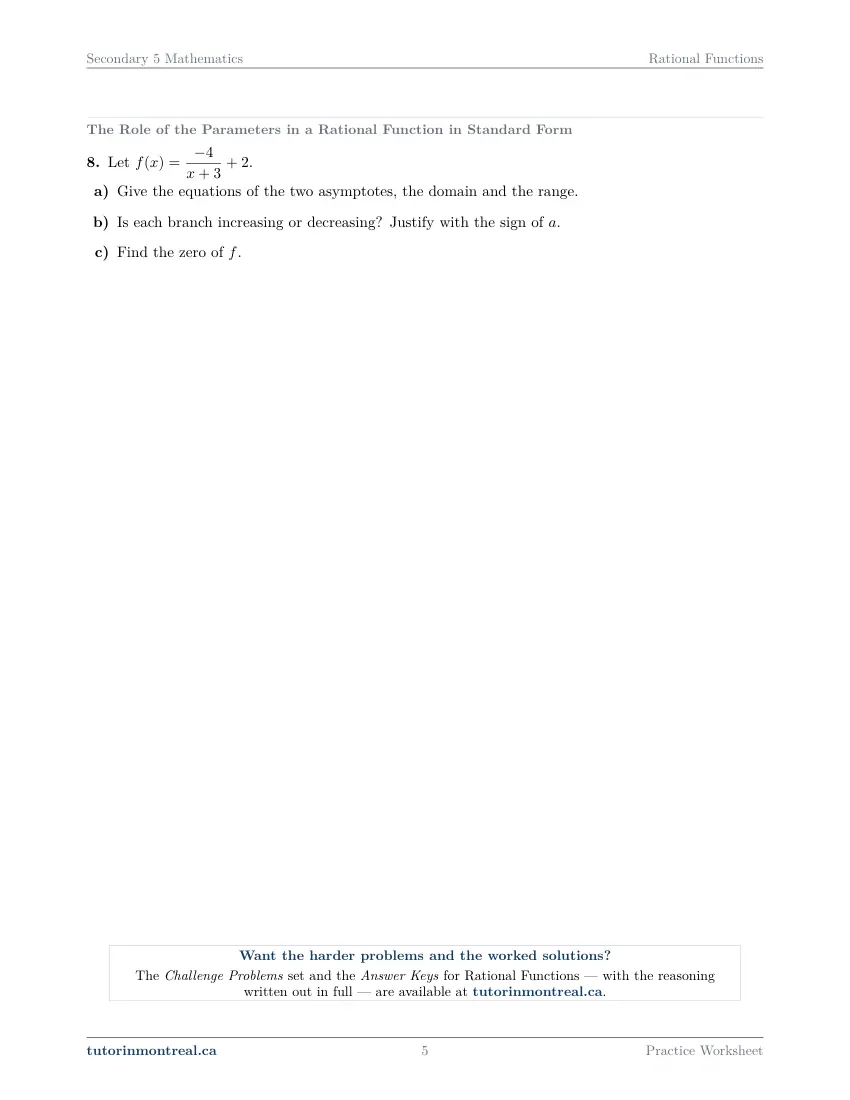
Q8The Role of the Parameters in a Rational Function in Standard Form
Let .
- Give the equations of the two asymptotes, the domain and the range.
- Is each branch increasing or decreasing? Justify with the sign of .
- Find the zero of .
The 7 challenge problems for this topic are a separate, paid sheet and are not reproduced here.
Which stream is this for? This sheet is built for SN. It assumes you work with the full standard form a/(x − h) + k, state domains and ranges as the reals with one value removed, convert to and from the general form (ax + b)/(cx + d), and construct inverses, and it goes to the depth that program expects.
How to do every concept on this sheet
This is the part worksheet sites usually leave out. Below is the actual reasoning behind each group of questions — not a full solution set, the decisions that get you to one. Read it before you start, or after you get stuck.
Standard form is a set of instructions, not a formula to memorise
Almost every question on this sheet lives in one shape:
f(x) = a ⁄ (x − h) + kOnce a rule is in that shape, four of the answers are already written down. The denominator cannot be zero, so x = h is the vertical asymptote and the domain is every real number except h. The fraction a ⁄ (x − h) is a non-zero constant divided by something, so it is never zero itself — which means f(x) can be anything except k. That is the horizontal asymptote, and it is why the range is every real number except k. Q2, Q3 and Q8 are all asking you to perform that reading.
The sign of h is the single most-lost mark on this topic. The form
says x − h. Q8 gives you −4 ⁄ (x + 3) + 2, and x + 3 is
x − (−3), so h = −3 and the vertical asymptote is x = −3, not
x = 3. Write the rule out with an explicit minus before you read anything off it. The
same trap sits in Q6's inverse and in Q5(b).
From a rational rule to everything a question can ask
The same five moves answer Q1, Q2, Q3 and Q8. Do them in this order and nothing is left over.
- 1Read h and k
From the rule, or from the asymptotes if the question gives those instead. In Q1 you are handed
x = 2andy = −3, soh = 2andk = −3before you have written a single equation. - 2Find a from one known point
Substitute the point's coordinates into
a ⁄ (x − h) + kand solve the resulting one-step equation. This is the only unknown left, so one point is always enough. Then substitute the point back to check — it costs five seconds and catches a sign error immediately. - 3The y-intercept: evaluate f(0)
Nothing clever. Put
0in forx. It exists unlessh = 0, in which case the y-axis is the vertical asymptote and there is no y-intercept at all. - 4The zero: solve a ⁄ (x − h) = −k
Set the whole rule to zero, move
kacross, then cross-multiply. Do not set the numerator to zero — see below. Ifk = 0there is no zero, because the curve never touches the x-axis. - 5Sign, or the sketch
The zero and the vertical asymptote are the only two places the sign of f can change. Mark both, test one point in each of the three resulting intervals, and you have the answer to Q3(c).
Why you never set the numerator to zero
Everywhere else in the course, "find the zero" means "set the numerator to zero". Here that reflex produces nonsense. In Q3 the numerator is the constant 4, and 4 = 0 is simply false — the fraction 4 ⁄ (x − 3) is never zero for any x. The curve reaches the x-axis only because of the + k outside. So the equation you actually solve is the fraction equalling −k. With a rule like 6 ⁄ (x + 1) − 3:
6 ⁄ (x + 1) = 3 ⟹ x + 1 = 2 ⟹ x = 1That "never zero" fact is doing double duty. It is also the reason the horizontal asymptote is never crossed: f(x) = k would force a ⁄ (x − h) = 0, which cannot happen while a ≠ 0. A curve in this family approaches y = k from one side on each branch and stays there.
Sign intervals: three pieces, and the asymptote is in none of them
Q3(c) asks where f is positive and where it is negative. The zero and the vertical asymptote cut the number line into three intervals; inside each one the sign cannot change, so a single test value settles it. Take f(x) = 2 ⁄ (x − 5) + 1, whose zero is at x = 3 and whose asymptote is x = 5: test x = 0, x = 4 and x = 6, and the pattern is fixed.
The bracket at the asymptote is always reversed. x = h is not in the domain, so it can be in neither the positive set nor the negative set. An answer like ]−∞, 3] ∪ [5, +∞[ is wrong twice over: at x = 5 the function does not exist, and at x = 3 it is zero rather than positive. Zeros go with "≥ 0" questions, not with "> 0" questions — read which one you were asked.
Increasing or decreasing: the sign of a does the opposite of what you expect
Q8(b) asks you to justify the variation from the sign of a, and the honest answer surprises most students. Follow one branch as x increases. Then x − h increases, so 1 ⁄ (x − h) gets smaller. Multiply by a positive a and it is still shrinking, so both branches decrease. Multiply by a negative a and the order reverses, so both branches increase.
Read that once more: a > 0 gives decreasing branches, a < 0 gives increasing ones — the reverse of the linear and square root families. And say on each branch. The function as a whole is not decreasing on its domain, because it jumps from the bottom of one branch to the top of the other across x = h. A variation table for a rational function always has a double bar at h.
Sketching both branches (Q2)
Draw the two asymptotes as dashed lines first. They are the scaffolding, and a sketch built on them is almost impossible to get badly wrong. Then place the two intercepts, which you already computed in part (a), and add the extra points the question asks for.
Choosing those extra points is the small skill worth having: pick x values that make x − h a divisor of a, and the coordinates come out as whole numbers. For Q2's rule, values of x sitting 1, 2, 3 or 6 units away from the asymptote do exactly that — on both sides, so you get points for both branches out of the same idea. With a > 0 the right-hand branch sits above y = k and the left-hand branch below it; with a < 0 they swap. Sketch a curve that hugs both dashed lines without ever touching them.
Standard form ↔ general form (Q5)
Q5 runs the conversion in both directions, and each direction is one idea.
Standard to general is just addition of fractions: put the + k over the same denominator and combine. 3 ⁄ (x − 4) + 5 becomes [3 + 5(x − 4)] ⁄ (x − 4), then expand the top.
General to standard is division: rewrite the numerator as a multiple of the denominator, plus whatever is left over. For (4x + 9) ⁄ (x + 2), ask how many times x + 2 fits into 4x + 9 — four times, using up 4x + 8 and leaving 1:
(4x + 9) ⁄ (x + 2) = [4(x + 2) + 1] ⁄ (x + 2) = 4 + 1 ⁄ (x + 2)Now the asymptotes are readable: x = −2 and y = 4. If the leading coefficient of the denominator is not 1, the multiple is a fraction — that is allowed, and it is where the arithmetic gets careless.
The horizontal asymptote of a general form is not y = 0. Students see a fraction, remember "big x makes a fraction small", and write y = 0. For (ax + b) ⁄ (cx + d) the top and the bottom both grow, and their ratio settles at y = a ⁄ c. Use that as a check on your conversion: after rewriting, the constant you pulled out front must equal the ratio of the two leading coefficients, and the vertical asymptote must be the solution of cx + d = 0. If either check fails, the division slipped.
The inverse, and the structural check that makes it free (Q6)
The mechanics are the usual ones: swap x and y, then isolate y. Starting from y = a ⁄ (x − h) + k you write x = a ⁄ (y − h) + k, move k across, and flip both sides of x − k = a ⁄ (y − h) to reach y − h = a ⁄ (x − k).
The result you should recognise: the inverse of a rational function is another rational function of the same family, with the same a, and with h and k exchanged. The two asymptotes therefore swap: the vertical one of f becomes the horizontal one of f−1 and the other way round. That is not a coincidence to memorise — it follows from the fact that inverting a function exchanges its domain and its range, and here the domain is "all reals except h" while the range is "all reals except k". Q6 asks for both sets of asymptotes precisely so you notice.
Finish with one numerical check: pick any convenient x, compute f(x), then feed that output into your f−1 and confirm you land back where you started.
Asymptote or hole? (Q7)
Q7 gives you three rules and asks two separate questions about each: is it a rational function, and does its graph have a vertical asymptote. They are separate, and that is the whole point.
A rule counts as rational here when the variable genuinely appears in a denominator. A rule like (x + 1) ⁄ 4 only looks like a fraction; dividing by the constant 4 is multiplying by 1 ⁄ 4, so it is a first-degree polynomial function, defined everywhere, with no excluded value and no asymptote.
A zero of the denominator gives an asymptote only when it is not also a zero of the numerator. If both vanish at the same value, the common factor cancels and you get a hole — a single missing point on an otherwise ordinary graph — not a curve shooting off to infinity. Compare (x² − 9) ⁄ (x − 3), which is the line y = x + 3 with a hole at x = 3, with 5 ⁄ (x − 3), which genuinely explodes there. Both have x = 3 excluded from the domain; only one has an asymptote. Factor the numerator before you answer.
Average-cost models (Q4)
Q4 is the applied shape this topic almost always takes on an exam: a fixed cost paid once, a variable cost paid per unit, and a question about the average. Divide the total by the number of units and then split the fraction into two pieces:
(F + rn) ⁄ n = F ⁄ n + rThat is standard form with a = F, h = 0 and k = r. Reading it that way answers part (c) before you calculate anything: the horizontal asymptote is y = r, the per-unit cost on its own, and the average cost falls toward it without ever reaching it, because the fixed cost is always being spread over some finite number of units.
Two habits for part (b) and its relatives. First, when you multiply both sides of the inequality by n, say out loud why the sense does not flip — it is because the context forces n > 0, not because inequalities are usually well behaved. Second, respect the context's domain: a number of printed parts is a positive whole number, so an algebraic answer of n > 300 is reported as "from the 301st part onward", not as an interval of reals.
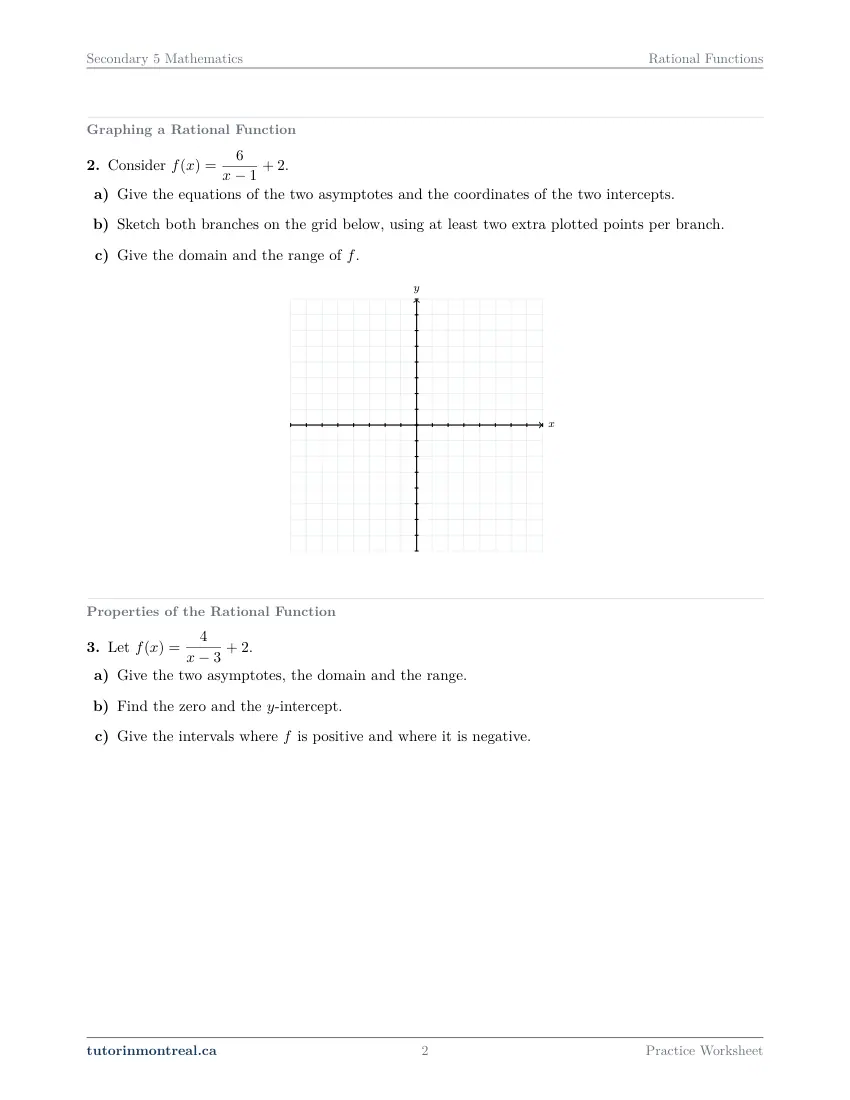
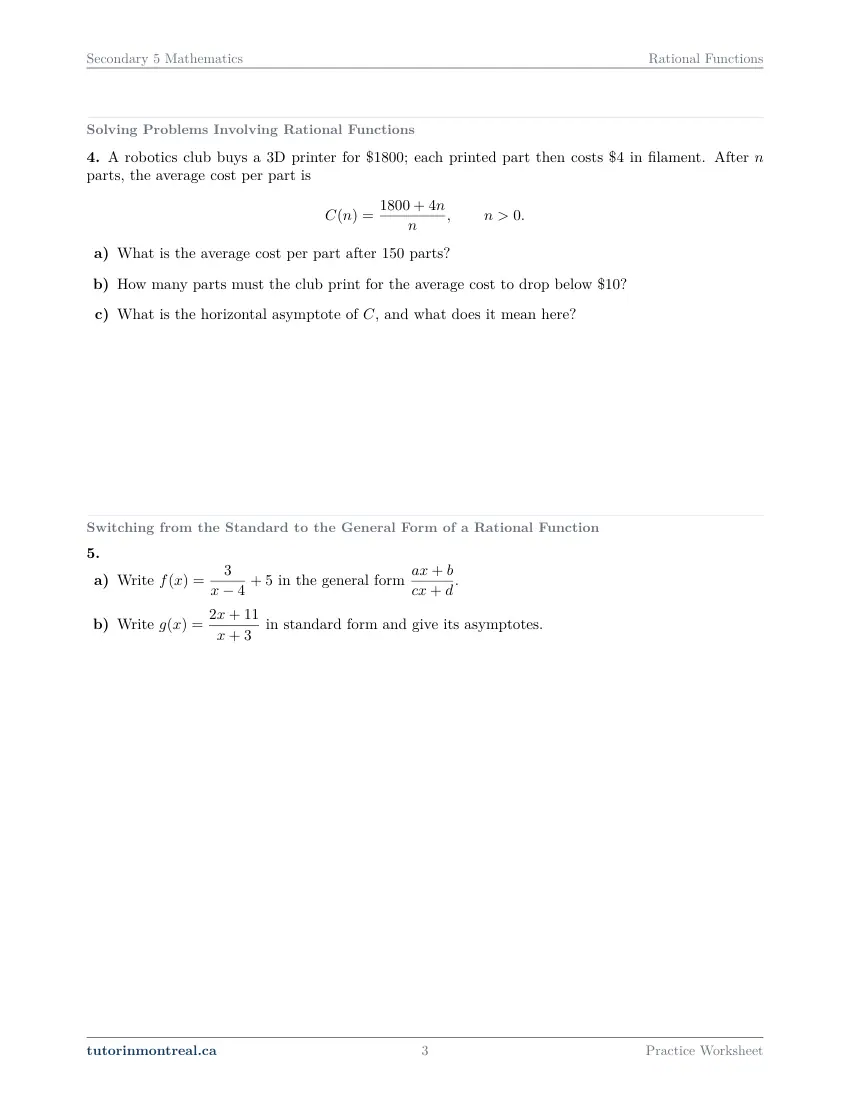
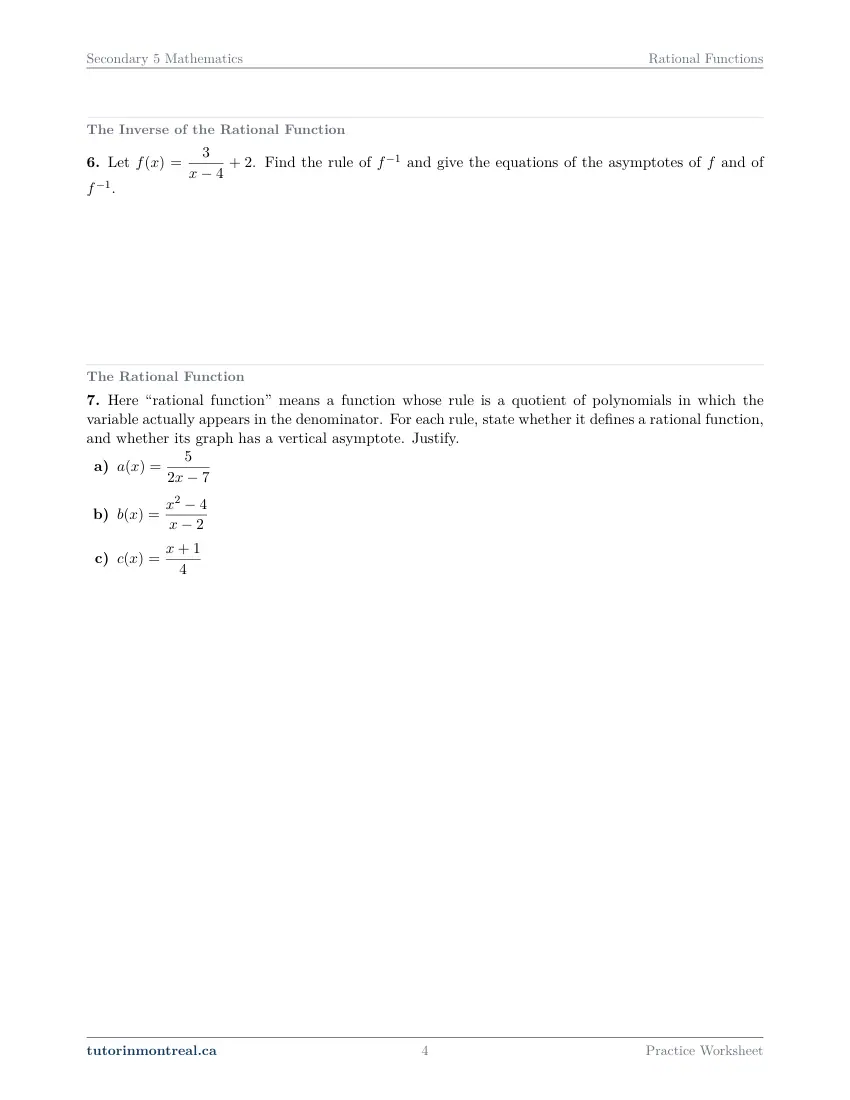
Preview all 5 pages
Click any page to open the full PDF.
Getting the most out of it
Draw the dashed lines before you draw anything else
On every graphing question, put the two asymptotes on the grid first, as dashed lines, labelled with their equations. A branch drawn into that frame lands in the right region automatically; a branch drawn freehand and then "fitted" to asymptotes almost never does.
Convert to standard form before you answer any question about a rule
If a rule arrives as (ax + b) ⁄ (cx + d), do the division first, even when the question has not asked for it. Every property you might be asked for — asymptotes, domain, range, variation, the inverse — is visible in standard form and hidden in the general one.
Check every rule you build with the point you were given
Q1, Q5 and Q6 all end with a rule you constructed rather than one you were handed. Substituting the original point back in turns a guess into a verified answer, and it takes one line. Build the habit here and it pays for itself on the exam, where nobody tells you a sign is wrong.
Want the solutions, or something more challenging?
The worksheet, the questions above and every explanation on this page stay free permanently. Three more PDFs exist for this topic — the worked answer key, a harder problem set, and the answer key to that. They come with the Secondary 5 Math Solutions Bundle, which is what keeps the rest of the series free.
What else exists for Rational Functions
Three PDFs · 11 pages · all three are in the bundle below.
- Answer key — 2 pages. All 8 questions worked step by step, including the restrictions and the justifications. Not a list of final answers.
- Challenge problems — 6 pages, 7 problems. A separate sheet at exam-plus difficulty covering the same 8 concepts. Harder than anything on the free sheet.
- Challenge answer key — 3 pages. Every challenge problem worked to the same standard, with the checks shown.
- PDF, letter size, print-ready.
The one thing that's for sale
Every Secondary 5 Math topic — the complete Solutions Bundle
One download, one payment, the whole program. Every answer key and every challenge set for all 21 Secondary 5 Math worksheet sets — including this one.
- Worked solutions, not answer lists — every step written out
- Covers the whole year's program at this level
- Less than the price of one hour of tutoring — for the entire year's solutions
Taking Secondary 1 Math as well? The Secondary 1 Math bundle covers all 15 of its sets — 45 PDFs, 182 pages — on the same terms.
Taking Secondary 2 Math as well? The Secondary 2 Math bundle covers all 14 of its sets — 42 PDFs, 181 pages — on the same terms.
Taking Secondary 3 Math as well? The Secondary 3 Math bundle covers all 11 of its sets — 33 PDFs, 154 pages — on the same terms.
Taking Secondary 4 Math as well? The Secondary 4 Math bundle covers all 17 of its sets — 51 PDFs, 154 pages — on the same terms.
Taking CEGEP Calculus I as well? The CEGEP Calculus I bundle covers all 8 of its sets — 24 PDFs, 82 pages — on the same terms.
Taking CEGEP Calculus II as well? The CEGEP Calculus II bundle covers all 8 of its sets — 24 PDFs, 90 pages — on the same terms.
Taking CEGEP Linear Algebra as well? The CEGEP Linear Algebra bundle covers all 7 of its sets — 21 PDFs, 82 pages — on the same terms.
Taking AP Calculus AB as well? The AP Calculus AB bundle covers all 8 of its sets — 24 PDFs, 126 pages — on the same terms.
Common questions
Is this worksheet really free?
Yes — the questions are on this page to read, and the PDF downloads directly, no email and no account. The one paid item is optional: the complete Secondary 5 Solutions Bundle, which covers every set at this level.
Why is the range every real number except k?
Because the fraction a/(x − h) can take any value at all except zero. A non-zero number divided by a real number is never zero, so f(x) can be anything except k + 0, which is k. That is the same fact that makes y = k a horizontal asymptote the curve never crosses.
How do I find the zero of a rational function?
Set the whole rule equal to zero and move k to the other side, so you are solving a/(x − h) = −k, then cross-multiply. Do not set the numerator to zero: the numerator is a non-zero constant, so that equation has no solution. If k is zero, the function has no zero.
Why are the branches increasing when a is negative?
Follow a branch as x increases: x − h grows, so 1/(x − h) shrinks. A positive a keeps it shrinking, so the branches decrease; a negative a reverses the order, so they increase. Say it of each branch separately — the function jumps across the vertical asymptote, so it is not increasing on the whole domain.
When does a zero of the denominator not give a vertical asymptote?
When the numerator is zero there too. The common factor cancels and the graph has a hole at that x-value rather than a curve running off to infinity. The value is still excluded from the domain either way, which is why you factor the numerator before deciding.
Which Secondary 5 stream is this for?
It is built for SN. The sheet assumes you work with the standard form a/(x − h) + k, convert to and from the general form (ax + b)/(cx + d), and construct inverses, and it goes to the depth that program expects.
Can teachers use this in class?
Yes. Print and photocopy it for your own classes freely — I just ask that the tutorinmontreal.ca footer stays on the page.
I'm stuck on one question. Can you help?
Yes — through one-on-one tutoring, in Montreal or online. Get in touch to arrange a session, or see the current rates.
← All 21 Secondary 5 Math worksheets · Secondary 1 Math series (15 sheets) → · Secondary 2 Math series (14 sheets) → · Secondary 3 Math series (11 sheets) → · Secondary 4 Math series (17 sheets) → · CEGEP Calculus I series (8 sheets) → · CEGEP Calculus II series (8 sheets) → · CEGEP Linear Algebra series (7 sheets) → · AP Calculus AB series (8 sheets) →